Antelopes (Antilopidae), a family of Mammalia belonging to the order of Ruminants (q.v.), and to the hollow-horned section of that order—in which the horns consist of a horny sheath, surrounding a bony process of the skull, and are permanent, not annually renewed. In antelopes, however, the bony centre of the horns is solid and not occupied, as in those of goats, sheep, and oxen, to a considerable extent, with cells communicating with the frontal sinuses. They differ externally from goats in their beardless chin, and from them and sheep in the absence of longitudinal angles or ridges on the horns, which are, however, very generally marked with cross rings. The body is slender and deer-like, the feet small and elegant, the tail short and tufted, the hair generally short, and the colour often lively. Some species, however, have comparatively long hair; and a few which inhabit cold mountainous regions are clothed with wool mixed with longer and coarser hair, as in the Chamois (q.v.) of the Alps, Caucasus, &c.; the Rocky Mountain Goat (q.v.) of North America; and the Chiru of the Himalayas. Many species have tear-pits below the eyes, as in Deer (q.v.). The females of many species, as of deer, are destitute of horns; and if they alone came under observation, it would be difficult to say to which genus they belonged. The size is very various; the Guevi, or Pigny Antelope of Africa (Antilope pygmaea), is only 8 to 9 inches high at the shoulders, whilst the largest forms measure 5 or 6 feet. Almost all the species of antelopes are peaceable, timid animals, and are distinguished by agility and fleetness. Most of them are gregarious. Some inhabit plains; others are found only in the most inaccessible mountainous regions; whilst others dwell in jungles and deep forests. Many, on the other hand, are water-loving forms, and frequent the banks of rivers. North America possesses two species, found only in the western parts of the continent, the Prong-horn (Antilocapra) and the Rocky Mountain Goat (Aplocerus), which depart considerably from the typical character of the genus. It has been proposed to introduce the latter as a wool-bearing animal into the Highlands of Scotland. The Prong-horn sheds the horns annually like most species of deer. Europe produces only the Alpine Chamois and the Saiga (A. saiga), which inhabits the southern plains of Poland and Russia. Asia has about fifteen species; but the vast majority are found in Africa, and particularly in South Africa. The very numerous forms are arranged in sections or groups according to the peculiarities of the horns and other characters, but a satisfactory classification is difficult. The flesh of most antelopes is used for food, and they are therefore much hunted. In Africa some of the species exist in great numbers, and when severe drought occurs in the regions which they ordinarily inhabit, dense and multitudinous herds occasionally appear in the interior of Cape Colony, to the terrible devastation of the crops. Even the saigas of the Tartarian plains congregate in herds of many thousands in the end of autumn.
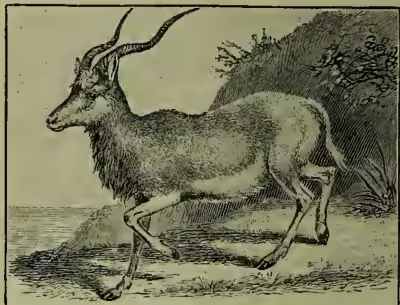
The name antelope is sometimes more particularly applied to a species also known as the Common or Indian Antelope, and as the Sasin. It is a native of India and the eastern parts of Asia, and is a beautiful animal about 2½ feet high at the shoulder, with erect, diverging horns, bent in a spiral of two or three turns. The hair is uniformly short, except that, as in many other species of antelopes, there are small tufts of bristles on the knees. It inhabits open plains, and the herds exercise great watchfulness. Its fleetness is such that greyhounds chase it in vain; and it can easily bound over an inclosure of 11 feet in height, or over a distance of 10 or 12 yards. The flesh is held in small esteem, and the animal is less than many of its congeners an object of the chase.—The Saiga is a much less graceful animal, with short, somewhat lyre-shaped horns in the males only. These are used by the Russians and Chinese for the manufacture of many articles of domestic economy; and it is chiefly for their sake and that of the skin that the saiga is hunted, the flesh having a disagreeable taste, which is ascribed to the saline and aromatic plants of the steppes.—The Dzeren (A. gutturosa), sometimes called the Chinese Antelope, and known among the Chinese by a name which signifies the Yellow Goat, is an inhabitant of the arid deserts of Central Asia. The flesh is highly esteemed. It derives its specific name from a large movable goitre-like protuberance on the throat of the old males, produced by a dilatation of the larynx.—The Addax or Nubian Antelope (A. addax), which was known to the ancients, and is mentioned by Pliny, has horns very similar to those of the Indian Antelope, but is a larger animal, less graceful, with a slight mane on the neck, a tuft of long hair on the forehead, and large broad hoofs, adapted for treading on fine and loose sands. It inhabits the deserts of Central Africa, and, contrary to the usual habits of the genus, is said not to be gregarious, but to live in pairs. The Chikara and some other Indian species are distinguished by two additional rudimentary horns in front of the ordinary horns, and immediately over the orbits. The chikara inhabits thick forests and jungles. Like the addax, it lives in pairs; as do also the Stein-bok of South Africa, an extremely graceful species, and the Kleene-bok of the same country (A. perpussilla), a beautiful and active little creature with very short horns. The kleene-bok is of a mild and gentle disposition, and extremely capable of domestication. The Gazelle (q.v.) of North Africa (A. dorcas), one of the species known to the ancients, is very frequently domesticated; and from its gracefulness of form, its gentleness of manners, and its bright black eyes, has afforded to the Arabian poets one of their most favourite objects of comparison. The South African Spring-bok (q.v.) is another very beautiful species, and is frequently domesticated by the colonists at the Cape of Good Hope. Among the numerous species which that country produces may
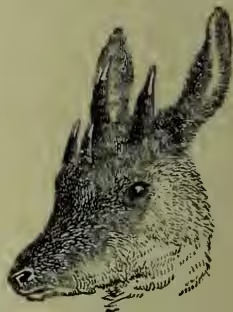
Head of Antilope chikara. be mentioned also the Blauw-bok (A. leucophæus), the Riet-bok (A. arundinaceus), and the Kaffarian Oryx (q.v.). Still more worthy of notice among the South African species, but in some measure departing from the strict antelope type, is the Eland (q.v.), the largest of all the antelopes—an animal which may probably be found valuable in domestication. The Koodoo is another noble species allied to the eland. The Nyl-ghau (q.v.) of India and the Gnu (q.v.) of South Africa are also among the largest antelopes, but depart still further from the generic type. Less different from the ordinary type, but still with a marked approach to a bovine appearance, are the Bubalis of the ancients, frequenting the north of Africa, and the nearly allied Kaana or Harte-beest of the Cape of Good Hope. The flesh, skin, and horns of the antelopes have been widely utilised from early times. Antelopes may be grouped according to habitat, as desert, bush, rock, and plain forms. The Indian antelope has some religious significance, and the exaggerated development of a single horn in the Chinese antelope is supposed to have given some basis to the unicorn myth.