Deer (Cervidae), a large family in the ruminant section of even-toed Ungulates. Though doubtless of common ancestry, the antlered ruminants or deer are definitely, though not very readily, separated from the other great family of horned ruminants or cattle. The contrasting characters of Cervidae and Bovidae are noted under the title ARTIODACTYLA (q.v.); only the chief peculiarities of the Cervidae need here be noticed.
General Characters.—If appendages are present on the head, they are true bony outgrowths, familiarly known as antlers. Except in one genus, they are confined to the males. There are two openings to the duct of the lachrymal gland, situated on or inside the orbit. A large cavity in front of the orbit cuts off the lachrymal bone from articulation with the nasals. The first molar tooth is short-crowned. There are usually upper canine teeth in both sexes, and these are often large in the males. In addition to the functional third and fourth digits, the second and fifth are very generally represented. The placenta has few cotyledons or villous patches. Except in Australia and Africa, the Cervidae are distributed over the globe, usually living in pairs or herds in wooded and grassy regions, and feeding upon herbage. About 100 living and extinct species are known.
Genera.—Dr J. E. Gray classified the Cervidae into two groups, according to the position of a hair-tuft on the lower part of the hind-leg. Professor Garrod has divided them according to features in the skull; Sir V. Brooke has classified them according to the state of the limbs. In their general outlines the three classifications agree; that of Brooke is here followed.
A. Upper ends of the second and fifth metacarpals remain—Plesiometacarpí—e.g. Cervus. B. Lower ends of the metacarpals remain—Telemetacarpí; within which the three genera Alces, Hydropotes, and Capreolus are separated by other characters from a more definite section, including Cariacus, Pudua, and Rangifer.
Important Forms.—As many of the important deer will be separately discussed under their common names, a list of the distinctive types is all that is here necessary. A. Cervulus muntjac, from British India and the Malayan region, with large canines in the males (see MUNTJAC); Elaphodus, with very small unbranched antlers; Rusa, a sub-genus of Cervus, from the Indian region, including some of the largest and smallest species—e.g. C. aristotelis, C. equinus; Rucervus, another Indian sub-genus, with forms of small stature—e.g. C. schomburgki; Elaphurus, Axis (q.v.), Pseudaxis, other sub-genera of Cervus; the genus Cervus, in the restricted sense, large deer in Palearctic and Nearctic regions, including the Red Deer (q.v.), or Cervus elaphus, in Britain, Continental Europe, Algeria, Asia Minor, and the Canæasus, and C. canadensis, in North America; Dama, another sub-genus, including forms of medium size, from south-western Palearctic regions—e.g. the Fallow-deer (q.v.), semi-domesticated in European parks. B. (1) The northern genus Alces, including the Elk (q.v.), of large size, with great antlers; the Water-deer (q.v.), or Hydropotes, without antlers in either sex; the genus Capreolus, including the small Roe-deer (q.v.) (Capreolus caprea), in Britain, Europe, North Palestine, &c. (2) The genus Cariacus, in its strict usage, including the Virginian Deer of the United States (C. virginianus) and the Mexican Deer (C. Mexicanus); the sub-genera of Cariacus—Blastoeerus, Furcifer, Coassus, from South America; Pudua, from the Chilian Andes; and the Reindeer (q.v.), or Rangifer, with antlers in both sexes.
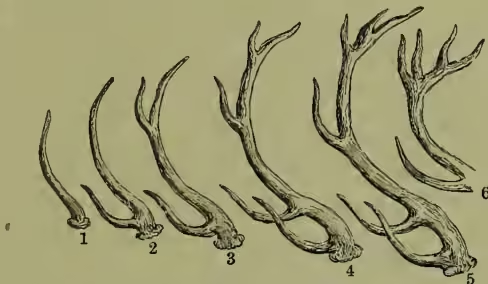
Antlers.—Antlers are usually present in the male deer, though absent in both sexes in Hydropotes, and present in both in the reindeer. Their nature as true bony outgrowths, their early covering with sensitive vascular skin or velvet, the drying of this to leave the horn a hard and insensitive weapon, the basal constriction and detachment, and the regrowth in the following year with an additional tine (No. 4 in the cut representing the fifth year), have been referred to at ANTTERS (q.v.). Amongst the technical terms are the permanent 'pedicle' or stalk from which the regrowth starts, the main stem or 'beam,' the branches, 'tines,' or 'snags,' and the not infrequent flattened or 'palmate' form. Antlers are of special importance as weapons used by the males in fighting for the possession of the females, and have doubtless been perfected by Sexual Selection (q.v.). They are also of interest in the parallel they illustrate between the life-history of the individual and the evolution of the race. The figure given of antlers at successive years in a stag's life will also suit for the evolution of antlers in successive historic periods. Young deer develop in the first year small simple antlers, and the branches are added on the annual regrowths. So the earliest (Lower Miocene) deer had no antlers, the Middle Miocene species had simple, at most two-branched processes, as in the second year of life, while in the Upper Miocene three branches occur; and in Pliocene and Pleistocene the modern luxuriance gradually appears. Sir V. Brooke gives full details (1) of the gradual evolution of antlers from very simple to complex forms, tracing the history from the earliest Dremotherium onwards; (2) of their constant tendency to vary, as is well known in the semi-domesticated species; (3) of 'variation extending far enough to induce the partial atrophy of one part of the antler to compensate for the extra development of some other part'; (4) of the transmission and establishing of such variations by heredity. A great part of the theory of evolution can be beautifully read from antlers alone.
The flesh, skin, and antlers of deer are valuable, but deer injure crops, eat the leaves, twigs, and bark of trees, and damage forest trees by rubbing their antlers against the trunks and branches.
See articles on the various kinds of Deer (RED DEER, &c.), DEER FORESTS, GAME LAWS, POACHING, STAG-HOUND; Sir V. Brooke in Proc. Zool. Soc. (1878); J. G. Millais, British Deer and their Horns (1897).