Water. In a state of purity, at ordinary temperatures, water is a clear transparent liquid, perfectly neutral in its reaction, and devoid of taste or smell. Its chemical constitution, indicated by the formula (molec. wt. = 17·96), is 2 parts of hydrogen to 15·96 parts of oxygen by weight, or very nearly two volumes of hydrogen to one volume of oxygen, which upon combustion form by their combination two volumes of water-vapour. The specific density of water at . is taken as the standard, and is reckoned equal to unity, or for some technological purposes as 1000. Water is used in the metric system as the means of connecting the measures of length and those of mass: a cubic decimetre measures a litre, and a litre of water at . weighs a kilogramme. Similarly the Gallon (q.v.) is ten avoirdupois pounds of water. The specific density of steam, reckoned (ideally) at ., is 0.6235 (air = 1) or 0.0008063 (water at ); that of ice is 0.94. If water be cooled to . (.), it freezes if it be maintained at or below that temperature; it may be cooled even to . (.), if it be free from air-bubbles and kept very steady, without solidifying; it then has a sp. gr. of 0.998145; at . it has a sp. gr. of 0.999118. If a block of ice at say . (.), be heated, its temperature first rises until . (.), is reached; its specific heat during this stage is 0.502; when it reaches . the ice begins to melt, but the temperature becomes stationary, remaining at . until all the ice has been melted. This takes place when 80.025 gramme-calories of heat per gramme have been absorbed; the latent heat of water is thus said to be 80.025. The water at . occupies less volume than the ice in the ratio of 94 to 100 nearly. At . the sp. gr. of water is 0.999871. As the heating is continued the temperature rises; the specific heat in this stage is 1, water being the standard substance for the measurement of specific heat; at . (.), the sp. gr. is 1.000, water being then at its maximum density. There is thus a shrinkage in bulk between . and .; but as the heating is continued the water begins to expand, the specific heat slightly increasing; at . (.), the sp. gr. is 0.999747; at . (.), it is 0.9882; and at . (.), it is 0.95865; thus 1 volume of water at . becomes 1.043 volumes of water at . As the heating is continued the water begins to boil: the temperature remains constant, apart from irregularities induced by superheating and consequent explosive bubble-formation and the presence of impurities (see BOILING-POINT): this goes on until the whole is converted into steam. Heat is absorbed in this operation equal to 536.5 gramme-calories per gramme. This steam has a temperature of .; its specific density will therefore be , and it will occupy 1694.5 times the bulk of the water at . If the steam be still further heated, it expands or exerts pressure like an ordinary gas: its specific heat is 0.4805 at constant pressure, 0.2989 at constant volume. If water be heated in closed vessels beyond ., it exerts great pressure on account of its own expansion and its tendency to form steam; but it has been inferred from the variations in the latent heat of evaporation of steam at different temperatures that, if water could be exposed to a temperature of . without bursting the containing vessel, it would present the phenomena of the critical state (see GASES).
Water dissolves a great many substances, forming aqueous solutions. Its solvent powers for solids and liquids are in general increased by heat, while those for gases are diminished. When water is superheated (above ., under pressure) it can even decompose some silicates such as plate and crown glass and extract the alkali, leaving silica. The following proportions by volume of the respective gases are soluble in water under a pressure of 76 cm. mercury column at . (.), and . (.) respectively: hydrogen, 0.0193 and 0.0193; nitrogen, 0.02035 and 0.01403; atmospheric air, 0.02471 and 0.01704; carbonic oxide, 0.0329 and 0.02312; oxygen, 0.04114 and 0.02838; carbonic acid, 1.7987 and 0.9014; sulphuretted hydrogen, 4.3706 and 2.9053; sulphurous acid, 79.789 and 39.374; ammonia, 1049.6 and 654.0. In some cases there is heat evolved when the gases dissolve. Hydrochloric acid evolves heat, but this is not a case of simple solution; there is some chemical combination; the gas and the water do not part company when heat is applied, but gas or water is given off until the solution attains a particular strength, after which it distils bodily. Some liquids dissolve in water by a process of interdiffusion; and salts dissolve each in its own proportion, which varies with the temperature. Heat is often evolved by the act of solution if there be chemical combination between the salt and the water with formation of hydrates; but if there be no such union, then the absorption of heat in liquefying the salt results in cooling. These two effects may more or less completely balance one another. Water may combine with an anhydrous acid, playing the part of a base and forming a salt of hydrogen, with evolution of heat: thus , sulphuric acid or hydrogen sulphate, analogous to , potassium sulphate. Similarly it may combine with an anhydrous base, forming a hydrate: . In these cases the water cannot, in general, be expelled by simple heating. When it combines with salts, being taken up by them in the act of crystallising, it is in many cases essential to the form of the crystal, but can be expelled by heating; the crystal in that event crumbling into powder: and such water contained in a crystal is called water of crystallisation. Beyond this there is often some water of constitution present: if the attempt be made to drive this off by continued or higher heating, the salt is decomposed. Crystals of sulphate of iron, , illustrate this; on gentle heating, the water of crystallisation is driven off and is left: if this be further heated it is decomposed (see SULPHURIC ACID).
Water is very slightly compressible: a pressure of 1 dyne per sq. cm. causes a reduction in volume of 1-20,700,000,000th; a pressure of one atmosphere (1033.3 dynes per sq. cm.) one of 1-20,033d. For many practical purposes, therefore, water may be regarded as incompressible. In the liquid state it is colourless in small quantities, blue-green in large masses, and blue in still larger masses: and it has a refractive index of 1.3324 for the sodium line D at . In the form of ice its crystals have forms derived from the rhombohedron and six-sided prism, and are doubly refracting, with an index of 1.3060 for the ordinary and 1.3073 for the extraordinary ray (red light). Water-vapour has a refractive index (Mascart) of 1.000257. Water is slightly diamagnetic, and in the pure state has no electric conductivity. The least trace of substance in solution confers electric conductivity upon it; and then, when a current is passed through it, it is decomposed or electrolysed, hydrogen being set free at the negative electrode as if it travelled with the current, and oxygen at the positive electrode (against). Water-vapour may be decomposed by a very high temperature; and this limits the temperature attainable in the oxyhydrogen flame, for the combination of oxygen and hydrogen is arrested when a certain temperature has been reached. Water-vapour is readily decomposed by oxidisable substances, such as glowing iron or coke; but the heat must be kept up in order to supply sufficient energy for the decomposition of the water-vapour. In the former case the products are hydrogen and magnetic oxide of iron; in the latter, water-gas. But if hydrogen is passed over glowing oxide of iron or copper, the oxide is reduced to metal, and water-vapour is formed.
Absolutely pure water is not to be found in nature, since water always finds something to dissolve even as it falls through the air in the form of rain: rain-water contains not only atmospheric air ( vols. per hundred), but also some ammonia and carbonic acid and traces of nitrates, together with salts derived from dust. The principal tests to which water is subjected in order to determine its impurities are examination of colour, taste, smell after being shaken up; analysis of the residue left after evaporation, for silica, iron, alumina, lime, and magnesia; acidifying with hydrochloric acid, and estimating the sulphuric acid by means of barium chloride; determination of the chlorine present; estimation of nitrates and nitrites (these being of importance as indicating oxidised organic matter and showing that the water had passed through organic matter); determination of the free ammonia and of the total amount of ammonia producible by reductive processes from the organic matter present in the water (albuminoid ammonia); estimation of the carbonic acid. The hardness of water is determined by making a solution of soap of such a strength that a standard volume of it will take a given quantity of barium chloride, and then be just able to froth on shaking. This standard soap-solution is then dropped into a measured quantity of the water to be tested, which is shaken after each addition, until frothing begins: from the quantity of soap-solution used, with the aid of a table (for the quantity of lime or magnesia salts present and the quantity of soap-solution used are not directly proportional to one another), the total hardness—i.e. the quantity of lime salts present, which curdle and waste soap by forming insoluble lime-soap—is determined. In another sample the carbonates of lime and magnesia are removed by boiling, and the above test then applied after cooling: this determines the ‘permanent hardness,’ due to sulphates of lime and magnesia. In both cases control experiments are made by removing the lime and magnesia by means of oxalate of ammonia, and then testing with soap. The results are expressed in ‘degrees of hardness,’ which in England mean grains of (or their equivalent in magnesia carbonate, or in sulphates of lime or magnesia) per gallon, in France centigrammes per litre, and in Germany centigrammes (or its equivalent in ) per litre.
The question as to who was the discoverer of the composition of water—the great Water Question—takes rank in the history of chemistry as the controversy as to the discovery of the calculus and of the planet Neptune in other sciences. Brougham, Brewster, Kopp, Arago, Dumas, and many others have maintained one or another of the theses; and the claims of Cavendish, James Watt, Priestley, and Lavoisier have been canvassed and defended. Research seems inclined to give the priority to Cavendish, while allowing that Watt made independent experiments and came to similar results soon after.
See Dr George Wilson's Life of Cavendish (1846); Muirhead's Watt (1854); and Thorpe at the British Association in 1890. See also articles on Sea, Mineral Waters; and on Boiling-point, Electricity, Evaporation, Freezing, Gas and Gases, Gas-lighting (for water-gas), Heat, Hydrogen, Ice, Magnetism, Melting-point, Metre, Oxygen, Refraction, Snow, Solution, Specific Density, Steam. For Water on the Brain (or in the Head), see HYDROCEPHALUS.
WATER-POWER.—Strictly speaking, says Professor Unwin, there is no such thing as water-power. The term is convenient but inaccurate; for whether the water descends on a water-wheel or actuates a pressure-engine, it is merely an agent of transmission, and water-motors might with more scientific precision be designated gravity-motors. The term water-power is, however, a convenient one, and is universally understood and accepted. The primary source of water-power is the evaporation of liquid water by the solar heat from the earth's surface and the sea. The vapour thus formed condenses in the upper and colder regions of the atmosphere, and falling as rain flows as streams from a higher to a lower level, exerting in such descent an amount of energy proportional to its weight and volume. By suitable mechanical appliances a portion of this energy can be utilised for industrial and economic purposes. The science and practice of collecting, storing, distributing, and beneficially employing the rainfall of a district constitutes an important branch of engineering.
The utilisation of water-power by means of mechanical contrivances dates far back into the world's history. The ancients appear to have fully appreciated the advantages of the water-wheel, though they used it chiefly for the purpose of raising water for irrigation. The Egyptian wheel may still be seen on the Nile; and similarly on the Euphrates, &c. the original form and use of the water-wheel are retained. Notably amongst eastern nations the Chinese were conversant with water-motors from a very early period. The first attempts to produce hydraulic machinery proper, as the term is now understood, were in the Greek schools at Alexandria which flourished under the Ptolemies, under whose regime Ctesibius and Hero (q.v.) invented the fountain of compression, the siphon, and the force-pump about 120 B.C.
Water-power engines are divisible into five sections, and are classified by Professor Rankine as follows: (1) Water-bucket engines, in which water poured into suspended buckets causes them to descend vertically, and so to lift loads or overcome other resistance, as in certain hydraulic hoists. (2) Water-pressure engines, in which water by its pressure drives a piston. (3) Vertical water-wheels, being wheels rotating in a vertical plane and driven by the weight and impulse of water. These are the most common of all water-power engines. (4) Horizontal water-wheels or turbines, being wheels rotating in a horizontal plane, and driven by the pressure and impulse of water. (5) Rams and jet-pumps, in which the impulse of one mass of fluid is used to drive another. The action of the water may be distinguished as taking place in three ways—(a) by weight, (b) by pressure, (c) by impulse.
I. Water-bucket engines constitute an exceedingly simple type of contrivance for utilising directly the weight of water. Buckets filled with water at a high level discharge themselves on descent to a lower one, having dragged up passengers, merchandise, &c. Power is, and has been for centuries, similarly obtained for stamping, threshing, and kindred purposes in primitive districts where water is abundant and rude appliances alone procurable.
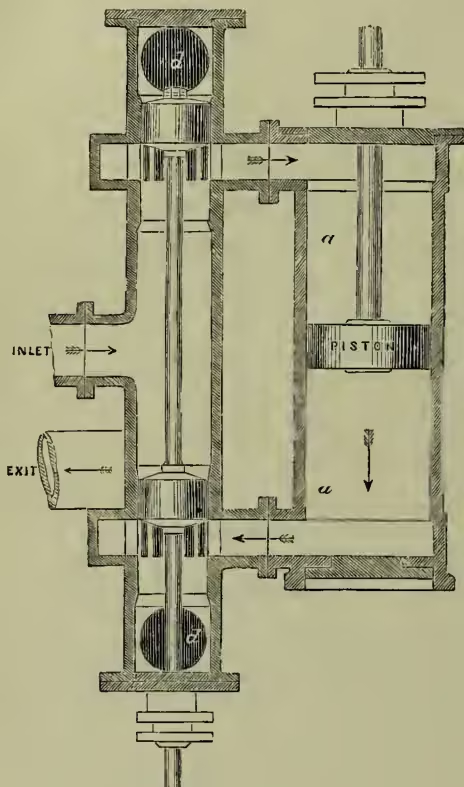
II. Water-pressure engines may be either single or double acting. Fig. 1. represents a reciprocatory hydraulic engine, whose action is similar in principle to that of the ordinary non-condensing steam-engine. The water under pressure is admitted at one end of a cylinder , the escape valve at the same end being simultaneously closed, and the corresponding valve on the other side opened. In this manner the alternating action of valves and piston is continuous. For smooth and effective work the piston area should be large and the speed slow. For mining and kindred operations, where water-power is available and fuel scarce, pumping, hauling, &c. is largely and advantageously performed by such engines. In towns where sufficient pressure can be obtained from the mains, engines of this class are useful for furnishing small power. Under circumstances where steam-power is inconvenient or unsafe, as in mines, docks, &c., hydraulic-power is extensively adopted. Hydraulic presses, cranes, hoists, &c. are largely employed, generally in connection with an accumulator.
III. Vertical water-wheels may be divided into three classes, and are thus described by Sir William
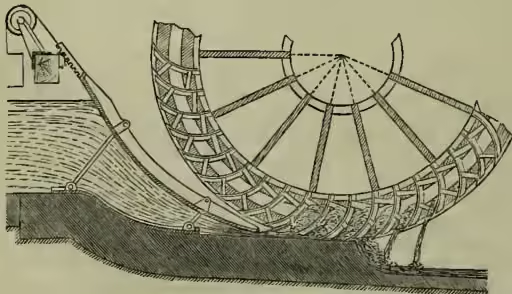
Fairbairn—(a) Overshot wheels, where the water is applied over the crest or near the upper extremity of the vertical diameter; (b) Breast-wheels, where the water is applied below the crest at the side of the wheel; (c) Undershot wheels, where the water is applied near the bottom of the wheel and acts (1) by gravitation as in the improved undershot wheel, or (2) by impulse as in the ordinary undershot and Poncelet wheels. With falls varying from 10 to 70 feet, and supplying from 3 to 25 cubic feet of water per second, a wheel may be constructed on which the water acts chiefly by its weight. If the variation of head-water does not exceed 2 feet, an overshot wheel may be used. With greater variation of head-water level, a pitch-back or high breast-wheel is better. When the fall does not exceed 6 feet the best water-motor to adopt in many cases is the undershot wheel with curved palettes invented by General Poncelet (1824). The ordinary undershot wheel develops only about 25 per cent. of the work of the water, whereas the Poncelet wheel utilises 60 per cent. of such work. The principle of this wheel, much used in France, lies in the water being received by the curved floats without any shock and finally discharged with a small velocity.
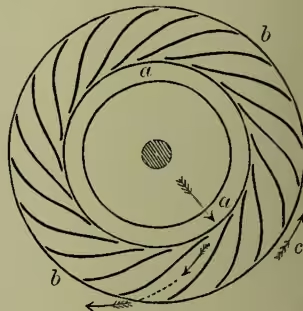
IV. Horizontal water-wheels or turbines are water-wheels with vertical axes, receiving and discharging water in various directions round their circumference. Fig. 3 represents in plan a reaction wheel. The water on admission from below passes upwards through the passages a, a, and escaping by tangential orifices, b, b, at the circumference—as indicated by the arrows traversing them—produces a reactionary motion of the wheel in the direction of the arrow c. The earliest form, known as Barker's Mill (q.v.), discharged water from straight tubular arms projecting from a hollow shaft. Fourneyron perceived that for water to leave the wheel without waste of energy, it must receive some initial forward velocity before entering, and his introduction of guide blades for this purpose formed the main feature of his important invention. Turbines are divisible into three classes, according to the direction in which the water moves before reaching the guide blades, and after leaving the wheel—viz. (1), parallel, (2) outward, and (3) inward flow turbines. By means of turbines or otherwise, water-power may be used to generate dynamo-electricity for the manufacture of aluminium, the carbides needed for acetylene, &c., as at Foyers; or for general manufacturing purposes on a vast scale, as at Niagara (q.v.).
V. Two other classes of machine fall to be noticed—(a) Those in which the energy of a mass of liquid descending from a small height raises a small portion of that liquid to a greater height as in Montgolfier's hydraulic ram; and (b) those in which a stream of fluid moving at first with a certain velocity drives and carries along with it an additional stream, the two streams finally mingling together and moving with a velocity less than that of the driving stream—as in the jet-pump, the water-blower, the blast-pipe, and the injector.
See ARCHIMEDES' SCREW, BARKER'S MILL, BLOWING-MACHINES, CRANE, HYDRAULIC PRESS, HYDRAULIC RAM, HYDRODYNAMICS, PUMPS, INJECTOR, IRON (p. 217), TIDES, TRANSMISSION OF POWER.
WATER-SUPPLY.—In old times kings and communities made artificial channels and conduits to convey good water in large quantities to important towns. Hezekiah made a pool and a conduit and brought water into the city; and the remains of Roman aqueducts in the Campagna; near Nîmes; and in many parts of the world give evidence that water-supply was well cared for in past ages (see AQUEDUCTS). The fact that water would, in an inverted Siphon (q.v.), stand at the same level in both legs, must have been observed; and it could not have been from ignorance of this circumstance that water was not conveyed across deep valleys by means of siphons. Indeed it appears that in the time of the Emperor Claudius there was constructed a conduit 13 leagues in length to supply a palace near Lyons; it traversed eight valleys by means of aqueducts, but in the case of the ninth valley the water was conveyed across by an inverted siphon, consisting of nine lines of leaden pipes, each pipe being 8 inches diameter and 1 inch thick. No doubt, therefore, it was the want of any such material as cast-iron for large pipes, and the consequent necessity of multiplying small pipes (small, to resist the pressure) in lead or in wood, that caused the hydraulic engineer of those days to prefer the grand masonry aqueducts.
Sources of Supply.—These sources all owe their being to that great heat-engine the sun, which vapourises the waters of the sea and produces the currents of air that convey these vapours to the land, where they are condensed into mist or rain or dew, and are gathered from little rills and streamlets into rivers, falling eventually into the ocean, with or without the intermediate receptacle, the lake; or, on higher grounds and in colder regions, fall as snow. Not only does the sun raise vapour from the waters of the ocean, but also from the surface of lakes and rivers, and from the moist earth and its vegetation, and even from the surface of ice, and does so without bringing that ice into the liquid condition. When the nature of the soil is favourable, a very large portion of the rainfall sinks in and traverses below by percolation, or in fissures, producing Springs (see SPRING); or else it continues its concealed course the whole way to the sea, or to some river, and is delivered sometimes above the sea-level, sometimes below it, so that in places fresh water can be gathered from among the shingle directly the ebbing tide has removed the cover of salt water. Under all circumstances the cycle—of evaporation, transport of vapour, condensation, and return to the liquid state, to be again evaporated—goes on, and thus, in the words of the Wise Man, ‘All the rivers run into the sea, yet the sea is not full; unto the place from whence the rivers come thither they return again.’ Springs may be found in proximity to a population, and issuing at a sufficient height to supply that town by gravitation. But more commonly springs issue at levels not sufficiently elevated to directly supply a town, and then recourse must be had to pumping. In mountainous countries it is quite possible to find streams near towns at such elevations as to admit of a supply by gravitation; and for towns more remote, it is a mere matter of engineering to convey the waters of such streams by means of aqueducts and pipes, so that the pressure (less the loss needed for ‘head’ to produce the flow) shall be maintained, and the distant town shall still be supplied by gravitation. In a plain country, far removed from an elevated supply, the best plan may be to pump from the neighbouring river. Wells in almost all cases demand the use of pumping-power. For even in true Artesian Wells (q.v.), those which overflow, it is rare that the mouth of the well is at such a level as to enable a supply to be given by mere gravitation. The spring and the river are natural supplies; the well is a product of art; the lake may be natural or be the artificial lake, which stores the rainfall from a gathering ground.
Quality of the Water.—That from springs may be of almost any character. It may be saline or ferruginous—in fact it may hold in solution any number of chemicals (see the analyses of renowned spas); it may be clear, bright, and palatable; or may resemble weak chicken-broth, flavoured with rotten eggs. It may give forth volumes of the carbonic acid with which we artificially impregnate waters for potable purposes; or it may be accompanied by torrents of foul sulphuretted hydrogen. Having regard to the great solvent power of water, and to the variety of materials among which subterranean water passes, and to the time it is in contact with these, it is not surprising that when it comes to the surface it should contain some of these various matters in solution. But the water of such springs as are used for water-works purposes is generally clear and bright, acceptable to the palate, and frequently ‘hard.’ So commonly is deep well water. Not only is there provided a natural means for the aeration of spring and well-waters; but this aeration burns up the organic matter brought down from the surface. It is extremely instructive to notice how a pervious soil—a chalk soil, for example—‘breathes,’ taking in and expelling air and gases. The breathing, it is true, is long-drawn and irregular, as it depends mainly, if not entirely, on the variation in the barometer. This breathing may readily be observed by closing the folding-doors over a chalk well and applying a lighted candle to the bucket-rope hole, when there will be found an indraught or an outdraught, as the case may be, varying in intensity according to the suddenness and extent of the recent barometrical change. But, though as a general rule springs and deep wells may be relied on to produce water uncontaminated by any matter detrimental to health, there are cases where such waters have been defiled, and are not sufficiently purified by the aeration above mentioned.
A river-supply will be influenced by the character of the gathering-ground, by the amount of spring-water which makes its way into it, and by the condition of the districts through which it passes. The quality of the supply for an impounding reservoir depends on the purity of the gathering area, on its freedom from cultivation, and on the presence or absence of peat.
Filtration, &c.—Waters which in their state of crude supply would not be potable may be rendered perfectly so, and in fact may be distributed in a condition which makes them superior to other waters deemed sufficiently good to be used without any treatment at all. Deposition and filtration will render water that is cloudy, owing to suspended matter, perfectly bright and clear, and it is now well established that filtration has a most important effect in the removal of germs. If possible river-water is not taken even into a depositing reservoir during times of excessive flood; but when received it is allowed to remain until the coarser particles have subsided. It is then drawn off, or more commonly has to be pumped from the depositing reservoir on to the filter-beds. A filter-bed is usually thus constructed: A water-tight tank is provided of some 12 feet deep, and of such area as may be determined upon—an acre is not unusual for large works; the bottom of the tank is formed with a slight fall from all directions towards a draw-off outlet. On the floor of the tank very coarse materials, such as rubble-stone, or irregular lumps of brick from the kiln, are arranged so that while presenting a surface to support that which is put upon them, they afford by their interstices a free flow towards the outlet. On this rough material is laid coarse shingle, then finer, then gravel, and finally sand. The whole thickness from the top of the coarse material to the top of the sand may vary from 2 to 4 feet. The water to be filtered is maintained on the sand-surface to a depth probably of 4 feet, more or less, while the outlet (the filtered water) is held up by adjustable means so as to give such a difference between the level of the water on the filter-bed and that of the outlet as will provide the ‘head’ needed to cause the water to traverse the sand at the desired rate. This rate varies very considerably, say from forty to eighty gallons per superficial foot in twenty-four hours; a very fair rate is fifty gallons.
It is advisable in the neighbourhood of towns to cover the reservoirs in which the filtered water is stored. A most useful adjunct to filtration, the invention of Dr William Anderson, has been adopted in certain cases where the source of supply has not been satisfactory. This invention consists in causing the water on its way to the filter-bed to pass through a large slowly-revolving cylinder charged with scraps of metallic iron. The action suggested is that the water on entering the cylinder attacks the metallic iron and forms ferrous oxide at the expense of a portion of the dissolved oxygen; after leaving the cylinder the water regains the oxygen it had lost, and the ferrous oxide is oxidised to ferric oxide. It seems probable that while a small proportion of the organic matter is attacked chemically, the chief action is mechanical and consists in the formation of an insoluble, bulky precipitate, consequent co-precipitation of organic matter, and better filtration through the film of oxide deposited on the sand of the filters. These iron purifiers have been adopted in the United States, in India, on the Continent, and for the Worcester water-supply. Their earliest employment on a commercial scale was in 1881 for the Antwerp Water-works, where the extremely unfavourable crude water of the river Nethe has been successfully transformed into an excellent potable water.
The quantity that can properly be filtered per foot super. per twenty-four hours being known, it is easy to determine what size and number of filters will be needed in work for any given supply—e.g. at fifty gallons per foot 20,000 superficial feet, or roughly, half an acre, would be required for one million gallons per day. But there must be in addition one or more filters, which shall be out of use for the purposes of cleaning. This cleaning consists in taking off the upper part of the sand, washing it thoroughly with filtered water, and restoring the cleaned sand to its place.
Softening.—Well-water and spring-water, if hard, generally contain in solution magnesia or carbonate of lime, or both. The carbonate of lime-water can be softened by Dr Clark's process, as follows. Ordinary quicklime is agitated with already softened water; by a mechanical stirrer, or by blowing in air. After the agitation the water is allowed to settle, resulting in the production of a perfectly clear water containing dissolved (not suspended) lime. A certain quantity of this lime-water—a quantity varying with the nature of the water to be softened, but very commonly of the hard water, or of the whole—is then allowed to run into the softening tank, the water to be softened is delivered into this same tank, and so as to mix with the lime-water. On the mixing of these two clear fluids they immediately become milky. The explanation of the process given by the chemists of the present day is that the carbonate of lime is soluble in water, because the water contains free carbonic acid, and that the addition of the quicklime absorbs this carbonic acid, making the quicklime into a carbonate, and rendering the water incapable of continuing in solution the carbonate of lime it originally contained, or of dissolving the newly-formed carbonate of lime. When the softening reservoir has been filled the water is allowed to stand until, the whole of the carbonate of lime having settled at the bottom, the water remains perfectly bright and clear. This is then drawn off by a hinged draw-off suction-pipe having a floating end which takes the water at about a foot below the surface, and falls as the water is pumped away. As soon as the suction-pipe approaches the sediment in the bottom the drawing-off is stopped, and the softening tank is re-charged for another operation. From six to twelve hours is a sufficient time to allow for the settling. By this process water of 17 to 20 degrees of hardness is readily reduced to a hardness of from 3 to 4 degrees.
Hard and Soft Water.—It is now generally recognised that on the score of health there is nothing to choose between these. Hard water is brisker and more agreeable to the taste, and has a better colour and appearance than soft water as derived from ordinary impounding reservoirs. For general manufacturing purposes the advantage is with the soft water.
A difficulty attending the use of an extremely soft water is its power of attacking the leaden service-pipes and of causing lead-poisoning (see Vol. VI. p. 545). One of the sources of supply to Sheffield gave considerable trouble on this score, but the difficulty has been overcome by the addition of powdered chalk to the extent of from a grain to (rarely) 3 grains per gallon. To set against this defect of soft water, it is alleged that the use of hard water wastes soap. It does seem a matter of regret that the processes of filtration, &c., so needful for the potable and culinary water, should be applied equally to the water which flushes a water-closet, or waters a road, or is used in scouring a floor. A dual supply would be the cure for this, and would also enable small but select sources of water to be distributed through a town in ample quantity for drinking and cooking, while a less good source might serve for coarser purposes.
Distribution.—The object is delivery into every house, and, within reason, to the top story of the houses; and also to provide such a pressure as will give efficient jets of water for fire extinction. Assume, that, either by gravitation or by pumping, the necessary pressure is obtained, the engineer then has to consider his system of distributing mains. These will vary in size from the large arterial mains supplying whole districts down through the lesser diameters supplying groups of streets, or a single street, to the small service-pipe which conveys the water to a single dwelling.
As to the flow of water through pipes, the 'heads' producing the flow being equal in two cases, and the lengths of the pipes being equal, the quantity delivered in a given time will vary as the square roots of the fifth powers of the diameters. That is, if a pipe of a diameter of 1, and of a length of 1, will, under a head of 1, in a time of 1, deliver a quantity of 1, then a pipe of a diameter of 2 will, all other things being equal, deliver a quantity of times the quantity.
There are two systems on which water is supplied to dwellings and to districts—viz. the intermittent and the constant, and each of these systems has its advantages and its disadvantages. The intermittent, carried out to its full extent, is a system wherein the water is turned on to a district say for two hours out of the twenty-four, or for a time that is sufficient to fill the receptacles with which on the intermittent system all the houses are provided. In this manner, notwithstanding that the actual expenditure of water within the houses varies most materially according to the hours of the day, the demand on any set of mains can by turning on district after district be kept practically constant, and thus a more uniform pressure can be maintained. Moreover, a low district is prevented from taking away the water from a higher district. The objections to this arrangement are the wages expense of the turncocks, and the chance that in the event of fire there may be delay in turning the water into the district mains. Further, the water must be received into cisterns, which are too commonly neglected and suffered to become foul.
On the constant system the cistern may be dispensed with altogether, and the water be obtained direct from a tap on the service-pipe. The objections are that water may be wasted by the careless leaving open of a tap, the possibility of the consumer's being left without a supply if a main burst, and the heavy draught on the mains at certain hours, and the consequent reduction of pressure, to the prejudice of the higher districts. When using constant service and where there are considerable differences of elevation in a town, it is expedient to divide the system of distribution into zones of level. Probably the best mode of domestic supply is that where constancy is combined with storage, the potable and culinary water, however, being obtained by direct draught from the service-pipe, and not from the storage-cistern.
Quantity required per Head.—A town supply may be divided into three distinct provisions—that used for domestic purposes proper; that used for municipal purposes, such as road-watering and drain-flushing; and that used for trades. When the supply is computed to allow for all purposes, it is clear the quantity must vary greatly in different towns. In manufacturing districts, where industries are carried on involving the use of water for washing and for dyeing, the water, if of suitable quality and obtainable at a low rate, will be very plentifully used, and so the quantity per head per diem will be largely increased. On the other hand, for domestic and such municipal purposes as road-watering and drain-flushing, it is found that an average of 25 gallons per head per day is ample, even when considering the needs of a strictly water-closet town, and with a liberal allowance of fixed baths and of hot-water apparatus. There are instances in the United Kingdom where it is said 50 to 60 gallons per head per day are used, but investigation would show, that although a quantity equivalent to this rate per head per day may be delivered into the distributing mains, it is never used—in fact, could not be used by the population. When in a non-manufacturing town such quantities as these are passed into the mains they never come into the possession of the householder, but escape, to a slight extent by leakage in the mains and services, or are wasted owing to improper fittings in the houses, or through the fittings being misused, or badly maintained.
Waste-prevention.—That this excessive quantity of water never comes even to the knowledge of the householder has been fully demonstrated by the use in numerous cases of an implement designed (about 1870) to detect the waste, and to prevent its continuance. This implement, the invention of Mr G. F. Deacon, for many years engineer of the Liverpool Corporation, consists of a meter through which the supply of a district, containing say some 200 houses, is passed. The meter is so constructed that the water in flowing through presses on a metallic disc, suspended by a counter-weighted wire, and capable of moving up and down in a vertical truncated cone. The parts are so proportioned that the height of the disc in the truncated cone is an index of the quantity flowing per hour. By means of a pencil attached to the wire, this height is automatically marked on a paper wound around a drum which revolves, by clockwork, once in twenty-four hours; the paper is ruled with vertical lines representing time, and with horizontal lines representing the rate of flow in gallons per hour. It is therefore easy to determine at a glance what has been the rate of delivery at all times during the twenty-four hours, and also by computing the area of the space bounded by the pencil line, to determine the actual quantity in any given time. In a district demanding nothing but a purely domestic supply it is to be expected that the requirements from midnight to say 5 A.M. should be practically nil, while between 6 A.M. and 10 or 11 A.M. the maximum should be reached. If therefore, on examining the curve drawn on the paper, it appear that during the hours shortly after midnight the passage of water through the meter was but small and that the increased flow shown in the morning hours, and at the other hours when meals are being prepared, was relatively large, then it may be fairly assumed that all is in order. If, however, the paper reveal that in the hours closely following midnight there was a delivery so large that the increased quantity of the maximum hours formed but a small percentage of the quantity passing during the night hours, then it may safely be assumed that there is great waste going on. On this being observed the district is perambulated at night, and the socket spanner, with which the stopcocks external to the consumers' premises are worked, is applied to all the houses in succession, and is used as a stethoscope to ascertain by the sound whether or not water is flowing into the house; if it be heard to do so, the cock is shut, and the time is noted. This course is pursued throughout the district; very probably not more than five or ten per cent of the houses will have given evidence of waste; but on revisiting the meter it will be found that at the times corresponding with those in which the cocks were shut there was an instant decrease in the rate of flow, and that the whole rate has now fallen to that which is permissible during the night hours. On inspecting next day the houses which had been shut off, it will commonly be discovered that there was not any ball-tap to the cistern, or that there was a burst service-pipe across the courtyard below the surface, or that there was some other source of waste. That this is sheer waste, of no use to the occupier, is made clear by the consideration—that the delivery of water is going on in the dead of the night, when he is utterly unconscious of the fact, and although it goes on the whole twenty-four hours round, the occupier is, during his waking hours, equally unconscious of it, and makes no use of the water. If a slight house-waste only be going on, and the stopcocks be closed, and if it be found on returning to the meter that the heavy night flow is continuing, then the water authority must proceed at once to make an inspection of its own pipes, to find out where the leak is taking place. Thus the waste-water meter is of service to detect waste in the pipes external to the houses, to detect waste within the houses themselves, and also to show the quantity of water really used within the houses.
Not only does the waste of water involve extended outlay in the water-works, and the appropriation of gathering-ground which may be sorely needed by a neighbouring town, but it involves renewing the distributing system with larger mains to prevent the excessive loss of pressure which arises from the demand for increased quantities. This loss of pressure both precludes the possibility of playing a useful jet from a hydrant for the extinguishment of fires, and also prevents the water from rising to a reasonable height in the houses.
Where the water authority dare not (for fear of its constituents) establish and enforce proper regulations as to the nature of the fittings, and as to their condition and fair usage, the waste becomes something appalling. The Return (1891) of the Philadelphia Bureau of Water shows that 71 American gallons (equal say to 59 English gallons) were delivered in 1881 per head of the population per diem; but this quantity, excessive as it was, increased steadily year by year, and in 1890 was 132 American (110 English) gallons.
Some of those who look approvingly on the large delivery of water allege that at all events it is of benefit to the drains. This is a mistake; the water from a uniform leak of many gallons per hour has no power to act as a flush; but this large delivery of water has an effect on the sewerage, and one of a most disastrous character—viz. that the volume is so much increased as to materially add to the difficulty of disposing of the sewage either on land or by precipitation, while it also adds to the first cost and to the annual cost of pumping, where pumping is necessary.
When good supervision is exercised to prevent waste, from 16 to 20 gallons per head per day is all that is needed. Allowing for road-watering and drain-flushing, a fair estimate in a non-manufacturing town is, as already stated, 25 gallons per head per diem, even when taking baths into account, for with respect to these it must be remembered that some 20 per cent. of the population are of seven years of age or under, and that in their case the hip-bath or the tub is better than a large bath. Records have been kept which show that 2 gallons per head per diem is an outside allowance for potable and culinary water. The allowance on board ship to emigrants is fixed at 3 quarts per head per diem, and 10 gallons per mess of 100 for cooking, or in all less than one gallon per day per head. A very small surface would supply sufficient water—even with the rainfall of London—if all that fell on that surface could be collected, to prevent a man dying from thirst. A full-size umbrella, with an area of about 9 sq. feet, will do this. Taking the London rainfall at 25 inches, this makes cubic feet, or 117 gallons = between and of a gallon per diem.
Selection of a Source.—When the average daily quantity of water needed, allowing for increase of population twenty to forty years ahead, has been determined, it then becomes necessary to see how it is to be obtained. If there be in the neighbourhood an adequate spring, or a river of satisfactory purity, the minimum daily flow of either of these is generally known, or can be approximately ascertained, and it will at once appear whether, taking into account other interests, the needed quantity can be drawn daily from the spring or from the stream. If, having regard to the geological character of the neighbourhood, it is deemed expedient the supply should be from deep wells, then there is generally evidence at hand as to the height at which the water stands at different seasons of the year and in different years in such wells, when pumping is not going on, and how much the level is lowered with different rates of pumping, and how far this pumping affects neighbouring wells. If the indications are satisfactory, trial borings are made, and the yield is tested. In some cases the supply afforded from one or more bore holes suffices; but frequently it is found necessary to sink a well, shutting out by means of cast-iron lining, or 'tubbing,' all surface-water, and when a sufficient depth is reached to drive adits—preferably at about right angles to the direction of flow of the underground water—so as to intersect the various fissures through which the water may be running. These adits may themselves be provided with bore holes.
There is a prevalent and mistaken notion that pumping from the chalk, in a chalk valley, in which there is a stream, must diminish, pro tanto, the quantity of water flowing in that stream. No doubt if the pumping were to take place at some point just above where the chalk spring gushes out to feed the river, this would be true; but, as a rule, the pumping does not take place in such a locality, but in situations where, when no pumping is going on, the water is many feet, not infrequently 60 feet, below the level of the water in the river. The fact that the water is at 60 feet below the river is proof that the abstraction of water at that point cannot influence the river; but what it does is this. It lowers the level of the water at the well, making a cone of depression for a certain distance round the well, and bringing to the surface and rendering useful that which otherwise would have passed away to the sea, invisibly and uselessly.
Where neither spring, river, nor well supply is available, and recourse must be had to gathering-grounds and impounding reservoirs, then arises the anxious question how near, and at what elevation can the needed area of gathering-ground be found? how much water will it yield during the year? are there many consecutive weeks or months during which the yield is but small? are there suitable sites for reservoirs and dams? and lastly, to what extent would the proposed works and abstraction of water interfere with existing interests? The difficulty of finding adequate and satisfactory gathering-grounds in the United Kingdom becomes more and more serious as suitable areas are taken up by one town after another. Mountainous or hilly gathering-grounds are, all other things being equal, to be preferred, because the rainfall is greater at high elevations, because the land is less suited for agricultural purposes, and because, even after allowing for the loss of head necessary to produce the flow through the conduit that extends from the reservoir to the town, the water can still be delivered into the service-reservoir at such an elevation as will supply the houses without pumping.
The engineer has also, in the United Kingdom, to allow for the water compensation to be given to the river fed by the gathering-ground. This compensation in the case of rivers in manufacturing districts is commonly fixed by parliament at of the whole water to be obtained by the works, leaving for the town; when the river passes through a mere rural district very much less compensation water is given. Whatever may be the quantity of the compensation water, it is always made a first (water) charge on the undertaking. This provision of storage and of compensation water is an advantage to the river, as by it heavy floods are prevented; and during those periods when for days or weeks together the natural flow of the river would be practically reduced to a mere rill, the compensation water affords a satisfactory and steady stream. Sometimes a separate reservoir is handed over to a committee of riparian proprietors, who regulate the outflow as they please. Sometimes the act prescribes that there shall be a continuous equable outflow day and night throughout the year; sometimes the compensation water must be given by an enlarged flow restricted to the working hours of working days; and sometimes the regular daily flow is reduced, so as to reserve water for periodical flushes of heavy delivery during the dry season. Bearing in mind the conjoined demands of the town and of the river, and knowing from rain-gauge observations the average rainfall on the gathering-ground, the engineer makes an allowance off this average for the diminution arising from three consecutive dry years; he next allows for loss by evaporation and absorption, and then treats the remainder as available for storage. Lastly he has to ascertain the irregularity from month to month in the rainfall, and he is then in a position to say how many days' storage the reservoirs should contain; these numbers of days vary very largely according to the character of the rainfall of the district.
Dams.—Having ascertained the extent of the storage needed, the hope of the engineer is that he may find among the hills on the course of the stream from the gathering-ground some valley not too steep, and having a contraction at its lower end, across which may be built a dam which will pen up in the valley the needed quantity of water. In the United Kingdom these dams have commonly been made by earthen embankments having faces of a very gradual slope, especially gradual on the outside and containing in the centre a wall of puddled clay carried down below the ground surface into 'the puddled trench' sunk into the substratum until a solid water-tight bed is reached. Some of these banks have been made of great height, as much as 120 to 140 feet above the surface. Elsewhere masonry dams have been employed to a considerable extent—as at Vyrnwy (q.v.) for the supply of Liverpool. In this case a masonry dam of 100 feet above the ground-level and 60 feet below ground has formed a lake containing 11,000 millions of gallons.
Charge for Water.—For trade purposes this is commonly done by meter. Meters may be divided into two great classes, the Inferential and the Positive. A typical inferential meter is one where the current of water in passing through the meter causes the rotation of a vane (like that of a smoke-jack), and experiment having shown what relation the revolutions of the vane bear to the quantity passed in that experiment, it is inferred that at all rates of delivery the revolutions and the quantity will vary together. There should not be any harmful loss of pressure in passing through such a meter. A typical instance of a positive meter is one wherein the water fills a vessel of known capacity, and is then automatically turned into a second vessel, which it fills while the first one is being discharged. Such a meter, when properly constructed, is indeed a positive meter, but it is obvious that the pressure with which the water is delivered is destroyed, and that thus such a meter could not be placed in the cellar, for example, with the intention that the water which it had measured should be sent to the top story of the house, or indeed to any higher point. Another kind of positive meter is one wherein a piston is caused by the water to traverse in a cylinder, and to change its direction of motion when the cylinder is full, thus recording cylinderfuls of water. In such a construction, or in the numerous modifications of it, the pressure is for all practical purposes preserved. There are also positive rotary meters.
It has been commonly suggested that water for domestic purposes should be charged for according to the quantity actually consumed. On the Continent many towns have followed the example set by Berlin, which has gradually given an entire meter-supply; but in Berlin, owing to the flat system, there are on an average seventy occupants per house—i.e. per supply; while in London there are only on an average 7.39 per supply. In Berlin the landlord of the whole house is made liable for the water, there being one meter; thus only a tenth of the meters that would be required for an equivalent London population is needed. Further, the tenants, although they can draw as much water as they please, are very soon checked if they waste it, because the landlord has to pay for the whole, and he at once complains if the tenants' fittings are out of order or the water is otherwise wasted. On the other hand, many persons say that it is of such vital consequence to encourage the poor in habits of cleanliness that it is worth while to pay for water by means of a rate upon the value of the houses, although thereby the well-to-do man living in a fashionable neighbourhood pays a much larger amount per 1000 gallons than does the poor man. But it is no more illogical to charge by a percentage rate on annual value for bringing water to a house than it is to charge in that manner for the use of the sewers taking the water away.
Other plans of charging have been proposed or are in use, such as payment by a rate upon the value of the house plus the employment of a meter, the rate payment on the value covering the supply of a certain number of 1000 of gallons per quarter without further cost to the consumer; but should this number of gallons (which varies according to the annual value) be exceeded, then a 'quantity' charge is made for that which is used in excess. In some cases, where the municipality is the water authority, there is a rate upon the properties using the water plus a general rate upon all properties whether they use the water or not; it being held that warehouses and other properties—even if no water be consumed there—benefit by the water-supply as regards safety from fire. There is another system of water-supply now largely extended in London—viz. that of high-pressure water (at 700 lb. to the square inch) provided for the purposes of hydraulic lifts, and for other motors, in establishments needing for brief periods considerable motive power.
The London water-supply has for some half a century been in the hands of eight companies—the Chelsea, the East London, the Grand Junction, the New River, and the West Middlesex supplying the town north of the river; the Kent, the Lambeth, and the Southwark & Vauxhall supplying the south side. The Chelsea, the Grand Junction, the Lambeth, the Southwark & Vauxhall, and the West Middlesex derive their supply practically entirely from the Thames, although some of them obtain a portion of this supply from wells and springs. The intakes of these companies are, none of them, lower than Hampton. The East London also procures a very small portion of its supply from the Thames at Sunbury, the remainder, and by far the principal part, being derived from the river Lea, or from the chalk wells in the Lea valley. The New River, as originally planned by Sir Hugh Myddleton (the London goldsmith), still brings the waters of the Chadwell, Amwell, and other springs from Hertfordshire to London; but the increased quantity now given by this company is obtained from the river Lea itself, near to the Chadwell spring, and from the chalk wells in the Lea valley. The Kent Company derives its supply entirely from chalk wells.
Sea-water may be rendered drinkable by being filtered through 15 feet of fresh dry sand; but at sea it must be distilled. The distilled water, however, has no air dissolved in it, and is unpalatable; and it has a nauseous odour and taste derived from the decomposition of organic matter in the sea-water. The addition of chemical reagents is objectionable; aeration of a large quantity of water is a slow process, and the air taken up may be of bad quality, as in the hold of a ship. In Dr Normandy's apparatus there is an evaporator in which sea-water is boiled by superheated steam in steam-pipes; the vapour is being cooled down in a condenser. The cooling water in the condenser as it is itself warmed loses its dissolved air; this air is led round and mixed with the steam which is being condensed, and the condensate is fully aerated.
The water-supply of great cities and towns is usually treated of in the articles on those towns (as in those on Bombay, Chicago, Glasgow, Liverpool, Manchester, New York, &c.). See also the articles BACTERIA, CANAL, CEYLON, FILTER, GERM, HYGIENE, INDIA (p. 113), IRRIGATION, RAIN, RIVER, SEWAGE, SHEFFIELD, TANSA; works by Hughes (1867; new ed. 1882), Humber (1876), Austed (1878), De Rance (1882), Bolton (1884; new ed. 1888), Silverthorne (1888), Slagg (1838), Turner and Brightmore (1893), W. K. Burton (1894); for Canada, Egypt, India, &c., Jackson (1886; new ed. 1889) and Stone (1889); for the United States, Fanning (1877; new ed. 1882), Nichols (1883), and Wegmann (1896).