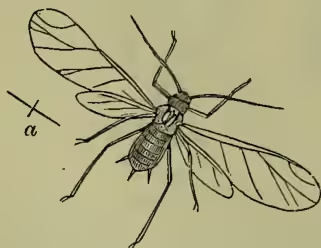
a, natural size.
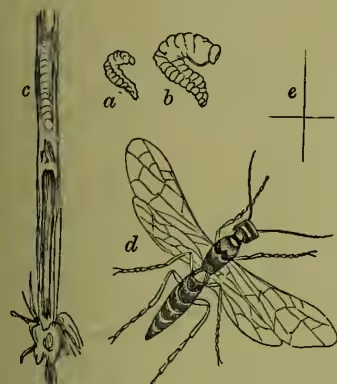
Corn Insects. While numerous insects are of great importance in carrying the fertilising pollen from one flower to another, and others are in themselves of direct use to man, there remains a vast crowd of more or less injurious forms. Of these some attack man and domestic mammals, others do damage quite as effectively by injuring fruit and forest trees, vegetables and crops. A convenient account of these injurious insects will be found in Miss E. A. Ormerod's Manual of Injurious Insects and Methods of Prevention, and fuller details may be gathered from other works mentioned below. It is here proposed simply to give a brief list of the more important insects injurious to corn crops. First then (following Leunis), we may notice some of those which are tolerably wide in their destructiveness: (1) Zabrus gibbus (Coleoptera, Carabidæ), a dark bronzed beetle, abundant in Central Europe, less common in England, ravaging wheat-fields, the adults devouring the grain, the larvæ the leaves. (2) Melolontha vulgaris, Cockchafer (q.v.). (3) Rhizotrogus solstitialis, Midsummer Chafer, a beetle nearly related to the last, of generally similar habit, the larvæ sometimes injuring the seed. (4) Agriotes lineatus, &c. (Coleoptera, Elateridæ), Skipjacks, Click-beetles, Wireworms (q.v.), injuring root, grain, and fodder crops. (5) Chrysomela ceralis, in the same genus as the Colorado Beetle (q.v.), common in Europe on grasses, and occasionally on cereals. (6) Cephus pygmæus, Corn Sawfly (Hymenoptera, 'wood-wasps'), a long, thin-bodied, minute insect, of a brilliant black colour, the larvæ injurious to wheat and rye, feeding on the inside of the stalk, and eventually cutting it through near the ground. (7) Agrotis tritici, &c., 'cut-worms' (Lepidoptera, Noctuidæ), common moths whose caterpillars feed upon the roots of grasses and other crops. Neuronia popularis is a similar form also injurious to grasses and the like. (8) Cecidomyia destructor, or Hessian Fly (q.v.). (9) Diplosis tritici and aurantiaca, allied to the last, infesting wheat, rye, &c. (10) Anthomyia coarctata (Diptera, Muscidæ), a fly whose eggs are laid in seed, which the larvæ devour in spring. (11) Pachytylus or Oedipoda migratorius and cinerascens (Orthoptera, Acrididæ), locust-like insects, which, like some other members of the order, do great damage when they appear in hosts. Acridium egyptium and Caloptenus italicus are allied forms not infrequently doing great damage to vegetation (see CRICKET and LOCUST).
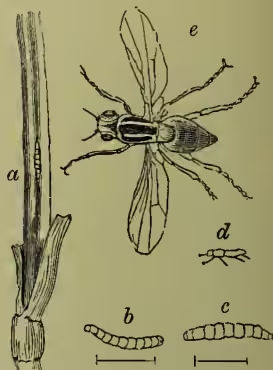
a, a portion of a culm or stem of wheat with a swollen joint, caused by larva of corn-fly; b, larva; c, pupa; d, fly, natural size; e, fly, magnified.
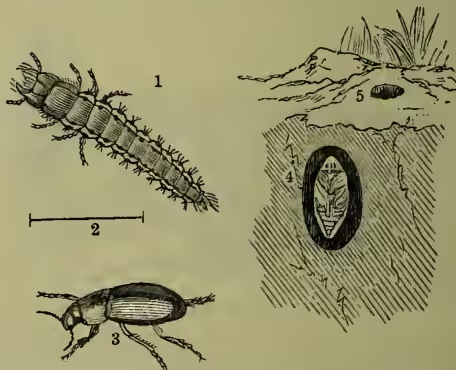
Wheat crops are specially liable to be attacked by the following insects: (12) Chlorops tæniopus and lineata (Diptera, Muscidæ), flies which deposit their eggs on the ears of corn. The development of the maggots checks the growth, and causes the ears to abort. In Britain barley is oftenest attacked by C. tæniopus, which has received the name of Gout-fly from the swollen distortions which appear at the joints of infected plants. Towards the end of summer the insects leave the ears as two-winged flies, about the eighth of an inch long, thick and stumpy in shape, yellow, with 1, larva, magnified; 2, natural size of larva; 3, perfect insect, female, slightly magnified; 4, a cell containing pupa; 5, a burrow. three black stripes along the back between the wings, and the abdomen of a greenish-black, with black cross-bands. C. lineata often does great damage to wheat crops. (13) Cecidomyia tritici, the Wheat-midge or Red Maggot (Diptera, Cecidomyidæ), in the same genus as the Hessian Fly (q.v.), deposits its eggs in the young wheat ears, and sometimes does much damage. Lasiopteryx obfuscata is another Wheat-midge of similar appearance and habit. (14) Aphis cerealis, Grain Aphid (Hemiptera,
Aphidæ), sucks the sap from wheat and other cereals, and sometimes does much damage (see APHIS). (15) Thrips cerealium, Corn-thrips (Thysanoptera, Thripsidæ), a very minute, hardly distinguishable insect, which sucks the sap from wheat ears and causes the seed to shrivel. (16) Tipula oleracea, or Daddy Long-legs (q.v.), or Crane-fly, often does great damage to corn and other crops.
Oats, like barley, are very often damaged by some of the above, and especially by Chlorops teneiopus and C. frit, Aphis cerealis and A. avenæ, and Thrips cerealis. Rye is also subject to these and some other devastating insects.
Of a somewhat different habit from the above is Tinea granella, the Corn-moth (Lepidoptera, Tineidæ), in the same genus as the Clothes-moths. This form lays its very small eggs among stored grain or on the sheaves. The larvæ, or Cornworms, appear among the grain on the granary floor, and when care is not taken to keep things clean and the grain well shovelled, often does much damage. From its voracity it is known as the wolf. It spins a web round several grains, and gradually devours them. Another of the granary pests is Calandra granaria, the Corn-weevil or brown Corn-worm (Coleoptera, Curculionidæ), a small reddish-black insect, not quite two lines long, and without wings. It seems to have come to Europe from the East, but is now common in the southern regions. The female lays an egg in each of a number of grains, the larvæ soon develop, and a second brood is produced the same summer. The most successful method of arresting the mischief is said to be that of leaving a small heap of corn undisturbed, while the great mass is well shovelled. The weevils shift to the unstirred heap, and may then be destroyed. See WEEVIL.
For the remedies used, Miss Ormerod's work should be consulted. See also Bulletins of U.S. Entomological Commission; Journal of Royal Agricultural Society; John Curtis, Farm Insects; Kaltenbach, Die Pflanzenfeinde aus der Classe der Insekten (1874); Taschenberg, Praktische Insektenkunde (1880); Schmid-Goebel, Die Schädlichen und nützlichen Insekten in Forst, Feld, und Garten (1881).