Earth is the name applied to the third planet in order from the sun. This planet is of unique importance as the dwelling-place of man, and is the only portion of the universe of which we have direct knowledge. Like other members of the solar system, the earth revolves in an elliptical orbit round the sun in a definite plane termed the plane of the Ecliptic (q.v.). The mean distance of the earth from the sun has been calculated from the Transit of Venus observations in 1874 and 1882 as 92,800,000 miles. The minimum distance, attained in December, is 91,250,000, and the maximum in June, 94,500,000, the difference, or 3,250,000 miles, is the eccentricity of the earth's orbit or the extent of its departure from a circle. The earth is accompanied by one satellite, the moon, at a mean distance of 238,800 miles.
Figure of the Earth.—It was anciently believed that the earth was a flat disc of land (see PTOLEMAIC SYSTEM), surrounded by a great world-river (Oceanus), but the theory of a flat earth has been abandoned by all but a few fanatics. The earth's figure may be popularly said to be that of a ball; many irregularities in form make it impossible to speak of it strictly as a sphere or even a spheroid. In consequence of the dip of the horizon, the field of view—the boundary line of which is a circle in all parts of the earth—becomes wider as the height of the observer increases. On a wide, smooth surface also, such as the sea or a great plain, the upper part of a distant receding object remains in sight when the lower part has disappeared. These facts, being verified experimentally in innumerable places scattered over the earth's surface, can only be explained on the assumption that the earth is like a ball. On travelling northwards or southwards from any place, the position of the stars, their daily path in the heavens, and the time of rising and setting are altered; and new stars, altogether invisible before, come into view as the traveller proceeds. This also can be explained only by the rotundity of the earth. The most convincing proof to the popular mind is, however, that the earth has been circumnavigated by vessels steering always in the same general direction.
If the earth were a sphere or perfect ball, the arc of the surface subtending an angle of at the earth's centre would be equal in every part of the circumference. The angle in degrees subtended by any arc of a meridian can readily be found astronomically (see LATITUDE), and the length of this arc in ordinary lineal units such as feet or yards can be accurately measured (see GEODESY). This has been done in several places, and the result (see DEGREE) shows that towards the north and the south the degree becomes longer than it is near the equator. It results that the earth is flattened somewhat at the poles and projects in the equatorial region. Delicate experiments at sea-level by means of the spring-balance or the pendulum show that the force of Gravity (q.v.) is greater in high than in low latitudes. A standard mass weighed in a spring-balance is heavier in Greenland than in Brazil, even after making the necessary correction for the result of centrifugal force (see CENTRE). Since the mass of the two attracting bodies remains the same, their centres must be nearer at the station where the weight is greater—i.e. the polar regions must be flattened so as to lie nearer the earth's centre than is the equator. The extent of the flattening is such that the polar diameter is approximately shorter than the mean equatorial diameter, a deviation from the form of a sphere far too slight to be detected by sight or touch in any model which is small enough to be seen at one view. Accurate measurements of degrees of longitude in tropical regions indicate that the equator is not a circle, as it would be if the earth's figure were that of an oblate spheroid, but an ellipse of very slight eccentricity (estimated by some calculators as , by others with more probability as ), the longer diameter running from about the meridian of Ireland to that of New Zealand.
The earth's surface is ridged and wrinkled with innumerable irregularities, so that the simile of an orange with its slightly corrugated rind, its flattened poles, and slightly irregular equator gives a very fair idea of the form, which is termed in geometry a geoid. All measurements of the earth's surface are hampered by the uncertainty of level; 'sea-level' being far from uniform in all places (see CONTINENT).
Dimensions.—Supposing the earth to be an oblate spheroid or ellipsoid of revolution, its polar or shortest diameter has been determined as 7899.6 miles, sufficiently near the value of 500 million inches to be conveniently remembered. The longer, or equatorial mean diameter is 7926.6 miles, a difference of 27 miles or of the mean diameter. The vertical distance between the greatest natural height and hollow (Mount Everest, and a point in Tuscarora Deep, east of the Kurile Islands) amounts to 11 miles, or of the mean diameter.
The meridional circumference of the earth is 24,856 miles, and the Metre (q.v.) was intended to be of this distance, though really made somewhat shorter. The circumference at the equator is 24,899 miles, and this is the longest distance which can possibly be travelled in a direct line over the surface. The total area of the earth's surface calculated from these dimensions is 197 million square miles, and the corresponding volume 260,000 million cubic miles.
Mass of the Earth.—The problem of measuring the mass or amount of matter in the earth is one of peculiar interest. The usual mode of measuring mass is by means of weight or the attraction of the earth on bodies, and this method is of course inapplicable in determining the mass of the earth itself. The method that is employed is to compare the attraction of gravity between two known masses, and between one of these masses and the whole earth. The simplest method of doing so is by observing the deviation from the vertical of a plumb-line near an isolated mountain. The volume of the mountain has first to be found by accurate survey, and its density calculated from the geological structure and the density of its component rocks. Observations have been successively made with great precautions on Chimborazo, on Schiehallion in Perthshire, and on Arthur's Seat, and the results are fairly concordant. Sir George Airy in 1854 made a series of experiments in the Harton coal-pit at South Shields, taking advantage of another principle. The rate of vibration of a pendulum at the surface depends on the attraction of the earth as a whole; but at the bottom of a shaft the same pendulum will vibrate at a different rate for two reasons: (1) faster, because it is nearer the centre; (2) slower, as the attracting mass is less. The spheroidal skin of the earth's crust equal in thickness to the depth of the shaft ceases to exert any influence, and the force of gravity due to this spheroidal shell is the difference between the force measured by the vibration of the pendulum at the surface and that at the bottom of the mine. If then the mean density (and hence the mass) of this spheroidal skin can be ascertained, the problem would be solved; but this it is impossible to do in a satisfactory way, and so the experiment is vitiated, and the results compare badly with other methods. Professor Tait has pointed out that an excellent opportunity of making an experiment of a similar kind is afforded on the shores of estuaries where there is a high rise of tide—e.g. the Bay of Fundy. It would be easy to estimate the gravitational influence exerted by the alternate piling up and clearing away of a readily calculated mass of water.
The most satisfactory method of finding the mass of the earth is that suggested originally by Michel, but carried out carefully by Cavendish, and hence known as the 'Cavendish Experiment.' It consists of measuring very accurately the minute attraction exerted by two large spheres of metal on two much smaller metal balls fixed to the extremities of a light lever which is suspended by a wire. The slight attraction of the large spheres is measured by the Torsion Balance (q.v.), of which the smaller balls form part, and the distance of the attracting bodies is known. Hence, making the proper allowance for distance in each case, the attraction of the large spheres on the small balls is to the attraction of the earth on the small balls—i.e. the weight of the small balls—as the mass of the large spheres is to the mass of the earth. The attraction measured is so minute that the most elaborate precautions are necessary to get a definite result. Cavendish used leaden spheres a foot in diameter, which were swung round so as to exert their attraction alternately on opposite sides of the torsion balance. The apparatus was much simplified by Cornu, who alternately filled with mercury and emptied hollow iron spheres suitably placed with regard to the small balls. A still further refinement has recently been introduced in this experiment by using an ordinary Balance (q.v.) of great delicacy, with double scale pans, the lower pan of each pair being suspended by a fine wire from the centre of the upper. On the right-hand side this fine wire is surrounded by a massive perforated cast-iron cylinder built up in sections. On standard masses being placed in the upper pans, the one on the right-hand side is heavier by the attraction of the iron; then when the masses are changed to the lower pans the right-hand mass is lighter by the attraction of the iron, so that the difference of weight represents twice the attraction. The iron cylinder is then taken to pieces, and built up round the left-hand wire, and the process repeated several times.
Mean Density of the Earth.—The result of all these experiments shows the mass of the earth to be approximately 6,000,000,000,000,000,000 tons. The mean density calculated from this mass, and the known volume of the earth, is a more manageable figure, and may be given as an example of the degree of accordance in the various measurements. The following table shows the values arrived at by the various experimenters:
| Cavendish..... | 5.48 |
| Reich..... | 5.49 |
| Baily..... | 5.67 |
| Baily (recalculated by Cornu)..... | 5.55 |
| Cornu..... | 5.50 |
| Maskelyne on Schiehallion..... | 4.36 |
| Carlini on Mont Cenis..... | 4.95 |
| James on Arthur's Seat..... | 5.32 |
| Airy in Hartou Pit..... | 6.56 |
The average of the concordant results may be taken as 5.5, the density of pure water at 4° C. being 1. The density of surface rocks is only about 2.5, but lavas of deep origin have densities ranging up to 3 or even higher, and it follows that the density becomes greater towards the centre. The whole earth is bound together mainly by the force of gravity, cohesion being of much less importance, and the pressure at great depths is so enormous, that at the centre it is calculated to amount to 15,000 tons per square inch. At this pressure the density of the ordinary rocks would be far greater than the mean density of the earth will warrant, so that instead of being obliged to suppose that all the heaviest metals have accumulated at the centre in order to account for the high mean density, we have to seek in the elevated temperature of the interior a reason for the mean density being so small as it is. The density of the crust of the earth is irregularly distributed. It must be greater under the Pacific Ocean, in order to balance the projecting mass of Africa and Europe on the opposite side of the world, otherwise, the globe would be lop-sided. In many places observations with the pendulum or plumb-line show discrepancies that cannot be accounted for by the configuration of the neighbouring surface, and must be due to irregularities in the density of the crust. The dimensions given above refer to the earth as a perfectly smooth figure, the solid geoid or lithosphere being surrounded by a fluid shell, the hydrosphere, 2 miles thick, which is included in the estimate, but this is enveloped by the Atmosphere (q.v.), which is of undefined extent, and is left out of account in calculating the size or the mass of the earth.
Constitution of the Earth.—The elements present in the earth are, as far as can be ascertained, the same as those in the sun and other members of the solar system. Of the seventy elements which are recognised by chemists, very few occur in a free state, in those parts of the crust accessible to us, except the oxygen and nitrogen of the atmosphere. The hydrosphere ( of the mass of the earth) is composed of about 97 per cent. of pure water, a compound of hydrogen and oxygen. The lithosphere is made up mainly of silicates—i.e. compounds of silicon, oxygen, and a few metals. The following table shows, according to Prestwich, the approximate composition of the crust of the earth, expressed in two different ways:
| As Elements. | As Oxides. |
|---|---|
| 1. Oxygen.....50.0 | 1. Silica.....53.0 |
| 2. Silicon.....25.0 | 2. Alumina.....19.0 |
| 3. Aluminium.....10.0 | 3. Lime.....6.3 |
| 4. Calcium.....4.5 | 4. Magnesia.....5.8 |
| 5. Magnesium.....3.5 | 5. Soda.....2.5 |
| 6. Sodium.....2.0 | 6. Potash.....2.4 |
| 7. Potassium.....1.6 | 7. Carbonic acid |
| 8. Carbon | 8. Iron oxides |
| 9. Iron | 9. Sulphuric acid |
| 10. Sulphur | 10. (Chlorides) |
| 11. Chlorine | 11. Other oxides.....3.5 |
| 12. Other elements.... 1.0 | |
| 100.0 | 100.0 |
The character of the rocks composing the lithosphere varies with depth. Beneath the outer part of the crust composed of sedimentary or metamorphic rocks, there seems to occur a zone of acidic lavas—i.e. rocks in which the proportion of silica is greater than is required to saturate the bases. At greater depths, basic lavas of greater density occur, in which there is a deficiency of silica. The thickness of the crust, and the constitution of the earth beneath it, can only be guessed at from superficial indications, or by deductions from its movements. The change of temperature with depth has been carefully studied (see TEMPERATURE), especially by the Committee on Underground Temperatures of the British Association, who have collected great masses of data, and shown that as a rule beneath the stratum of invariable temperature (which lies at a variable depth, and is the limit of solar influence), the temperature increases at the rate of about 1° F. in every 55 or 60 feet. There are indications of this rate diminishing at great depths. The deepest depressions of the oceans extend about 5½ miles below sea-level, and it might be expected that the heat of the earth's crust would raise the temperature of the water there, and keep up, if not a boiling sea, at least energetic oceanic circulation. This is found not to be the case, as the cold water from the polar regions has long since cooled down the bed of the open oceans to a temperature nowhere higher than about 40° F. When a tunnel is bored horizontally through a mountain, the temperature in the interior is found to be higher than corresponds to its distance from the centre of the earth, but quite in accordance with the depth beneath the summit of the mountain. Although the temperature in the interior of the earth is unquestionably high enough to melt, and possibly even to vaporise all known substances, the fact that the melting-point of rock-materials is raised by pressure, makes it probable that the earth as a whole is a solid body, and is not merely a thin hard crust like an egg-shell, encircling a vast molten sphere. Astronomical observations, and the investigations on earth-tremors and tides, indicate that the lithosphere, as a whole, has a rigidity approximately equal to that of steel. The theory of a solid earth in no way hampers the explanation of Volcanoes (q.v.) emitting vast quantities of fused rock-materials, as there may be relatively small accumulations of fluid rocks here and there, or more likely some temporary relief of pressure lowers the melting-point, and allows the rocks to liquefy explosively. The origin and probable age of the earth are treated of in special articles. Considerations of the rate at which stratified rocks are deposited, and the thickness of these deposits, have been interpreted so as to give a period of about 1000 million years as the time during which the earth's crust has been solid. Sir William Thomson, arguing from the rate of loss of heat, cuts down this period to less than 100 million years, and Professor Tait shows reasons for believing 10 million years to be nearer the truth. Geologists, however, demand not less than 100 million years to account for the changes in plant and animal life during geological time. See GEOLOGY, NEBULÆ.
The Surface of the Earth.—After a solid crust had been formed, the contraction consequent on cooling caused the core of the earth to shrink away, parts of the unsupported crust either fell into the cavities formed, or were drawn in by the contracting nucleus, and so gave rise to hollows and ridges on the surface. The oceans conceal so much of the earth's surface from our view, that we are apt to form a wrong idea of its real configuration. If the hydrosphere were of one quarter its present extent, only the deepest hollows would be covered with water, and all the rest would be land, while, if it were four times as extensive, even the highest ridges would be submerged. As it is, the emergent ridges or land areas amount to 28 per cent. of the entire surface, with a mean height of about 2000 feet above the sea, and the submerged hollows occupying the remaining 72 per cent. of surface have an average depth of about 12,000 feet beneath sea-level. The distribution of land and water is such that the land is massed mainly in the northern hemisphere, the Arctic Circle having the largest proportion of land in its course, nearly seven-eighths of its length; the equator crosses land only for one-sixth of its length, and the parallel of 57° S. runs entirely over sea. If the world were divided into two hemispheres, with the English Channel at the centre of one and New Zealand at the centre of the other, the proportion of land to sea in the former would be twelve to thirteen, and it would contain seven-eighths of the land; the proportion of land to sea in the latter would be one to twelve, and it would contain three-quarters of the sea of the globe. The question of the permanence of the main lines of surface-features is referred to in CONTINENT and in SEA. In an exhaustive discussion of the height of land and depth of sea, published in 1888, Dr John Murray states that 54 per cent. of the surface of the land of the globe, and 84 per cent. of its bulk, lies between sea-level and a height of 1500 feet, 36 per cent. of surface between 1500 and 6000 feet, and only 9 per cent. above that elevation. In the ocean, only 17.4 per cent. of area has a depth between sea-level and 6000 feet, and this contains 42 per cent. of its bulk; 77.8 per cent. of area and 56 per cent. of volume lie between 6000 and 18,000 feet. The total volume of ocean is fourteen times as great as that of dry land; if all the land were levelled down to sea-level, only one-fourteenth of the oceanic depressions would be filled up. For the comparative area of land and water, see SEA, Vol. IX. p. 272.
Movements of the Earth.—The fact that the earth rotates always in the same way gives the globe polarity, or the property of two-endedness, and the fact that the axis of rotation coincides with the shortest diameter of our planet, strongly confirms the nebular hypothesis by indicating that the earth assumed its existing form, approaching an oblate spheroid, by rotating rapidly about its present axis while in a fluid or at least a plastic state. The rotation of the earth gives the power of distinguishing and defining directions. The direction towards which rotation takes place is the east, that from which it takes place is the west. These terms are purely relative. Compared with Britain, America is the western continent; compared with Japan, it is the eastern continent; there is nothing like an east or west pole. The ends of the earth's axis are fixed points—one called the north pole, the other the south pole. The north pole is defined as that end of the axis which points towards a bright star in the constellation of the Little Bear, the star being named in consequence Polaris, or the Pole-star (see LATITUDE, POLES). While the rate of angular rotation is uniform in all parts of the earth, namely, one complete revolution in 24 sidereal hours (or in 23 hr. 56 min. 4 sec. solar time), or 15° per hour, the tangential velocity varies with the cosine of the latitude. At the equator, with its circumference exceeding 24,000 miles, the velocity of a point on the surface of course exceeds 1000 miles an hour. At the parallel of 60°, which is only half the length of the equator, the tangential velocity is 500 miles an hour, while at the poles themselves there is no tangential velocity, but rest as far as axial rotation is concerned. In virtue of inertia, the property of matter defined in Newton's first law of motion, the direction of the axis of a rotating body tends to remain unchanged. As the earth has a rapid motion of revolution round the sun, varying from a maximum in perihelion to a minimum in aphelion, the plane in which it moves also tends to remain unchanged, and these two directions afford standards in space to which the inclination of all other planes and lines may be referred. The eccentricity of the earth's orbit is subject to changes, maxima of eccentricity occurring at irregular intervals of about half a million years, but its plane is much more constant. The time occupied by the earth in its circuit of 580 million miles is one year, or 365 days, 6 hours, 9 minutes, which implies an average velocity of 66,000 miles per hour.
The inclination of the earth's equatorial plane to the plane of the ecliptic is 23° 28', and the variations are scarcely perceptible. The most important of the earth's motions resulting from perturbations by other heavenly bodies, is Precession (q.v.), which is due to the differential attraction of the sun and moon on the bulging equatorial region. This attraction constantly tends to turn the earth's axis at right angles to its orbit; but it results only in a slow rotation round a perpendicular axis which occupies about 25,800 years, and has the effect of making the pole describe a circular path in the heavens. The possibility of changes in the inclination of the earth's axis having taken place within recent periods, is a question of great importance with regard to geological climate (see GLACIAL PERIODS); but the balance of evidence seems to be against the probability of any such change. Astronomical observations at Pulkowa in Russia indicated a movement of the north pole over the surface of the earth at the rate of a foot per annum, but the equally accurate observations at Greenwich show no trace of such an alteration of the direction of the axis. The proofs of the diurnal rotation of the earth are numerous and complete. A consequence of rotation from west to east has been deduced by Ferrel to the effect that any body moving on the earth's surface, in whatever direction, tends to deviate from a straight path towards the right in the northern hemisphere, and towards the left in the southern. For bodies moving towards or from the equator, this can be easily understood. Suppose an ocean current to start from the equator, flowing due north. At the equator it has, if the earth rotates from west to east, a much greater eastward velocity than has the part of the earth's surface to which it flows, so that it must of necessity flow eastward as well as northward—i.e. it must turn towards the right as it proceeds. Similarly moving southward from the equator, the current must retain an easterly drift as it advances, thus deviating to the left. This is the mode of circulation which actually takes place in the oceans. Many large rivers of the northern hemisphere, such as the Volga, press harder on the right bank, which is accordingly steep and always receding, while the left bank is a more gentle slope. The same thing is observed in a more marked degree in the case of winds; and even in gunnery, allowance has to be made for the deviation of the projectile from this cause. The fact that a bullet dropped from a lofty tower falls a little to the east of the vertical, has been repeatedly verified, and can only be accounted for by the upper part of the tower having a greater tangential eastward velocity than the base, on account of its being farther from the earth's centre, this greater velocity being shared in by the dropping bullet. But the most convincing proof was given by Foucault with the Pendulum (q.v.). A long and heavy pendulum swings in a plane, the direction of which is by Newton's first law of motion constant in space. Yet when such a pendulum is set swinging in a room, its plane of vibration very soon appears to be changing. The plane always appears to twist round in the same direction, and since we know that the plane of the pendulum does not change, we must conclude that the room turns round it in consequence of the rotation of the earth. Direct proofs of the revolution of the earth round the sun are less simple. The Aberration of Light (q.v.) proves that the observer accomplishes some yearly journey at a rate that is comparable, though remotely, with the velocity of light; and the parallax of some of the nearer stars when corrected for aberration, indicates that we view them at opposite seasons of the year from opposite ends of a line, 180 million miles long.
The earth performs none of its motions with rigorous precision. The solar system is so balanced and knit together that each of its members exerts some influence in determining the movements of all the rest. See PERTURBATIONS.
Distribution of Solar Energy on the Earth.—The energy of the sun continually beating upon the earth keeps up the circulation of the atmosphere and hydrosphere, through which it acts on the lithosphere and becomes available for the use of living creatures. Only of the energy actually given out by the sun is intercepted by the earth, but this minute fraction is great enough to produce enormous results. As the globe rotates, one half is always exposed to sunlight, one half always immersed in darkness. The refractive power of the atmosphere makes the rising or setting sun appear higher than its true position in the sky, and so keeps it visible for a longer time than if there were no air. The length of the day and the amount of daylight in high latitudes are thus considerably increased.
Not considering the effect of refraction, it is easily understood how at the summer solstice of the northern hemisphere, when the north pole is inclined towards the sun, sunlight falls beyond the pole, and as the earth rotates all this region remains in daylight the whole twenty-four hours.
At this time the south pole is turned from the sun to the same extent, and no light can reach within of the south pole. The circles bounding those regions of continuous daylight or darkness at the solstices are termed the Arctic and Antarctic circles, and the space within them the North and South Frigid zones. At the summer solstice of the northern hemisphere the sun is vertical at a distance of N. of the equator. This is the highest north latitude at which a vertical sun is experienced, and is termed the Tropic of Cancer from the constellation in which the sun appears at the time. At the
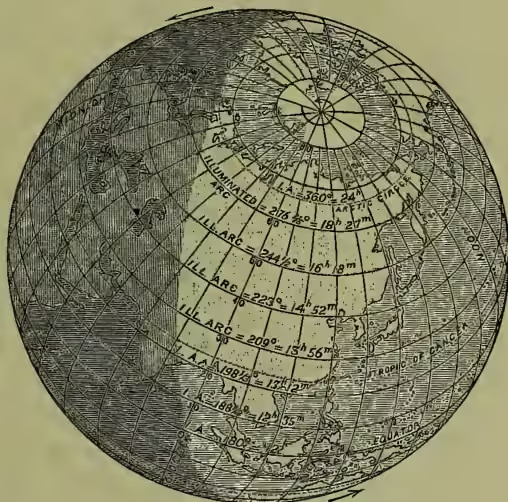
The figures on the parallels of latitude indicate the length of the illuminated arc in degrees, and the period of daylight (longest day) in hours. winter solstice of the northern hemisphere the sun is vertical at a distance of S. of the equator or on the Tropic of Capricorn, which is the highest south latitude for a vertical sun. As the sun appears overhead in all places between these circles twice in the year, and thus exerts its maximum heating power, this broad belt of the earth is termed the torrid zone. Between the tropics and the polar circles there are two regions, each wide, in which the sun is never overhead, nor is it ever beneath or above the horizon continuously for a period of twenty-four hours. These are the northern and southern temperate zones. In high latitudes the sun's rays strike the earth's surface obliquely, and have thus less heating power than in low latitudes (see CLIMATE; see also DAY and SEASONS). The northern winter and southern summer occur in perihelion, so it might be supposed that more heat reaches the southern than the northern hemisphere. Kepler's second law explains, however, that the earth moves so much more rapidly when near the sun than it does when distant from that centre, that the amount of heat received in equal times is the same in both cases.
Work of Solar Energy.—The sun's heat-power is constantly at work breaking down the rocks of the higher parts of the lithosphere, and spreading the triturated substance as soil over the lower ground. The circulation of water is the great instrument for this work; vapour raised from the oceans and carried by wind is condensed as rain on the high-lands, and returning to the sea in the form of springs and streams, has a chief share in wearing down the surface of the land. This process would ultimately reduce all the land to a uniform low level, were it not counteracted by the continual gentle elevations and depressions of the surface, consequent on internal changes (see UPHEAVAL). The energy of the sun acting through living plants enables these to recombine the elements of the soil and the air, and thus to form a variety of new products, most of which can as yet be produced in no other way. Thus the greater part of the land surface of the earth is covered with growing vegetation. The distribution of plants over the earth's surface depends on configuration, climate, and soil. Where these conditions were favourable, great stores of solar energy have been laid up in the potential state by the preservation as fossils of ancient forests. Coal is the best example, and the distribution of coal is at present one of the most important factors in the life of a modern manufacturing community. Animal life, which is ultimately dependent on plant-life, and cannot get energy from the sun direct, carries on the process of rearrangement and redistribution of matter farther. It also has had a share in producing the present condition and aspect of many parts of the earth. The chalk, limestone, and marble which characterise many regions of the land, and the coral reefs and islands of tropical seas, are immediate consequences of the action of animal life. The distribution of plants and animals in their natural state is determined solely by the physical conditions of their surroundings; but the actual distribution has been greatly modified by the action of man.
Man to a large extent modifies and reverses the ordinary course of natural phenomena and the laws of Geographical Distribution (q.v.). The greatest density of human population would occur naturally in those regions where the means of life are most abundant and most easily obtained, such as the alluvial plains of hot regions; hence the valleys of the Nile and Ganges and the plains of China have always been amongst the most populous parts of the world. With the development of means of transport and of manufacturing processes a drift of population set in towards regions of mineral wealth, so that in manufacturing countries, such as western Europe and the eastern United States, the coal-fields are most densely peopled, and the population is fed by grain and flesh raised in far distant parts of the earth. Tribes of the human race early began to claim exclusive rights to the region of the earth's surface they inhabited, and definite districts of the earth have from remote historical times been associated with particular races, who either continue to hold them if strong enough to resist invasion, or are superseded by more powerful immigrants. The artificial boundaries of countries appeal so much more strongly to the popular mind than the natural boundaries of such regions of the earth's surface as plains, plateaus, or river-basins, that in most atlases the maps are coloured to show only the arbitrary human divisions. It is the purpose of Geography (q.v.) to consider the earth in its special relations to man.
The intense manufacturing activity of modern life has an important bearing on the future of the earth as a habitable planet. Mineral fuel and metals are being extracted and consumed with great and increasing rapidity, and from many causes they are being produced and stored up at a slow and decreasing rate. Hence, viewing the subject from the standpoint of geological time, the supply of potential energy is nearly at an end. The sun pours upon the earth every day enormous quantities of energy, continually available in wind and water power, and these must be utilised more and more as the accumulated reserve of energy in coal and metals diminishes. In the same way vegetation is a regenerative process; but by the destruction of forests without replanting and the exhaustion of soils the availability of solar energy in this way has been destroyed in some parts of the world (see PALESTINE), and greatly impaired in others. It is necessary, in viewing the earth as a home for man, to bear in mind that if it is to continue capable of maintaining its present population of 1450 millions in comfort—not to speak of the vastly increased population that is accumulating at the rate of more than 10,000,000 a year—the stores of potential energy must be carefully preserved, and care must be taken to allow the daily solar supplies to produce their fullest effect by applying the principles of forestry and agriculture.
The Future of the Earth.—The principle of the degradation of energy teaches that the earth will gradually cool down as the ages proceed. The sun also cooling, although at a slower rate (about 1° in 3000 years), will gradually reduce the supply of external energy, the friction of lunar tides will lengthen the rotation period of the earth until it coincides with its reduced period of revolution round the sun. Ultimately, if this principle holds good, all the bodies of the solar system will clash together, restoring by the impact much of the potential energy to the kinetic state, and in so doing they will start a reduced duplicate of the old solar system, with a less supply of energy. The cycle of nebula, sun, and planet will go through the same round again and again with diminishing speed, until ultimately in the course of infinite time all the matter of the universe will be accumulated in one vast mass, with all the energy of the universe uniformly diffused through it at one level of temperature and utterly unavailable, and the universe will be dead.
The internal composition and gradual changes of the interior, the somewhat complicated distribution and mode of origin of the surface, irregularities of the lithosphere, the various motions of the earth as a whole, and the action, modified by all these conditions, of solar energy on the atmosphere, hydrosphere, and lithosphere, determine all the changes of the earth's condition and appearance, including its relations to living plants and animals. The investigation and description of these features and their rationale constitutes the study known to the Germans as Erdkunde, to the French as Physique de Globe, and in this country by the unsatisfactory and inadequate names of physical geography, physiography, or earth knowledge.
For the full explanation of the phenomena of the earth, reference may be made to many other articles, some of the more important of which are:
| Africa. | Creation. | Indian Ocean. | Ptolemaic |
| America. | Day. | Island. | System. |
| Antarctic. | Desert. | Lakes. | Rain. |
| Arctic Ocean. | Earthquake. | Latitude. | Rivers. |
| Armillary | Ecliptic. | Longitude. | Sea. |
| Sphere. | Europe. | Meridian. | Season. |
| Asia. | Fjord. | Meteorology. | Snow. |
| Astronomy. | Geodesy. | Mountains. | Solar System. |
| Atlantic. | Geographical | Nebulae. | Sounding. |
| Atmosphere. | Distribution. | Nutation. | Storms. |
| Australia. | Geography. | Pacific Ocean. | Temperature. |
| Climate. | Geology. | Parallel. | Tides. |
| Continent. | Glacial Period. | Planets. (tion. | Volcanoes |
| Copernican | Gravitation. | Polar Explora- | Water. |
| System. | Ice. | Poles. | World. |