Echidna, or PORCUPINE ANT-EATER, a genus included with Ornithorhynchus (q.v.) and another genus in that lowest sub-class of Mammalia which has been variously designated Monotremata, Ornithodelphia, or Prototheria. In many ways the few animals in this section are primitive—in skeleton, brain, heart, and reproductive organs especially.
None of their peculiarities, however, are more striking than their oviparous, instead of viviparous habit. They lay eggs instead of bringing forth their young as such, like other mammals. The temperature of the body is very low (in Echidna 28° C.), and this may be taken as a sort of physiological index of the low pitch of the life. In several features besides the egg-laying habit the Prototheria resemble birds, but this is not due to any relationship other than that of a far back common ancestry.
The genus Echidna is found in Australia, Tasmania, and New Guinea. The cut shows the general appearance of the animal. The hair is partly replaced by the porcupine-like spines, which are doubtless useful in protection and in burrowing; the toes are armed with strong claws, dexterously used in rapid digging both for food and for concealment; the tail is rudimentary; the skull is prolonged into a narrow snout; the mouth, which has a very small aperture, is entirely toothless, but contains a long extensible worm-like tongue, viscid with saliva, which is quickly moved out and in for catching ants. The hind-leg or heel of the males bears a horny spur, connected with a gland on the thigh, but of unknown significance. The
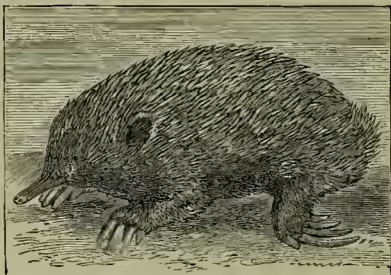
Echidna has a better brain than the duckmole, the cerebral hemispheres being not only larger, but well convoluted. A unique skeletal peculiarity for a mammal is the incompletely ossified socket (acetabulum), where the thigh-bone works on the hip-girdle. In skull, mouth, feet, tail, skin, and general habit, the Echidna is obviously very different from the ornithorhynchus. The animal is emphatically a burrower. In walking, the hind-toes are turned outwards and backwards. It feeds on ants, caught as above described, and crushed by spines on the tongue and palate. The Echidna is thus a prophecy of the true Ant-eaters (q.v.). The eggs are large, and inclosed in a tough egg-shell. After being laid, they are carried in a pouch developed round about the depressed area on which the milk-glands open. There are no teats.
There are several species of Echidna, the best known being E. aculeata, in Australia and Tasmania. Another form, 'with longer fur almost concealing the spines,' is distinguished as E. setosa. A third species—E. laevesii, from New Guinea—has also been distinguished. All these have five claws on each foot. A larger form, with only three claws, occurs in New Guinea, and is separated as a distinct genus, Acanthoglossus or Pro-echidna brujinii. The upper arm of a fossil Echidna has been found among Pleistocene remains.
See Gould, Mammals of Australia (3 vols. 1845-63); Gervais, Ostéographie des Monotremes (Paris, 1878); Oldfield Thomas, Proc. Zool. Soc. Lond. (1885); Baldwin Spencer, Nature, xxxi. (1884-85); and Haacke on 'Oviparity,' in Proc. Roy. Soc. xxxviii. (1884-85).