Mollusca, a large division of invertebrate animals, including three chief classes: bivalves or Lamellibranchs, 'snails' or Gasteropods, and cuttle-fish or Cephalopods. As these are separately discussed, it will be enough to state the general characters and classification of the series.
General Characters.—Though most cuttle-fish and not a few gasteropods are free swimmers, the average habit of molluscs tends markedly to sluggishness, and with this the calcareous shell of the great majority may be naturally associated. Most of the genera are marine, but there are many fresh-water forms (probably originating 'from the conversion of shallow continental seas into lakes'), while the species of terrestrial snails and slugs are legion. As to diet, the sluggish bivalves feed on microscopic animals and organic debris wafted to the mouth by the gills; the gasteropods are divided into carnivores and vegetarians, omnivorous glutons and dainty epicures; and the cephalopods are voracious flesh-eaters. In this connection the absence of a rasping tongue in the bivalves, and its presence in all the others should be noticed.
One of the most conspicuous structural characters is the absence of the segmentation and the serial appendages which characterise the arthropods and higher 'worms.' The typical mollusc is bilaterally symmetrical, as may be seen in bivalves and in those gasteropods of which Chiton (q.v.) is a representative, but in the majority of gasteropods the body is markedly lop-sided. This condition is referred by Lankester to the exaggerated vertical growth of the viscera into a dorsal hump surmounted by a shell, which in creeping animals will tend to fall to one side, and thus produce torsion. With the skin, which is soft and glandular, and often ciliated, two very characteristic structures are connected on the dorsal surface, the one a small pit constant in the embryo—the primitive shell-sac or shell-gland; the other a fold of skin overlapping the sides and forming the 'mantle.' From the latter a very varied permanent shell is usually formed as a cuticular product composed of carbonate of lime and an organic basis. Its thickness seems often to bear some relation to the external and internal activities of the mollusc, for it is thin in the active scallop (Pecten) and Lima, thick in the passive oyster and Tridacna, slight or absent in the pelagic Pteropods (sea-butterflies) and in the active Cephalopods, but heavy in most of the slowly creeping littoral forms. But that this is only one condition of shell-development is evident in many ways—for instance, when we compare land-snails with slugs; for the latter, though hardly less sluggish than the former, are practically shell-less. Another very distinctive structure is the molluscan 'foot,' a muscular protrusion of the ventral surface, usually locomotor in its function, but turned to various uses, and degenerate in the most sedentary bivalves, especially in the oyster.
As to the less obvious general characters, the nervous system consists typically of a pair of cerebral ganglia, connected to a pair of pedals and to a pair of plenrals, the latter associated with a visceral nerve-loop which may also be ganglionated. In the cephalopods, and in most gasteropods, the three chief pairs of nerve-centres are closely united in the head, but in the symmetrical chitons a much more primitive, and in the bivalves a much less concentrated arrangement obtains. The sense-organs vary greatly, but there may be tentacles like the snail's 'horns,' head-eyes like those so well developed in most cuttle-fish, while a pair of ear-sacs or otocysts in the front of the foot and a smelling-patch or osphradium at the base of the gills are all but constant. On the edge of the mantle of many bivalves, or penetrating the shell-plates in Chiton, there is quite a plethora of eyes, some of which are imperfectly visual and possibly light-absorbing in function. The food-canal includes in the mouth-region a toothed ribbon, absent in bivalves, and bears further back a digestive gland often of large size. The long coils of the gut are depressed ventrally into the foot of bivalves, and are protruded as if in a hernia on the dorsal surface of most gasteropods. The heart, absent only in Dentalium and related genera, lies dorsally in a special portion of the body-cavity known as the pericardium, and drives colourless blood through the body, thence into the gills and kidneys, whence it returns purified. The gills are vascular outgrowths of the body-wall, usually sheltered by the mantle, which in the terrestrial forms like the snail makes a lung-like chamber. A paired or single kidney connects the pericardium with the exterior. The reproductive organs—unisexual or hermaphrodite—vary extremely, from great simplicity in most bivalves to an extraordinary degree of complexity in many gasteropods, such as the snail.
In their life-history most molluscs pass through two larval stages. The first is a somewhat barrel-shaped form, with a ring of cilia in front of the mouth; it is known as a trochosphere, and is quite like the young stage of many 'worms.' This passes, however, into another more characteristic phase called the Veliger, which bears on its head a ciliated area or locomotor 'velum' often produced into lobes, has its body already characterised by a visceral hump and a ventral foot, and possesses on its dorsal surface the little shell-gland already mentioned. In the cephalopods, whose ova are rich in yolk, the trochosphere and veliger stages are skipped over, and there are also notable modifications in the development of terrestrial and fresh-water molluscs.
Classification.—Branch A. Those with a well-developed head and a rasping tongue: Class I.—Cephalopoda (q.v.). See also CUTTLE-FISH, NAUTILUS. Class II.—Gasteropoda—(a) More or less unsymmetrical forms (see GASTEROPODA, also LIMPET, SNAIL, WHELK, &c.); (b) Symmetrical and primitive forms—e.g. Chiton (q.v.); (c) A distinct sub-class of pelagic forms, the Pteropods (q.v., sometimes called a class, or united with Class I.). Class III.—Scaphopoda—A few very distinct forms, of which Dentalium (q.v.) is the best-known representative. Branch B. Those in which the head-region is very slightly developed, and without a rasping tongue: Class IV.—Lamellibranchiata or Bivalves (q.v.). See also MUSSEL, OYSTER, &c.
History.—Provided as most molluscs are with substantial calcareous shells, their fossil remains have been to that extent very perfectly preserved, and long series have been traced out with remarkable success. Remains of the great types occur even in the Cambrian rocks, and more abundantly from the Lower Silurian onwards. The earliest Nautilus type of cephalopod has waned away through the ages, and only one genus (see NAUTILUS) now persists, while the cuttle-fish type which appeared much later is still represented by numerous species. As a whole, however, this class seems to have dwindled, for there are towards 4000 fossil species—distributed of course over many ages—as against less than 200 living forms. With the gasteropods, however, the case has been very different, for the number of genera steadily increases from the Cambrian and Silurian onwards, and of the total number of species, computed some years ago at 23,000, the extinct forms are estimated at 7000, the living forms at 16,000, which proves beyond doubt a notable increase in numbers. Nor can we deplore any modern diminution of lamellibranchs, for, although the extinct species are reckoned at about 9000 and the living at about 5000, the former were distributed over a much vaster period, while in some families the number of living species greatly exceeds that of the extinct. As one would expect, the lung-breathing gasteropods and the fresh-water lamellibranchs are both relatively late in appearing.
As to the pedigree, some of the characters of the chiton-like gasteropods and the general occurrence of a trochosphere larva suggest the origin of molluscs from some worm-like type, but this is not saying much. Very helpful has been Professor Ray Lankester's attempted reconstruction of the ancestral or archi-mollusc, from which all the early divided into two series, the sluggish bivalves, with many structures (e.g. the atrophied head) modified in relation to a sedentary life, and the active aggressive gasteropods and cephalopods, in which the general features of the archi-mollusc are more evidently retained.
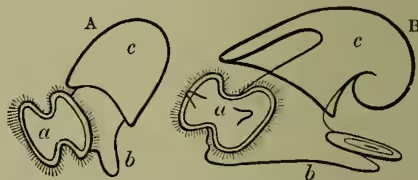
a, velum; b, foot; c, visceral dome.
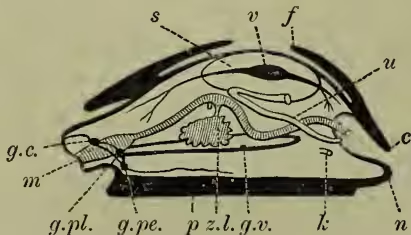
m, mouth; g.c. cerebral, g.pl. pleural, g.pe. pedal, g.v. visceral ganglia; p, foot; z.l., left lobe of digestive gland; k, genital opening; n, posterior end of the foot; c, edge of the mantle; u, kidney; f, edge of primary shell-sac; v, ventricle of the heart; s, pericardial cavity.
As the economic importance of molluscs is recognised in special articles (such as those on Bivalves, Cuttle-fish, Gasteropoda, Mussel, Oyster, Snail, Whelk, &c.), we shall simply illustrate in conclusion their general zoological interest. For a long time the study of molluscs hardly penetrated beyond their shells; but, though this Conchology (q.v.) was often a collecting craze, and sometimes led to positively misleading conclusions, no one will dispute the charm of beauty and variety which these externalities possess, nor deny that their investigation rightly pursued (in relation to the tenanted animals and the surrounding conditions of life) may yield most important scientific results. It is very interesting also to consider how the limits of Mollusca have been gradually changed. As the original title, Malakia, means soft, it is necessary to explain that Aristotle applied it solely to the practically shell-less cuttle-fishes, while Linnæus used the Latinised term Mollusca also in primary reference to naked forms, along with which he included, however, hydroids, annelids, and echinoderms. The shelled molluscs which form the majority of the modern classes he separated off as Testacea. But strangely enough this last title was gradually replaced by Mollusca, under which Cuvier included not only cephalopods, gasteropods, pteropods, and the 'acephalous' or headless bivalves, but the lampshells or Brachiopods, the Nuda or Ascidians, and the barnacles or Cirripoda. In modern times, as a reference to the articles on Brachiopoda, Ascidians, and Cirripedia will show, the researches of Vaughan Thompson, Kovalevsky, Milne-Edwards, and others have entirely freed the class of molluscs from Cuvier's last three divisions. The incomparably careful anatomical work of Lacaze-Duthiers, along with the researches of Kölliker and Gegenbaur, Huxley and Spengel, the embryological discoveries of Ray Lankester and others, and the generalisations which we owe to Huxley and Lankester are notable illustrations of recent progress in the study of molluscs. Moreover, on the problems of evolution no little light has been cast—e.g. by Würtzberger's comparison of the racial and individual development of the Ammonites, by Hyatt's monumental monograph on the evolution of fossil cephalopods, or even by the single chapter in which Hilgendorf worked out the variations of Planorbis in the Upper Miocene beds of Steinheim. In other directions, too, the inquiries of Dall and others into the deep-sea molluscs, the experiments by which Semper was able to impress changes upon various forms by altering their surroundings, Sollas's research on the origin of fresh-water fauna, Lang's study of the influence of sedentary life, Bateson's account of the variations of the cockle, and many other evolutionist investigations have yielded results not less valuable than those of the anatomists. known forms are supposed to have sprung. As will be seen from the figure, this schematic conception combines the general characters which we have noted above. Its descendants must have
See E. Ray Lankester's article 'Mollusca,' Encyclo. Brit. (vol. xvi.); Keferstein's 'Mollusca' (1862-66) in Bronn's Thierreich; S. P. Woodward's Manual of the Mollusca (3d ed. 1875); Hatchett Jackson and Rolleston's Forms of Animal Life (1888); and the Challenger Reports.