United States of America, the largest and most important republic of the world, embracing nearly one-half of the area of the North American continent, and about nine-tenths of its inhabitants. Its area is more than three-fourths that of all Europe; including Alaska, it is almost equal to it; but its population is less than one-fifth of that of Europe.
GEOGRAPHY, PHYSICAL AND POLITICAL.
The United States consists of two detached portions of the continent of North America and the islands which are adjacent to these sections. The isolated territory of Alaska has been for convenience considered separately, and the reader may be referred to the article on it. The United States proper occupies the central part of the continent, extending from the Atlantic to the Pacific Ocean, and from the Great Lakes to the Gulf of Mexico. By natural and arbitrary boundaries it is separated from the Dominion of Canada on the north, and from Mexico on the south. It lies between the parallels 24° 30' and 49° N. lat., and between the meridians 67° and 124° W. long. Its greatest length from east to west is about 2700 miles, and its greatest width from north to south about 1600 miles. Its total area is somewhat more than 3,000,000 sq. m. As compared with Europe, for example, the coast of the United States is relatively unbroken, and has few indenting bays or projecting peninsulas. The great indenting sea known as the Gulf of Mexico is of special climatic and commercial importance, but it is as much a geographical feature of Mexico as of the United States. On the coast of the New England states there are many indentations which, though small, furnish commodious harbours. Long Island Sound adds to the commercial importance of the harbour of New York, and farther south are Delaware and Chesapeake bays, Albemarle and Pamlico sounds, and several small indentations such as those which form the harbours of Charleston and Savannah. On the Pacific border, with the exception of Puget
Sound, the Bay of San Francisco, and the harbour of San Diego, there is scarcely a noticeable break in the continuity of the coast-line. There are many small rocky islands along the coast of Maine, and on the southern New England coast is a group of islands to which belongs Long Island, the largest of the islands of the United States. Farther south, off the Atlantic coast, and also in portions of the Gulf of Mexico, are many low sand-spits lying parallel to the coast and having behind them shallow channels, lagoons, and swamps. On the Pacific coast there are no islands of importance except the Santa Barbara group off the southern coast of California.
The two great mountain-systems of North America, one along the western, the other near the eastern border, attain their fullest development in the United States, and form the framework or skeleton of its physical structure. The Appalachian system, in the east, though of secondary geographical importance, is the older of the two highland regions, and of primary interest when considered with reference to the history and development of the nation. It enters the country in the northern part of New England (in Maine without the appearance of regular ranges) and New York, and extends south-westward to Alabama and Georgia, being divided by the valley of the Hudson River and Lake Champlain, and that of the Mohawk River, into three distinct sections. The system is described in detail at APPALACHIANS. A coast-plain extends from its eastern base to the sea. It is narrow in Maine, where it terminates in a bold rocky coast indented by bays, and broken into projecting promontories and islands. South of Massachusetts Bay the coast becomes lower and more sandy, and the plain grows gradually wider, with the exception of a narrow belt at New York, until in North Carolina it attains a width of 200 miles. In the southern part of New England it is characterised by hills, and below New York by a distinct coast region and a more elevated slope. This higher region, which in Virginia and thence southward is marked by a somewhat abrupt terrace, varies in altitude from a few hundred to more than a thousand feet, and is known as the 'Piedmont Plateau.' The lower coast region is seldom more than 100 feet above the sea. It has a sandy soil, and in many places there are large swamps near the coast. Much of this swampy country is uninhabitable, but when reclaimed, as it has been in many parts of North and South Carolina, it makes valuable rice-land. Many acres of fertile agricultural land have also been secured in Florida by draining its swamps. The middle elevated region is diversified by hills and valleys, and has a productive soil. The dividing line between it and the low coast-plain marks the head of navigation of most of the streams, and also determines the sites of many important towns.
West of the Appalachian system and lying between it and the western highland is the Central Valley, forming part of the great continental depression which extends from the Arctic Ocean to the Gulf of Mexico. It is almost an absolute plain, rising gradually from the Gulf toward the chain of Great Lakes in the north, and toward the mountains on the east and west. The only important departure from its uniform level character is an elevation of from 500 to 2000 feet, running from southern Missouri through north-western Arkansas into Indian Territory, and known as the Ozark Mountains. This great valley occupies about one-half the entire area of the United States, and the fertile prairies and bottom-lands of the eastern and central portions make it the most important agricultural basin of the globe. From an irregular line west of the Mississippi River the land rises in an almost imperceptible slope till it reaches the base of the western plateau. Much of this region, known as the Great Plains, has a light rainfall and is less favourably adapted for agricultural purposes than is the eastern portion, but it affords admirable and extensive pasturage.
The western or Pacific system of mountains forms a part of the vast elevation which extends from the northern to the southern extremity of the western continent. In the United States it is a great plateau of 4000 to 10,000 feet surmounted by a complex system of ranges, in its widest part more than 1000 miles broad. Of this Cordilleran region the Rocky Mountains form the eastern and the Sierra Nevada and Cascade Mountains and the Coast Ranges the western border. For the former, reference must be made to the article ROCKY MOUNTAINS. In the ranges of central Colorado alone nearly forty of the summits have an altitude of more than 14,000 feet. The culminating point of the Rocky Mountains is Blanca Peak (14,463 feet). In the Wind River Mountains, in Wyoming, are the head-waters of the Colorado, the Columbia, and the Mississippi, the three great river-systems of the United States; and in the north-western corner of the same state is situated the National Park, famous for its hot springs and geysers as well as for its magnificent scenery (see YELLOWSTONE). Between the Wahsatch Range and the lofty masses of mountains in Colorado is a region of peculiar interest, consisting of level plateaus, in which the changes of elevation from one plain to another are marked by abrupt descents and steep cliffs. It is furrowed by cañons or gorges, whose sides are nearly vertical; and the bed of the Colorado (q.v.) is in some places more than a mile and a quarter below the surface of the plateau. Between the Wahsatch Range and the Sierra Nevada lies the Great Basin (q.v.), an immense tract having at best but little rainfall, except upon the summits of the ranges by which it is traversed, and none of whose waters are drained to either ocean. Much of this region is at present an absolute desert, although within comparatively recent geological time the conditions were such that two great fresh-water lakes, one nearly as large as Lake Erie, the other more than twice that size, occupied the now arid area. The saline swamps, salt lakes, and sinks of Nevada indicate the former location of one of these lakes; Great Salt Lake is all that now remains of the other.
The Sierra Nevada (q.v.) and the Cascade Range (q.v.) are topographically continuous, and constitute a great mountain-wall which so far as the height of the peaks and the grandeur of the scenery are concerned is one of the most striking portions of the Cordilleran system. Most of the peaks of the Sierras are, however, of granite and metamorphic rock, while those of the Cascade Range are volcanic. The greatest altitude is attained between the parallels 36° and 37°, with Mount Whitney (14,898 feet) as the culminating point. The lofty character of the range is maintained throughout the greater part of California, and the sublimity of the scenery is justly celebrated (see YOSEMITE VALLEY). Between the parallels 39° and 40° the volcanic character of the peaks comes into prominence. From this point there extends northward one of the most remarkable groups of extinct or faintly active volcanoes to be found anywhere in the world: the lava overflows in this region cover an area of above 200,000 sq. m. The most prominent peaks are Mount Shasta (14,442 feet) in California and Mount Rainier (14,444) in Washington. In three separate places rivers have cut a passage through the volcanic portion of the range. The most notable is the passage of the Columbia River in a grand cañon more than 3000 feet in depth. The region which lies north of the Great Basin, between the Cascade Range and the Rocky Mountains, is known as the Northern or Columbian Plateau. Much of it is covered by material thrown out in volcanic eruptions, and has been eroded not only by the Columbia, but by its tributaries. The Shoshone Falls (q.v.) of the Snake River probably rank next to Niagara in grandeur. The Coast Ranges of Washington, Oregon, and northern California consist of numerous and approximately parallel chains, which as a rule pitch off abruptly toward the sea, leaving no coast-plain. Between the Coast Ranges and the Sierra Nevada and Cascade Range is a series of broad valleys, occupied mainly in Oregon by the Willamette River and in California by the Sacramento and San Joaquin. In southern California the mountains of the Coast Ranges diminish in height, but throughout their whole extent they are interspersed with picturesque and fertile valleys.
The drainage of the United States is determined by its physical structure, which is such as to make the country pre-eminent for the number and length of its navigable rivers, and for the abundance and size of its lakes. The lake region lies in the northern part of the country, forming a part of the great belt of lakes which sweeps in a broad curve around Hudson Bay as a centre, and extends from the Atlantic to the Arctic Ocean. Besides the chain of Great Lakes which forms a part of the northern boundary, there are thousands of lakes in the New England states and in New York, nearly ten thousand in Minnesota, and numerous mountain-lakes among the Cordilleras. The peculiar lacustrine character of the northern portion of the United States is undoubtedly a legacy of the glacial period, and it is also a fact worthy of notice that this belt of lakes lies mainly in the customary path of the great cyclonic storms. Most of the important rivers of the United States also have their origin in its northern sections. The drainage areas may be broadly classified as the Great Lake or St Lawrence, the Atlantic, the Pacific, and the Great Basin or interior systems of drainage. The tributaries of the Great Lakes and the St Lawrence within the United States are rather insignificant, but the Lakes themselves form a feature of obvious importance. In the Atlantic system is included all the drainage which ultimately reaches the Atlantic Ocean, but for convenience the rivers might be further subdivided into two classes, one comprising the streams flowing directly into the sea, the other comprehending those of the Central Valley which discharge their waters into the Gulf of Mexico. The rivers of the Atlantic slope rise in the Appalachian mountain region, and are shallow and rapid until they reach the terrace which divides the highland from the true coast region. In this latter portion of the course they are as a rule navigable. The upper courses of the streams furnish available water-power, and have played a conspicuous part in developing the manufacturing industries. The Penobscot, Kennebec, Merrimac, Thames, and Connecticut in New England, the Hudson with its original commercial importance greatly augmented by the Erie and Champlain canals, and farther south the Delaware, Susquehanna, Potomac, James, Roanoke, Nense, Cape Fear, Great Pedee, Santee, Savannah, Altamaha, and St John's are the principal streams. The Mississippi-Missouri, with its tributaries the Ohio, Platte, Arkansas, and Red rivers, is the chief stream of the Central Valley. Its basin is second only to that of the Amazon, and in length and extent of navigable water it surpasses all other rivers of the world. East of the Mississippi are the Mobile and Appalachicola, and to the west the Sabine, Brazos, and Rio
Grande. The Colorado, the Sacramento and San Joaquin, the Willamette, and the Columbia are the important streams emptying their waters into the Pacific. With the exception of the Sacramento and San Joaquin, and the lower portion of the Colorado, the rivers of the Pacific coast are not navigable. The rivers of the Great Basin are uncertain in volume and of no great size.
Climate.—With its great extent and its diversified topography, the United States has every variety of climate characteristic of the temperate zone. The annual isothermal lines, except where they are influenced by the two great mountain-systems, pursue a fairly uniform east and west course across the country. They are somewhat deflected to the south by the Appalachian Mountains; but though the high mountain regions produce great local deflections of these lines, a vast elevated mass like the Cordilleran Plateau does not seriously affect the mean annual temperature. In the southern part of the plateau there is a slight general deflection toward the south, but in Montana and the north-western portions of the country the isotherms indicate a warmer annual mean than that prevailing farther east. A marked difference is, however, observable in the disposition of these lines on maps representing respectively the summer and the winter temperatures. The influence of the oceans
| Political Divisions. | Capital. | Date of Admission as State. | Land Area in sq. miles. | Water Area in sq. miles. | Gross Area in sq. miles. | Population in 1900. | Population per sq. mile. |
|---|---|---|---|---|---|---|---|
| Alabama..... | Montgomery..... | 1819 | 51,540 | 710 | 52,250 | 1,828,097 | 35 |
| Alaska Territory..... | Sitka..... | .. | .. | .. | 570,000 | 44,000 | 08 |
| Arizona Territory..... | Phoenix..... | .. | 112,920 | 100 | 113,020 | 122,212 | 108 |
| Arkansas..... | Little Rock..... | 1836 | 53,045 | 805 | 53,850 | 1,311,564 | 2436 |
| California..... | Sacramento..... | 1850 | 155,360 | 2,380 | 158,980 | 1,485,053 | 938 |
| Colorado..... | Denver..... | 1876 | 103,645 | 280 | 103,925 | 539,700 | 519 |
| Connecticut..... | Hartford..... | 1788 | 4,845 | 145 | 4,990 | 905,355 | 18204 |
| Delaware..... | Dover..... | 1787 | 1,960 | 90 | 2,050 | 184,735 | 9111 |
| District of Columbia..... | Washington..... | .. | 60 | 10 | 70 | 278,718 | 388169 |
| Florida..... | Tallahassee..... | 1845 | 54,240 | 4,440 | 58,680 | 528,542 | 901 |
| Georgia..... | Atlanta..... | 1788 | 58,980 | 495 | 59,475 | 2,216,329 | 3726 |
| Idaho..... | Boise City..... | 1890 | 84,290 | 510 | 84,800 | 161,771 | 191 |
| Illinois..... | Springfield..... | 1818 | 56,000 | 650 | 56,650 | 4,821,550 | 8510 |
| Indiana..... | Indianapolis..... | 1816 | 35,910 | 440 | 36,350 | 2,516,463 | 6923 |
| Indian Territory..... | .. | .. | 31,090 | 400 | 31,400 | 391,960 | 1248 |
| Iowa..... | Des Moines..... | 1845 | 55,475 | 550 | 56,025 | 2,251,829 | 4019 |
| Kansas..... | Topeka..... | 1861 | 81,700 | 380 | 82,080 | 1,409,496 | 1790 |
| Kentucky..... | Frankfort..... | 1792 | 40,000 | 400 | 40,400 | 2,147,174 | 5315 |
| Louisiana..... | Baton Rouge..... | 1812 | 45,420 | 3,300 | 48,720 | 1,381,627 | 2835 |
| Maine..... | Augusta..... | 1820 | 29,895 | 3,145 | 33,040 | 694,366 | 2102 |
| Maryland..... | Annapolis..... | 1788 | 9,860 | 2,350 | 12,210 | 1,189,946 | 9746 |
| Massachusetts..... | Boston..... | 1788 | 8,040 | 275 | 8,315 | 2,805,346 | 33738 |
| Michigan..... | Lansing..... | 1837 | 57,430 | 1,485 | 58,915 | 2,491,782 | 4107 |
| Minnesota..... | St. Paul..... | 1858 | 79,205 | 4,160 | 83,565 | 1,751,395 | 2101 |
| Mississippi..... | Jackson..... | 1817 | 46,340 | 470 | 46,810 | 1,551,372 | 3314 |
| Missouri..... | Jefferson City..... | 1821 | 68,735 | 680 | 69,415 | 3,107,117 | 4476 |
| Montana..... | Helena..... | 1889 | 145,310 | 770 | 146,080 | 243,289 | 167 |
| Nebraska..... | Lincoln..... | 1867 | 76,840 | 670 | 77,510 | 1,068,901 | 1379 |
| Nevada..... | Carson City..... | 1864 | 109,740 | 960 | 110,700 | 42,334 | 38 |
| New Hampshire..... | Concord..... | 1788 | 9,005 | 300 | 9,305 | 411,588 | 4423 |
| New Jersey..... | Trenton..... | 1787 | 7,455 | 360 | 7,815 | 1,883,669 | 24103 |
| New Mexico Territory..... | Santa Fé..... | .. | 122,460 | 120 | 122,580 | 193,777 | 158 |
| New York..... | Albany..... | 1788 | 47,620 | 1,550 | 49,170 | 7,268,009 | 14782 |
| North Carolina..... | Raleigh..... | 1789 | 48,580 | 3,670 | 52,250 | 1,891,992 | 3621 |
| North Dakota..... | Bismarck..... | 1889 | 70,195 | 600 | 70,795 | 319,040 | 451 |
| Ohio..... | Columbus..... | 1802 | 40,760 | 300 | 41,060 | 4,157,545 | 10126 |
| Oklahoma Territory..... | Guthrie..... | .. | 38,830 | 200 | 39,030 | 398,245 | 1020 |
| Oregon..... | Salem..... | 1859 | 94,560 | 1,470 | 96,030 | 413,532 | 431 |
| Pennsylvania..... | Harrisburg..... | 1787 | 44,985 | 230 | 45,215 | 6,301,365 | 13936 |
| Rhode Island..... | Providence, Newport | 1790 | 1,085 | 165 | 1,250 | 425,556 | 34284 |
| South Carolina..... | Columbia..... | 1788 | 30,170 | 400 | 30,570 | 1,340,312 | 4384 |
| South Dakota..... | Pierre..... | 1889 | 76,850 | 800 | 77,650 | 401,559 | 517 |
| Tennessee..... | Nashville..... | 1796 | 41,750 | 300 | 42,050 | 2,022,723 | 4810 |
| Texas..... | Austin..... | 1845 | 262,290 | 3,490 | 265,780 | 3,048,828 | 1147 |
| Utah..... | Salt Lake City..... | .. | 82,190 | 2,780 | 84,970 | 276,565 | 325 |
| Vermont..... | Montpelier..... | 1791 | 9,135 | 430 | 9,565 | 343,641 | 3593 |
| Virginia..... | Richmond..... | 1788 | 40,125 | 2,325 | 42,450 | 1,854,184 | 4368 |
| Washington..... | Olympia..... | 1889 | 66,880 | 2,300 | 69,180 | 517,672 | 748 |
| West Virginia..... | Charleston..... | 1863 | 24,645 | 135 | 24,780 | 958,900 | 3878 |
| Wisconsin..... | Madison..... | 1848 | 54,450 | 1,590 | 56,040 | 2,068,963 | 3692 |
| Wyoming..... | Cheyenne..... | 1890 | 97,575 | 315 | 97,890 | 92,531 | 95 |
| Total..... | ..... | ..... | 2,970,000 | 55,600 | 3,595,500 | 76,358,501* | 2520 |
* Including 145,282 Indians on Reservations outside of the Indian Territory, and 84,000 persons abroad in the service of the United States. The Hawaiian Islands Territory, Porto Rico, the Philippine Islands, Guam and Samoa, are also, more or less intimately, parts of the United States. Cuba (q.v.) is at most a protectorate. and of the Great Lakes is at once apparent. Both the heat of summer and the cold of the winter season are greatly modified, whereas in the interior and in the region of the Cordilleras the extremes of heat and cold are both abnormally great. The warm ocean current of the Pacific, which bathes the western coast, produces a more uniform temperature than that which is found on the Atlantic seaboard, along which flows a cold polar current. The annual range of temperature is very great. In winter there sometimes exists at the same instant between the northern and the southern borders a difference of 120°. In summer the diurnal variation of a single locality is in some instances from 40° to 50°. A narrow strip in the south, including the southern portions of Florida, New Mexico, and Arizona, has what may be called a tropical climate. Northern Florida, southern Louisiana, southern Texas, and portions of New Mexico, Arizona, and southern California have a subtropical climate. The sugar and rice regions have a mean annual temperature above 70°. The tobacco region lies between the isotherms of 50° and 60°. The annual temperature of the great cotton region ranges from 60° to 68°, and the prairie regions devoted to the raising of wheat and other hardy cereals seldom have an average temperature above 55°. On the wheat fields of the
Dakotas the annual mean does not exceed 45°. The rainfall of the United States varies greatly in different sections, not only as to quantity, but as to distribution throughout the year. The eastern part of the country is well watered, having not only an ample supply, but an average rainfall for any month which in the long run does not vary much from that of any other month. The requisite moisture is furnished by the Gulf of Mexico and the Atlantic Ocean. The western portion, excepting the strip between the Sierras and the Cascade Range and the Pacific Ocean, and a few limited areas favoured by some peculiar features of topography, has an insufficient supply, and agriculture is dependent for success upon Irrigation (q.v.). Between the two regions is a belt approximately following the meridian of longitude 100°, in which agriculture may sometimes be carried on without recourse to irrigation, but which in any season is liable to suffer from drought. The rainfall of the Pacific coast is peculiar. The westerly winds crossing the warm oceanic current are laden with moisture, which is precipitated whenever the air is sufficiently cooled to lower the dew-point. In Washington, where the land is relatively cooler than the sea for the greater part of the year, rains are frequent, but heavier in winter than in summer. Farther south the land is warmer than the sea in summer, but cooler in winter, so that in northern and central California, for example, there is a wet and a dry season. In southern California, where the land is, as a rule, warmer than the sea, there is little or no rain, and an arid climate prevails.
The eastern portion of the United States is in the main well wooded. Forests also occur in northern California, Oregon, Washington, and in northern Idaho and Montana. The Cordilleran region and the Great Plains are treeless, except upon high plateaus and mountains. The limit of the growth of trees in the east is approximately marked by the same line which separates the region of ample from that of insufficient rainfall. In fact the distribution of forests very closely follows the distribution of rainfall. There is, however, a tract in the central portion of the country, between the parallels 39° and 43°, which at the time of the advent of the white man was a prairie region with very little woodland. The conditions of rainfall and evaporation, together with the prevalence of prairie fires in this area, were such that apparently trivial circumstances turned the tide against forests. With a modification of these conditions by the increase of civilisation, the prairie regions are disappearing and wooded tracts are increasing.
Political Divisions.—Under its present organisation the United States comprises fifty different political divisions besides its Arctic province of Alaska. Of these forty-four are states enjoying the full privileges afforded by the federal constitution; four are organised territories not yet admitted to statehood; one is an unorganised territory set apart as a home for Indian tribes, and one is a special district containing the capital of the nation. By reference to the table (page 373) the name of each of the divisions, its capital, its area, and its population in 1900 may be seen. Both the land and the water area are given in accordance with the computations of the census of 1890. The chain of Great Lakes is excluded from the calculations of enclosed water surfaces. It is worthy of remark that the centre of population has advanced westward during the ten decades since 1790 in a nearly uniform line along the 39th parallel of latitude. It has progressed during the century from a point 23 miles east of Baltimore, a distance of 505 miles, to a point 20 miles east of Columbus, Indiana. Of the total population 96 per cent. of the inhabitants live in that part of the country which is drained to the Atlantic Ocean, and more than one-half live in the region drained by the Gulf of Mexico. The greatest density of population is in the region having a mean annual temperature of from 50° to 55°, rapidly diminishing with the increase or decrease of temperature. In 1900 three cities, New York (over 3,000,000), Chicago, and Philadelphia, had a population of over 1,000,000. St Louis, Boston, and Baltimore had each over 500,000. Five cities had over 300,000; eight cities between 200,000 and 300,000; nineteen between 100,000 and 200,000; forty between 50,000 and 100,000; eighty-one over 25,000 and under 50,000; in all there are 159 cities of over 25,000, aggregating 19,694,625. See also the articles on the states, territories, rivers, lakes, &c.
GEOLOGY AND MINERAL RESOURCES.
The continent of North America began to be developed in the earliest time of which we have as yet any knowledge. It is evident that this part of the world was the seat of certain land areas in the Laurentian age, though we cannot as yet determine the form or position of these ancient islands. In the period of the Lower Cambrian we know that there were dry lands in the Rocky Mountain district, in the region to the south and east of Hudson's Bay, extending as far south as northern New York and along the Atlantic coast from Labrador to Georgia and Alabama. These islands, probably in area small as compared with the present surface of the continent, in a general way outlined the form of the great land. Its subsequent development has been in the main on the lines which were thus traced, the islands of the ancient archipelagos having become united and extended as the continental elevation has been gradually uplifted above the level of the sea. During the Silurian and Devonian periods not only were the lands enlarged, but the seas lying between them were shoaled, so that the great Mediterranean included within the eastern, northern, and western groups of islands was converted into shallow water.
In the early stages of the Carboniferous period a great portion of the continent, which had gradually been rising from the depths of the sea, was uplifted above the ocean's level and converted into low marshy plains upon which developed the luxuriant swamp vegetation from which the deposits of coal were formed. These plains of the coal-making age were mainly developed within the limits of the United States, occupying a broad field to the west of the ancient mountain-ranges of the Blue Ridge, stretching thence for the greater part of the distance across the valley of the continent to the westward. A fringe of similar lowlands lay along the Atlantic coast from Labrador to the southern part of New England. In this age the continent, which has always been subject to oscillations of level, appears to have been peculiarly unstable, so that from time to time the swamps which were formed on these plain lands were lowered beneath the waters, and their accumulations of peaty matter were buried beneath layers of sand, gravels, and mud, after a while to be again elevated and reconverted into swamps. By these successive movements the peaty matter, which has gradually been converted into coal, was imbedded in the rocks of the Carboniferous period. In the time when the Triassic rocks were formed there came one of the greatest periods of mountain-building which the continent has experienced. The ranges of the Alleghany system, extending from near New York to Alabama, were uplifted, and about the same time the region of the Cordilleras or Rocky Mountains underwent extensive elevation. Coincident with these movements the great central trough of the continent, now occupied by the rivers of the Mississippi system, rose so far above the level of the sea that North America took on something like its present outline.
Until the close of the Carboniferous time the central portion of the continent, though occasionally and in parts above the level of the sea, had never been brought for any length of time above the ocean's level. With possible exceptions there appears always to have been a sinus or strait connecting the waters of the northern and eastern ocean with the Gulf of Mexico. During the Jurassic and Cretaceous periods a northward extension of the Gulf of Mexico more or less constantly occupied a portion of the continent lying to the east of the Rocky Mountains, and perhaps extending to near the Mississippi River. It is not certain that this sea extended to the Arctic Ocean, but it probably united the waters of the north and south for a portion of these ages. A further elevation of the continent occurring in the later Cretaceous time reduced this great central bay to the state of very extensive fresh-water lakes, which formed a fringe along the eastern border of the Rocky Mountains. These basins were gradually filled with the waste from the neighbouring highlands; and, with the slow uprising of the continent which occurred in the later Tertiary time, the rivers which drained them carved their ways to such depths that these remnants of the continental seas disappeared. To these same relatively recent elevations we owe the uplift of the great southern plain about the Gulf of Mexico which reduced the old American sea to its present narrow limits in the gulf just named.
The elevations which took place during the Tertiary period were in the eastern part of North America unattended by any considerable crumpling or folding of the rocks, such as produces mountains. In the western portion of the continent, however, the mountain-building forces, from the beginning more constantly active than in the eastern district, profoundly affected the topography of the surface. This greater intensity of mountainous growth in the western portion of North America was attended by a development of volcanic activity in that part of the continent. In the region east of the Mississippi this form of geological activity has not been distinctly manifested since the Triassic time.
The last great geological accident of North America consisted in the wide-spread extension of glaciers, which in a relatively very recent time occupied the surface of the country from the high north to the central portions of the United States, covering the greater portion of the land as far south as the parallel of 40°. Although this visitation of the ice occupied a relatively brief period, it greatly affected the surface of the country, and has had a profound influence upon the character of its soils. During the glacial period the surface of North America appears to have been subjected to remarkable oscillations of level—at least in the district east of the Mississippi River—the northern portions having sunk down, probably in consequence of the burden of ice laid upon them, while the southern parts were correspondingly elevated. At present, the ice having recently passed away, the form of the continent appears to be undergoing some readjustment, a considerable portion of the Atlantic coast in the region south of New York being in process of down-sinking.
The geological resources of the United States include a greater variety of economically valuable substances than has as yet been found within an equal area in the other parts of the world. Most of these may for convenience be classed as carbonaceous materials, metalliferous substances, and architectural materials. The first group includes the varieties of coal, petroleum, and the burnable rock gases. These three classes of substances exist in remarkable quantities in the United States, particularly in the region to the east of the Mississippi River. Probably nine-tenths of the workable deposits of carbonaceous material contained in North America lie in the district between the Blue Ridge Mountains and the Mississippi River. As there are no considerable coal-fields in the Canadian Dominion or in the countries which lie to the south of the Federal Union, it follows that the United States possesses by far the greater part of the subterranean fuels which the continent contains. The Appalachian coal-field, together with the somewhat detached area lying in western Kentucky and the southern parts of Indiana and Illinois, contains over 60,000 sq. m. of workable coal-deposits. In the western portion of the country there are a number of small coal-basins, mostly formed in later ages than the Carboniferous, which afford fuels of lower grade than those obtained from the true coal-measures, and which are of only local importance. On the Atlantic coast to the east of the Appalachian Mountains there are several small coal-fields, of which those about the Gulf of St Lawrence and about Narragansett Bay in the states of Rhode Island and Massachusetts are of Carboniferous age, while those near Richmond, Virginia, and in the valley of the Dan River, North Carolina, were formed in the Triassic time. By far the larger part of the fields have the fuel in the ordinary bituminous state. Some small areas in the mountain-built districts afford anthracites varying in quality from excessively anthracitic coal, such as is found in the Narragansett district, to materials which verge on the bituminous state. The coals found in the Cordilleran region, especially those deposited in the later geological ages, generally belong to the group of lignites. The coals of the United States possess the advantage that they are prevalently of excellent quality, being especially well suited for use in smelting ores, and they generally lie in positions where they may be mined by means of horizontal galleries penetrating from the neighbouring valleys.
The strata containing economically valuable deposits of petroleum lie in the rocks between the Cambrian and the Carboniferous, though there are some small basins which afford rock-oils in the more recent beds of the Cordilleran mountain district. The greater part of these burnable fluids is obtained from the horizontally stratified rocks lying in the valley of the Ohio River. In this field the product is obtained from a number of distinct areas, where the decomposition of the organic matter buried in the rocks at the time of their formation has produced the petroleum, and where the physical condition of the strata has led to the safe storage of the material in the strata. The range in quality of the American petroleum is great, some of the fields yielding oils of a light nature, others producing forms of the substance suitable for lubricating machinery.
The rock gases of a burnable nature, which were formed under substantially the same conditions as those which led to the production of petroleum, are somewhat more widely distributed than the fluid materials. They occur wherever rocks rich in organic matter, and in which the gases are produced, are overlaid by impervious strata. The beds where these gases have been proved to exist in economically important quantities extend, though not in a continuous way, from central New York southward and westward through the Ohio valley. Similar deposits, though as yet of unknown value, exist in the more western portions of the country. The utilisation of natural gases for lighting and heating is an industrial feature which is almost peculiar to the United States.
The most important metallic resources of the United States are found in its iron ores. These exist in great quantities in various parts of its territory. On the Atlantic slope north of New York City the only important deposits lie in the valley of the Hudson, and are mainly magnetic oxides. In Virginia, and thence southward in the Appalachian mountain-system to central Alabama, there are very rich beds of limonite ores which lie in the horizons of the Cambrian. Farther to the west the rocks of the Clinton epoch in the Upper Silurian age contain some layers of limonites and hematites, which are remarkably continuous deposits extending with few breaks from Lake Ontario to Alabama. In the northern part of the field these deposits rarely exceed a foot in depth, but they thicken to the southward until, in the region beyond the Tennessee River, they often have a depth of from 10 to 20 feet. The portion of the Appalachian iron-field from the Potomac southward has the advantage that the ore-beds lie near to coals which afford excellent coke, and are in the immediate vicinity of limestones which are well suited for fluxing purposes. It is characteristic of these southern ores of iron that they are rarely in the form of magnetic oxides, and that they are prevalently too phosphatic for the manufacture of steel by the Bessemer process, though they are well suited to conversion by means of the basic method of reduction. In the region about the western extremity of Lake Superior, particularly in the states of Wisconsin, Minnesota, and Michigan, there are very extensive deposits of high grade iron ores, principally magnetites, which, though occupying a much smaller field than those of the Appalachian district, have been for years the seat of the most extensive production of iron ore in the country. These beds appear to be in strata lying between the true Laurentian and the Cambrian deposits. Owing to the fact that coal is lacking in this district, almost all the ores are shipped away to the regions in the south and east where coke from the Appalachian coal-fields may be had. Most of the ores from the Lake Superior district are used for the manufacture of iron which is to be converted into Bessemer steel, while the ores from the Appalachian field serve in the main for the qualities of iron used for ordinary castings. In the region of the Cordilleras there are very great deposits of iron ore which occasionally, as at Leadville, are associated with the precious metals; but as yet these iron-fields have been but little explored.
The next most important metal in the United States is copper, which is widely distributed both in the metallic state and in that of ores. In the older rocks of the Appalachian Mountains it occurs in mineable quantities at a number of points from central New Hampshire to eastern Tennessee. Formerly the production from these mines of the eastern mountain-system was considerable; but the copper district of Lake Superior, which is limited to a small field in northern Michigan, has since the decade 1860-70 been the principal seat of production of this metal in North America. It is an eminent peculiarity of the mines in this region that they afford the substance in the metallic state: sometimes it occurs in the form of very great sheets of an indistinctly lens-like form, each of which may contain scores or even hundreds of tons of the metal. The deposits occur in rocks which were formed in Cambrian or perhaps in earlier times, and they lie in beds of conglomerate, or in accumulations of volcanic ash. At various points in the Cordilleran region, particularly in Montana and Arizona, there are deposits of copper ores which have been accumulated in wide veins, and which contain small amounts of gold and silver. Although the production of the metal from these ores is more costly than in the case of the mines of Lake Superior, these fields of the Rocky Mountains are very productive, and vie with those of Michigan in their contributions to the market.
Lead ores, mainly in the form of galena, occur in great quantities and with a wide distribution in the United States. The easternmost region which has yielded a considerable supply is in Iowa and Illinois, where the mines of this metal were in the middle part of the 19th century of much importance, though they have been rendered almost valueless by the cheaper production in the more western states. In Missouri galena occurs in large quantities mingled with zinc blende, and is produced in considerable quantities. But the present source of supply is mainly from the silver-bearing lead ores in the Rocky Mountains. Many great vein deposits in that district consist of lead ores which contain a sufficient amount of silver to make them profitable for the precious metal alone, so that the lead is produced as a by-product and practically without cost. The ores of zinc occur in economically valuable quantities in the Appalachian district south of New York, in Missouri, and at various points in the Cordilleras.
We have now noted the most important of the grosser metals which occur in economically valuable quantities in the United States. The following named, however, deserve mention because of their incidental value in the arts. Oxide of manganese is found in workable quantities at various points in the southern Appalachian district, in western Arkansas, and at various places in the Cordilleran region; iron pyrites in numerous large veins in the Appalachian and Rocky Mountain districts, the ore commonly containing a share of copper, and not unfrequently some gold; and the ores of tin at many points in the older rocks of the eastern and western mountain-systems, but so far not in conditions to have any commercial value—although recent discoveries appear to indicate that the metal may occur in quantities sufficient to repay mining in the Black Hills of South Dakota. Nickel has been mined in Pennsylvania and in Oregon, the last-named region giving promise of a considerable production. The country has a full share of the world's gold and silver, and platinum occurs, though it is not yet economically valuable. In the Appalachian region ores containing silver in quantities to profit the miner are unknown. Gold-bearing rocks are there widely distributed, but the veins containing the metal are commonly lean, and the mines opened on them have been unremunerative except in the region south of the Potomac, where during the slave-holding time a considerable amount of gold was produced by the use of this cheap labour. Gold and silver occur in conditions to tempt the miner in the region about the west end of Lake Superior; but, though some of the deposits have been temporarily productive in former years, the efforts to win these metals in this district have on the whole been unremunerative. From the eastern face of the Rocky Mountains westward to the Pacific coast deposits of varied character containing silver and gold are extremely abundant. In fact this portion of the Cordilleran region appears to be the richest in precious metals of any equal area in the world. The silver of this district generally occurs in combination with galena, and has thus been won so cheaply and in such quantities as greatly to lower the price of the metal in the world's markets. The gold of this region occurs partly in ordinary lodes of varied character, and partly in deposits of gravel, sand, and clay, which occupy extensive areas in the river-valleys, especially in the state of
California. Although in all countries where gold has been mined more or less considerable portions of the metal have been won from alluvial deposits, these auriferous gravels of the Cordilleran district have attained an economic importance unknown in any other country, and have become the seat of a peculiar kind of mining known as the hydraulic process (see GOLD). So extensively was this hydraulic mining carried on that the beds of the rivers in the lowlands became filled with the debris which was thus washed into them, and the sands overflowed wide areas of tilled land. On this account it has been found necessary in California to limit its practice by law.
Not only the existing river-valleys of the Cordilleran region contain gold-bearing gravels, but many ancient stream beds, which were filled with lava by volcanic eruptions and have since been left by the down-wearing of the country high above the drainage level, also contain deposits of the precious metal commingled with alluvial material. The precious metal deposits of the Cordilleras differ in an interesting way from those of other countries. The Comstock lode of Nevada is not only remarkable for its great width and the surprisingly rich though widely separated pockets of ores of gold and silver which it afforded, but also for the extraordinarily high temperature which is encountered at from 1000 to 2000 feet below the surface. Although this heat is variable in different parts of the mine, it occasionally amounts to more than 120° F., making the work of mining extremely costly. In Nevada and elsewhere ores of silver, and less commonly of gold, are often found deposited in caverns originally excavated by the waters of hot springs, and since more or less completely filled with deposits bearing those metals.
The architectural stones of the United States, though on the whole less varied and ornamental than those of the Old World, are abundant and well suited to the needs of construction. In the eastern part of the Appalachian district, particularly in New England, granitic and other related rocks of excellent quality for building plentifully occur. The marbles of Vermont are the seat of a great quarrying industry, and are excellent for the builder's use. Similarly extensive deposits occur in north-western Georgia. In this Appalachian section also occur many deposits which afford good roofing slates, and the sandstones of Triassic age are well suited for architectural work. In the central parts of the Mississippi valley the unmetamorphosed strata of Paleozoic age afford many varieties of limestone and sandstone which are serviceable for building purposes. In the Cordilleran district we find the richest field for the quarrymen which the continent affords. In addition to the more ordinary varieties of building stone, there are many species of volcanic rock which are admirably adapted for constructive purposes, being easily worked, enduring, and of pleasing colours.
The varieties of clays used for making bricks of various kinds, and for pottery purposes, abound throughout the districts between the western portion of the Mississippi valley and the Atlantic seaboard. Certain clays found near Milwaukee produce, under skilful burning, brick of a very delicate buff colour. The refractory clays suited for resisting high temperature are very abundantly developed, especially in the rocks of Carboniferous age. Their frequent occurrence in this formation is due to the fact that the earth had the lime and other basic materials which cause ordinary brick to melt removed by the action of the roots belonging to the species of plants which form the coal-beds. Rocks affording cements abound in almost all parts of the country; but the product of the quarries is on the whole not as good as that obtained from similar deposits in England and Germany.
Among the most important mineral deposits of North America, and particularly of the United States, must be reckoned the phosphatic rocks which are used in the manufacture of agricultural manures. These accumulations in quantities sufficient to have a great commercial value are found in the district about Charlestown, South Carolina, and in a field having an aggregate area of about 1000 sq. m. in western Florida, bordering upon the Gulf of Mexico.
Although certain precious stones have been found within the limits of the United States, none of the prized species occur, so far as is known, in quantities sufficient to have distinct economic value.
The mineral springs of the eastern part of the United States do not exhibit a great variety, and, except in Virginia and North Carolina, none of them are sufficiently warm to be prized for their temperature. Hot springs of much medicinal value occur at Little Rock, Arkansas. Their waters have a higher temperature than those of any other part of the continent east of the Rocky Mountains. In the Cordilleran district the number of mineral springs and those of high temperature is exceedingly great. As yet their therapeutic value is imperfectly known, but it seems certain that ultimately they will prove to be of much value.
EDUCATION.
Introductory.—The country at large has no national system of education. By the constitution of the United States only such powers are vested in the federal government as concern the whole people. Education is left to the states. The central government has contributed greatly and in many ways to the encouragement of schools and the integration of systems, and toward unifying the educational policies of local authorities. It has influenced the direction of educational thought, and fixed the character of educational institutions. It possesses, however, neither legislative nor administrative power to improve schools directly. The schooling of the Indians and special education to fit for service in the army and navy only have been made a charge of the nation. There is maintained at the capital, however, as a division of the department of the interior, a 'Bureau of Education,' whose twofold function is to collect statistics and to diffuse information. Based upon the information voluntarily returned to it by local and state authorities, it issues an annual report, special reports upon educational questions, and numerous minor bulletins and 'circulars of information.'
By the general government also there is administered at Washington the Smithsonian Institution (q.v.); and still further, the federal government liberally supports special scientific inquiry, through the coast, geographical, and geological surveys, the Signal Service (or weather) Bureau, frequent naval explorations, and a national observatory, besides numerous publications of a scientific or historical character, incidentally connected with one or another of the several departments. And finally, under the provisions of the 'Ordinance of 1787,' granting to each state organised thereafter section 16 in every township for school purposes; and by an Act of 1849 setting off 500,000 acres to each of certain specified states; and again by an Act of 1862 giving to each state 30,000 acres of land for every representative in congress, to be used in establishing schools of agriculture and the mechanical arts, land has been appropriated by the national government for purposes of education in the states, aggregating nearly 80,000,000 acres.
All educational systems in America are relatively recent. Except for some New England attempts made in Massachusetts by the law of 1647, and under the Connecticut Code of 1650, no effective movement for general education was inaugurated in the United States prior to the 19th century. In a few states permanent educational funds (hinting at centralisation and state control) were begun just after the revolution. But not until 1812 (in New York) was any law passed that could be construed as contemplating a uniform system for an entire commonwealth. That of Massachusetts, as now in force, dates from 1837. The Michigan system is a year older. Connecticut organised in 1838, and Rhode Island in 1843. But for the country at large the period of growth and the integration of systems, and the centralisation of control, includes little more than the years since 1870. Closer supervision, the improvement of teachers, the revision of school courses, the introduction and multiplication of technical and trade schools, the adoption of the Kindergarten, and the marvellous development of free schools in the southern states belong wholly or chiefly to this period.
The public school system now is practically co-extensive with the nation. Theoretically, the state agrees to furnish schooling for all who seek it (restricted as to age only), schooling of any grade to any class, with free tuition in some states even through the university. But other agencies also have the right to conduct schools, with or without the sanction of the state authorities. Their management (whether private or parochial) is free from state oversight; it passes upon the qualifications of, and employs, its own teachers; it determines its own courses and textbooks; it is required to make no reports; in short it is regarded in every respect by the civil authorities as a private enterprise, and treated accordingly.
Denominational Schools, &c.—Among the earliest of educational agencies in every section has been the church: not unfrequently the first schools among the pioneers have been veritable home missions. But now elementary denominational schools are neither numerous nor largely attended. Most Protestant sects patronise the public system; five-sixths of all the 700,000 children attending the parochial schools of all the states are Catholics. Of 1324 non-public secondary schools reporting to the National Bureau 548 are church controlled, and enrol nearly 90,000 pupils. But as an educational agency the church shows greatest zeal in establishing higher institutions of learning: of 506 colleges entitled to grant degrees 382 are avowedly denominational. There are also (approximately) 200 superior institutions, independent of both church and state, some of them endowed, varying greatly both as to quantity and quality of work, empowered to grant degrees. Of the eight colleges of the first class for women seven are private foundations, and enrol more than 2000 students. Of the 114 degree-giving institutions for women included in the second class 59 are private organisations, and have an attendance of about 9000 students. Of the 12 university foundations five are independent corporations having 6000 students. Sixty-one of the 384 colleges for men alone or co-educational for the sexes are private, and enrol 10,000 students. In addition to these still, there are 32 independent schools of science with 8000 students. In the aggregate the private institutions for superior instruction number 164, with an annual membership of 35,000 students.
Public (State-controlled) Schools.—The schools of all grades enrol approximately 14,000,000 pupils. Of this number nearly 12,500,000, or 90 per cent., belong to public institutions; the remaining 10 per cent. to denominational and private schools. Moreover of those in the public schools 96 per cent. are in the elementary grades (six to fourteen years of age); 31·2 per cent. in the public high schools, or preparatory departments; and about one-fourth of 1 per cent. in the state colleges and universities, including students in the public technological schools. The first two of the grades mentioned constitute the 'Common School System' of the states, tuition in both of which is free. In most states admission to classes beyond high school involves the payment of a small fee, though most of these institutions have some endowment, and, in addition, most receive periodical appropriations from the legislatures that created them. The total appropriations average perhaps not less than a million dollars annually; the income from all other sources being about twice that amount. The endowment for all such institutions organised since 1800 began in the Federal Act, 1785, granting out of the public lands one full township (later two) to each state for the establishment and maintenance of a 'Seminary of Learning.' This as a nucleus has been variously managed by the different states, and sometimes increased through special appropriations, &c. Although the schools of this group comprise but one-fifteenth of all the superior institutions of the country, they enrol one-sixth of the students. The state agricultural and mechanical schools have all grown up since 1865, taking their rise in the grant of land by congress in 1862, supplemented by that of money in 1890. Institutions so aided are found in all the states and territories except Alaska, to a total of 64, in 61 of which agricultural courses are maintained; some of the states also make appropriations for the support of such institutions.
Professional Schools.—Among the professions medicine ranks first in number of schools (188), theology second (141), and law last (52). The schools of theology have nearly 7000 students, and represent 27 different denominations. In the 52 schools of law are 4000 students, and in medicine (including surgery, dentistry, pharmacy, and veterinary science) there are as many as in theology and law combined. Of the 52 law schools 18 are state supported, and of the medical schools 37. There should also be mentioned 33 schools for nurses, representing fourteen states, twenty-two cities, and 1248 students. The courses average two full years in length, from which are graduated annually over 400 nurses.
Supplementary Institutions.—There are 74 schools for deaf-mutes, with 8156 students; 33 schools for the blind, having 3134 students; 26 schools for the feeble-minded, with 4784 pupils; and 50 reform schools, with 19,790. These schools for the defective and wayward classes are found in almost every state, are generally public, and represent an aggregate annual expenditure of five and a half million dollars. Evening schools are maintained more or less regularly and successfully in 150 cities. Half as many cities sustain Kindergartens, public or private. The support of these latter is, in most cases, an experiment only, though Boston, Philadelphia, St Louis, and a few other cities include them in the common school system, and provide for all alike. Here, as in so many other educational interests, private enterprise and church zeal have taken the initiative. For university education, see UNIVERSITIES, p. 400.
Common School Statistics.—The lowest minimum age is 4 years, the highest 8, the average 5·5 years; the lowest maximum age 15 years, the highest 21, the average 19·7 years; the average school period 14·2 years. The highest ratio of school census to population is 22·9 per cent., the lowest 11·4 per cent. The accompanying table presents the population of the United States for the three census years 1870-80-90, together with the school enrolment for each year, its ratio to the total population, and the school attendance :
| Year. | Population. | Enrolment. | Per cent. | Attendance. |
|---|---|---|---|---|
| 1870. .... | 38,558,371 | 6,871,522 | 17.8 | 4,077,347 |
| 1880. .... | 50,155,783 | 9,867,505 | 19.7 | 6,144,143 |
| 1890. .... | 62,640,335 | 12,697,196 | 20.3 | 8,144,938 |
The brief period in the year during which the schools are open detracts greatly from an otherwise efficient system. The average for the entire country is a little less than 136 days—i.e. between six and a half and seven months. The shortest state average is 63.4 days; the longest, 189 days. The unsatisfactory condition of many rural schools may be inferred from the fact that the average length of term in 638 cities of the country is a fraction over 188 days. The general average attendance for all the states is 87.6 days. This means that the real efficiency of the system is diminished by nearly fifty days. The lowest average attendance for any state is 39.2 days; the highest, 139.4.
Finances.—The funds necessary for the support of public schools are raised from several sources, state and local taxation being the chief. Permanent funds, of which the interest only is used, are provided by the sale of certain 'sections' of public domain set aside for the purpose in the townships of the newer states. There are also endowments by private gift or bequest. In 1896-97 the total amount expended on elementary and secondary public schools was 187,320,602. The 472 universities and colleges had, from invested funds and federal, state, and municipal appropriations, 18,972,414. The income of the 48 technical schools was 3,550,000, and that of 157 colleges for women, 3,135,842. In 1896-97 the number of pupils in public common schools was 14,652,492, while the number of teachers was 403,333 (131,386 male and 271,947 female).
CONSTITUTION.
The constitution of the United States seeks at once to maintain, by its federal structure, a strong national government, and yet fully recognise the claims of separate and in a sense sovereign states. All powers not expressly given to the federal government remain with the several states or the people; and every state has the right of self-government in all ordinary matters of legislation and administration. The constitution of the federal government, like that of the separate states, was framed on the English model, with an executive head and a legislature in two houses.
The head of the executive of the United States is a president, who is commander-in-chief of the army, navy, and militia, and exercises a veto on the decisions of Congress. In the republic he wields the executive power—political, diplomatic, and military—that in a monarchy appertains to a king. President and vice-president are chosen, for four years, by electors appointed by the several states of the Union. The powers of president and vice-president are treated in a separate article in Vol. VIII. on the PRESIDENT OF THE UNITED STATES. The president chooses a cabinet of eight members, each having charge of an administrative department, but none of them having a seat in Congress; cabinet government being thus precluded, and a very different complexion given to the parliamentary system as compared with the English plan. The Senate must approve the president's choice. Instead of a ministry responsible to the legislature as in Britain, in America the ministry is independent of the legislature, and cannot be removed during the four years which is its natural term of existence. The legislative power belongs to the Congress, which comprises a Senate and a House of Representatives. The powers of the two Houses, jointly and severally, are discussed in the article
CONGRESS, in Vol. III. Instead of the control inherent in the British plan, by which ministers sit in parliament, America has controlling committees nominated in the House of Representatives by the Speaker, who is thus not merely the chairman of the House, but the party leader. Party government in the English sense would seem not to have been contemplated or provided for. The history of the political parties known as DEMOCRATS and REPUBLICANS are dealt with in separate articles; and further information about the constitution is given in the section below at pp. 381-389 on the history of the United States. The federal Senate and the national House of Representatives were a balanced compromise between the states and the nation; and the clauses on slavery were a compromise between the principles and feelings of the North and the South. Senators are chosen, two from each state, by the several state legislatures, and hold office for six years. The Senate has the power of confirming or rejecting treaties with foreign powers. The House of Representatives is composed of members elected biennially by the citizens of the several states, the laws as to franchise, &c., not being precisely similar in all the states. Usually the electors are all male citizens of twenty-one years of age. Wyoming, Colorado, Idaho, and Utah give women the privilege. The number of representatives for each state is proportional to population (after the census of 1890, one for 173,900 inhabitants). The territories send delegates who may speak but do not vote. Senators and representatives have a salary of $5000, with travelling expenses. Each state in the Union has its own constitution, which provides for a governor, legislature of two houses, and distinct judicial system. The details vary considerably in the various states, but are analogous to the constitution of the Union. The state legislature is supreme in all matters except those reserved for the federal government. The states are prohibited from laying import or transit duties on each other's goods, internal free-trade being thus secured. For the amendment of the constitution two plans, both difficult to work, are provided; initiative may come from two-thirds of both Houses of Congress, or from the legislatures of two-thirds of the states. The interpretation and legal guardianship of the constitution is vested in the Supreme Court, whose judges are appointed by the president, with the consent of the Senate.
STATISTICS.
Population.—The first census of the Union was taken in 1790, when it comprised thirteen states; in 1820 there were twenty-three states and three territories; in 1860 thirty-three states and five territories; in 1880 thirty-eight states and nine territories; in 1900 forty-five states and five territories, not including Alaska or island dependencies. The following table shows the population of the republic at intervals from 1790 till 1900 :
| Year. | White. | Free Coloured. | Slave. | Total. |
|---|---|---|---|---|
| 1790 | 3,172,006 | 59,527 | 697,681 | 3,929,214 |
| 1820 | 7,862,166 | 233,634 | 1,538,022 | 9,633,822 |
| 1860 | 26,922,537 | 488,070 | 3,953,760 | 31,443,321 |
| 1880 | 43,402,970 | 6,580,793 | .... | 50,155,783 |
| 1890 | 54,983,890 | 7,470,040 | .... | 62,622,250 |
| 1900 | .... | .... | .... | 76,358,501 |
The Indian Territory and other Reservations have 537,242 inhabitants, of whom 201,315 are Indians; Hawaii, 154,001; Porto Rico (1899), 953,243; the population of the Philippines is estimated at about 8,500,000, of Guam and Samoa at 13,000. Of the population in 1890, 14.7 per cent. were foreign-born; from the United Kingdom, 4.86 per cent. (two-thirds from Ireland); Germany, 4.41; and from Scandinavia, 1.47. (See table at p. 373.)
Religion.—There is no state church in the United States. In 1890 the Roman Catholics claimed to have over 6,250,000 of the population; the Methodists, nearly 5,000,000; Baptists, 4,300,000; Presbyterians, 1,230,000; Jews, 1,200,000, of whom about a third are in New York; Lutherans, 1,086,000; Disciples of Christ, 641,051; Congregationalists, 492,000; the Episcopal Church, 480,000; Reformed Church (German and Dutch), 309,000; besides Friends, Mormons, United Brethren, and others.
Agriculture.—Nearly one-seventh of the people are actively engaged in agriculture. In 1890, 4,767,179 families occupied farms, of whom 3,142,746 owned their farms, and 1,624,433 had hired farms; and the total acreage of these farms was over 630,000,000. There were 134,489,286 acres under cereal crops (maize, wheat, oats), and the value of these was 1,311,255,609. The production of wheat is growing rapidly in importance; the chief states growing it are California, Kansas, N. and S. Dakota, Indiana, Ohio, &c. In 1898 the wheat crop was the largest ever produced, the value being 675,000,000, an increase of $145,000,000 over 1897. In 1897, 22,100,000 acres were under cotton, which produced a crop of 8,532,705 bales. The other principal crops were: corn (maize), 1,902,968,000 bushels; oats, 698,768,000 bushels; potatoes, 164,015,964 bushels; barley, 66,685,127 bushels; rye, 27,363,324 bushels; buckwheat, 14,997,451 bushels; sugar, 287,578 tons; hay, 60,664,876 tons; tobacco, 403,000,000 lb.; besides rice, hemp, flax, hops, &c. (See the articles on WHEAT, MAIZE, COTTON, TOBACCO.) The numbers of live-stock in 1898 were: cattle, 45,105,083; sheep, 37,656,960; swine, 39,759,993; horses, 13,960,911; mules, 2,190,282. The total value of farm animals exceeds 1888 million dollars. In 1897 over 42,000,000 gallons of wine were produced in the San Francisco district, besides 2,000,000 gallons of brandy. Large quantities of apples, plums, raisins, &c. are also grown.
Manufactures, Mines, and Railways.—Manufactures in the United States have made great progress in recent years, and continue to grow in importance. The production of pig-iron, which in 1885 amounted to 4,044,526 long tons, was in 1897 9,652,680 long tons, and of the value of 95,122,299; and in 1898 the quantity had risen to 11<math>\frac{1}{2}</math> millions of tons. In the same years the steel rails produced were 963,750 tons and 1,645,020 tons respectively. Steel ingots and castings were respectively 1,711,920 tons and 7,156,957 tons. The production of cotton in 1880 was 2,771,797,156 lb., and in 1898, 5,677,276,159 lb. Cotton goods to the value of 17,024,092 were manufactured for foreign exportation. There are also large manufactures of woollen goods, the annual value being about 350,000,000. The value of the gold production (mainly in California) was in 1893 35,950,000, and in 1898 65,000,000. Silver in 1897 was 69,637,172, and copper 54,080,180. The other metals produced are lead, zinc, quicksilver, nickel, aluminium, and antimony. Non-metallic products, consisting of coal, anthracite, building stone, petroleum, salt, limestone, cement, mineral waters, &c., had a total value of 329,113,395 in 1897. In 1897 446,982,063 lb. of tin-plates were produced, as against 307,228,621 lb. in 1896. In 1898 there were in the United States over 2500 miles of canals; of railways, 187,500 miles; of telegraphs, about 250,000 miles; and of telephones, 951,283 miles of wire. (See RAILWAYS, TELEGRAPHS. For the system of reckoning time in the various sections, see TIME.) The value of lumber is about 600,000,000 a year; of the fisheries, 45,000,000.
Imports and Exports.—The imports and exports also show the extraordinary development of trade in the United States. Prior to 1876 the imports, except on rare occasions, exceeded the exports.
Since that time, however, a gradual change has taken place. In 1870 the imports of merchandise were 435,958,408, and the exports 392,771,768; in 1890 the figures were 789,310,409 and 867,828,684; while in 1898 the imports were only 616,049,654, and the exports had reached the enormous amount of 1,231,482,330. The principal heads of exports were (1898): manufactures, 290,697,354; agriculture, 853,683,570; mines, 19,410,707; forests, 37,900,171; fisheries, 5,435,483; and the chief details: bread-stuffs, cotton (raw and manufactured), meat and dairy produce, mineral oils, animals, iron and steel, iron manufactures, wood and wood manufactures, tobacco (raw and manufactured), copper manufactures and ore, leather, oil-cake, &c. The principal heads of imports were: food and animals, 181,480,011; raw materials, 204,543,917; manufactured articles, 82,570,687; partly manufactured articles, 69,957,983; luxuries, &c., 77,452,561; and comprised coffee, sugar, silk (raw and manufactured), chemicals, wool (raw and manufactured), cotton manufactures, other textile fibres and manufactures, iron and steel ore and manufactures, hides and skins, indiarubber and gutta-percha, tea, &c. The chief trade is with Great Britain, which in 1898 took 43.93 per cent. of the exports, and sent 17.67 per cent. of the imports. In 1898 there were registered 13,666 sailing-vessels of 1,835,827 tons, and 6712 steam-vessels of 2,371,923 tons. In 1897-98 the total tonnage entered at United States ports was 25,344,834; and cleared, 25,594,201. Of the total foreign trade only 11 per cent. was carried in United States vessels, the bulk being carried in foreign bottoms, of which by far the greater proportion was British. Strong efforts are being made to remedy this state of affairs.
Revenue, Debt, and Currency.—The federal revenue ranged in the years 1890-98 from 403,080,982 to 405,321,335, and the expenditure from 297,736,486 to 443,368,583. These figures are exclusive of postal revenue and expenditure, which about balance each other. The principal items of revenue are (1898): internal revenue, 170,900,641; customs, 149,575,062; sale of Kansas and Union Pacific Railroads (accidental to this year), 64,751,224; and miscellaneous. The chief expenditure comprised: civil list, 96,520,505; military, 91,992,000; naval, 58,823,985; interest on debt, 37,585,056; pensions, 147,452,369; Indian service, 10,994,668. In the same period the public federal debt ranged from 1,552,140,205 to 1,796,531,996. The separate states raise the revenues necessary for their administration principally by a tax on real and personal property. At the census of 1890 the total value of assessable property was 25,473,173,418, and the taxation amounted to 470,651,927, of which 125,168,134 was expended on schools and 345,483,793 for general purposes. The total state debt was at the same period 1,135,351,871, and the annual interest charge $65,541,776. The unit of currency is the silver dollar of 100 cents, having a value equivalent to 49.32d. English. The gold coins of 10 and 5 dollars, eagles and half-eagles, are also commonly in use, and both silver and gold are legal tender, the monetary system being theoretically bimetallic. The Treasury, however, issues legal tender notes, and silver certificates circulate freely.
See the articles on Bimetallism, Canal, Census, Cotton, Great Britain and statistics there, Iron, National Debt, Patents, Pensions, Protection, Railways, Shipping, Steel, Sugar, Telegraph, Timber, Tobacco, Wheat, Vine, Wool, &c.; the United States Census Reports from 1850 to 1900; the annual Statistical Abstract of the United States, and the other exceptionally copious reports of the Statistical Bureau in Washington; the publications of the American Academy of Political Science, the Johns Hopkins University Studies in Historical and Political Science, the American Questions of the Day series, as well as innumerable annual handbooks.
NAVY AND ARMY.The navy of the United States has been greatly enlarged and to a great extent reorganised in recent years; and the result of the war with Spain in 1898 caused a still further development. A bill which passed in 1899 raised the legal establishment of 12,500 men and 1500 apprentices to 17,500 and 2500 respectively, with 18 rear-admirals, 70 captains, 112 commanders, 170 lieutenant-commanders, 300 lieutenants, and 350 junior officers, and the executive and engineering branches were amalgamated. In 1900 there were 149 vessels of all classes fit for service, including 1 second-class and 5 first-class battle-ships, cruisers, monitors, gunboats, torpedo-boats, &c., and extensive additions were under construction or have been planned. The standing army has always been strictly limited in numbers, and in 1875 the maximum limit was fixed at 25,000 enlisted men. As in the navy, the Spanish war of 1898 caused a change, and the bill reorganising the army passed in 1899 provides for a maximum enlisted strength of 65,000 men. Besides the regular army, each state is understood to have a militia force in which all men from 18 to 44 capable of bearing arms are supposed to be enrolled. The actual organised militia amounts to about 115,627 men, with 9376 officers, but the number who in case of war may be enrolled is over 10,000,000.
FOREIGN DEPENDENCIES.Since 1898 the national energies have been directed into a new channel, the States having definitively accepted the principle of colonial expansion. Heretofore the acceptance of the Monroe doctrine (see MONROE), excluding European occupation of any new areas on the American continent, was held as implying the converse doctrine that the United States did not propose to occupy territory outside the North American continent. Thus under the constitution there were obvious difficulties in the way of holding lands whose inhabitants were not to be admitted to political privileges as citizens of the republic. Hawaii was definitively annexed in 1898, and finally admitted as a territory in 1899. The result of the war with Spain in the same year, arising out of the Spanish misgovernment of Cuba, left Cuba (q.v.) temporarily an American dependency, its status being substantially that of a military protectorate. The war with Spain led also to the United States (on payment of $20,000,000 to Spain) assuming authority over the Philippine Islands (q.v.), in spite of the strenuous opposition of the native armies under Aguinaldo, who in 1901 still aimed at complete independence. Porto Rico (q.v.) was made over by Spain in 1898; Guam, the largest of the Ladrones (q.v.), was ceded at the same time, the rest of the Ladrones, Pelews, and Carolines being sold by Spain to Germany. And in 1899 Samoa, since 1889 recognised as neutral and independent under the joint protection of Great Britain, Germany, and the United States, was divided between the two latter, Great Britain withdrawing. Colonial expansion presents many problems of administration, necessitates the creation of a new civil service, and involves permanent and large extension of the army and navy of the United States.
HISTORY.England claimed the greater part of North America by right of the discovery of John Cabot in the summer of 1497. The first permanent settlements, however, were made by the Spaniards in Florida, and by the French on the banks of the St Lawrence. The later half of the 16th century witnessed a great and sudden expansion of England's sea-power. The defeat of the Armada made the seas vastly safer for the navigator, and rendered improbable another Spanish attack like that of Menendez (1565) on the French Huguenots in Florida. A sudden plunge into speculative ventures brought disaster in its train, and it is to this commercial distress of the early years of the 17th century that the planting of the first permanent English colony was due. Sir Walter Raleigh (q.v.) sent out colonies in Elizabeth's time, but the name Virginia is all that remains to remind one of his vast schemes. In 1608 his rights reverted to the crown, and in 1606 the Virginia Company was chartered to make good England's claims to the American land. Virginia, as defined in this charter, extended from 34° to 45° N. lat. Two sub-companies were provided—one, with headquarters at Plymouth, to settle the northern part; the other, with an official residence at London, to settle the southern portion. In April 1607 the London company founded the first permanent English colony at Jamestown, on the James River, near Chesapeake Bay. The English were then only learning the art of colonisation, and most of those who came to Virginia during the first half-dozen years of its existence starved to death. But others took their place, and the success of the plantations was ere long assured. There are few more astonishing phenomena than the rapid spread of the tobacco habit; before 1615 the demand was sufficiently great to ensure the permanence of Virginia. The early colonists were men, but the company encouraged the immigration of marriageable girls, and soon the settlers were bound to the soil by ties of family responsibility. Labour was still scarce, but in 1619 that problem was solved, for the time at least, by the introduction of negro slavery; though as a commercial venture the company was a complete failure. In 1619 the London company inaugurated a new era by granting a modified form of self-government to the colonists.
The next permanent settlement was made farther north by a band of honest, religious folk, who brought their wives and children with them. Some of them had passed a few years in the Netherlands, and they all are usually known as the Pilgrims (see PILGRIM FATHERS). They settled in 1620 on the shores of a wretched tidal harbour, which was called Plymouth (q.v.). Ten years later the colony of Massachusetts (q.v.) was founded by the English Puritans, to provide an asylum for themselves and their friends in the event of the struggle in England going against them. The council for New England, as the successor to the Plymouth end of the Virginia Company was called, gave them a grant of land, which the king confirmed, whilst giving them in addition very extensive powers of government. For ten years (1630-40) a constant stream of immigrants poured into New England. It could hardly be expected that all these Puritans should think alike. Some of them, regarding Massachusetts as too liberal, settled at New Haven; while others, thinking it not liberal enough, founded the colony of Connecticut (q.v.). In 1662 Charles II. granted a charter to the people of Connecticut, including the New Haven colony. Other Puritans, whom the Massachusetts people did not like, settled Providence and the island of Rhode Island (q.v.); and these settlements were united and incorporated by charter in 1663 (see WILLIAMS, ROGER). The two last-named charters gave, in effect, self-government to the people of the two colonies. They were so liberal that the Connecticut charter remained the fundamental law of Connecticut till 1818, while the Rhode Island charter was not superseded by a state constitution until 1842. Other settlements were made by Puritans and others along the Merrimac River and the seaboard north of Massachusetts. The former were known as New Hampshire. The latter were within the province of Maine, and the rights of the original grantees were purchased by Massachusetts in 1677. Maine remained under crown purchased the rights of all but one of the grantees, and assumed the government of the whole, the province being divided (1729) into two governments, North Carolina and South Carolina. Before long South Carolina became very prosperous, her rice supplanting that of Egypt in many markets of Europe.
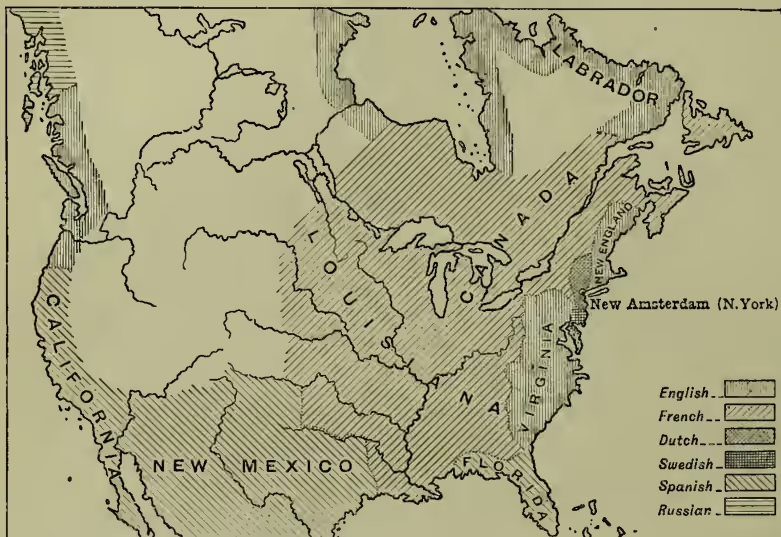
The government of the Restoration adopted the colonial policy of its predecessors, and restricted colonial trade as much as possible to England and to subjects of the English crown; thus, certain goods could be exported only to England in English or colonial ships. The country bordering on the Hudson and Delaware rivers had been settled by the Dutch and Swedes, and was now in the hands of the Dutch. It was impossible to enforce these navigation laws under the circumstances, and the conquest of the Dutch colonies was resolved on and accomplished in 1664—though for a few years they again came under Dutch control. They were finally surrendered to England in 1674. Even before the conquest Charles II. granted these Dutch colonies to his brother James, Duke of York and Albany; and James, with the Stuart love of giving, re-leased a valuable portion of it to two of his friends, Berkeley and Carteret, who were also among the grantees of Carolina. In honour of James, the Dutch settlements, when conquered, the government of Massachusetts until 1820. In 1643 four of these colonies, Massachusetts, New Plymouth, Connecticut, and New Haven, joined together for mutual convenience and defence, under the name of the United Colonies of New England.
In 1624 the Virginia charter, by one of those arbitrary acts common during the Stuart period, was annulled, and the colony thus became a royal province. Little change seems to have been made in the government of the province, but one king after another granted away land which had been included within its charter limits. The first of these grants in point of time was made by Charles I. to his former secretary, George Calvert, first Lord Baltimore, who was a Roman Catholic. Before the patent was actually issued George Calvert died, and it was issued to his son Cecil, Lord Baltimore (see MARYLAND). Calvert's design seems to have been to found a landed estate for his family and an asylum for his fellow Roman Catholics. In both these designs he was successful, and the Baltimore family derived revenue from the province until the time of the American revolution. A toleration act for Maryland, the first in the history of the English race, was passed in 1650 by an assembly composed of both Protestants and Catholics.
During the great Civil War and Commonwealth periods immigration into the Puritan colonies almost ceased; indeed, at times the movement seems to have been the other way. Beyond requiring an acknowledgment of allegiance and obedience to the navigation ordinances, the Puritan rulers of England left the colonies to themselves, and for some half-dozen years all the colonies enjoyed self-government.
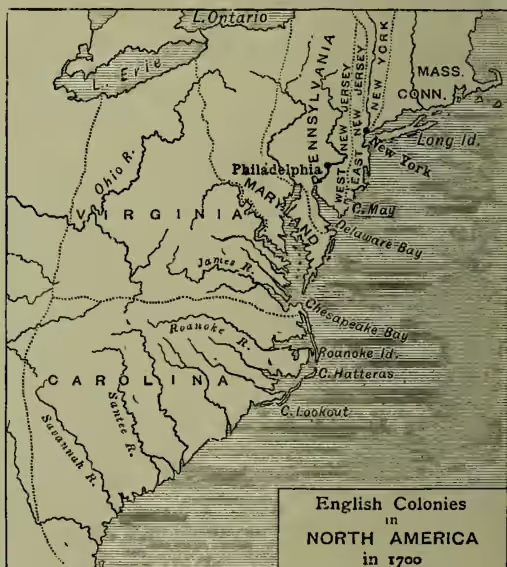
With the restoration of the Stuarts there came a revival of the colonising spirit. In 1663 Charles II. granted to Clarendon and other courtiers a vast tract lying south of the settled portions of Virginia, under the name of Carolina. The grantees attempted to introduce a fantastic form of feudalism (see NORTH CAROLINA), but the colonists would have none of it. Early in the 18th century the were called New York; while in commemoration of the fact that Carteret had held the island of Jersey for the Stuarts during the Civil War the portion given to him and Berkeley (1664) was called New Jersey. In 1674 these grants were renewed. New York was thus a conquered province, and the people there had none of the privileges enjoyed by the people of the colonies which had been originally colonised by Englishmen.
The governors of New York, sensible of the grave error of the grant of New Jersey, placed all possible obstacles in the way of the grantees, and before long the property came into the hands of a syndicate of Quakers, at the head of which was William Penn. Trouble continued with New York, and the Quakers became involved in innumerable disputes about land and matters of local government. To avoid further complications the jurisdiction was surrendered to Queen Anne (1702). For a time New York and New Jersey had the same governor, though separate legislatures. In 1738 a governor was appointed for New Jersey, and thus it became a separate colony, remaining so until the revolution. William Penn does not seem to have been disturbed by the disputes of the New Jersey Quakers. He obtained from the king, in 1682, a large tract of land on the west side of Delaware, under the name of Pennsylvania (see PENN). He also obtained from the king and the Duke of York the Swedish-Dutch settlements on the western side of Delaware Bay, south of Pennsylvania. There was a long and bitter dispute between Penn and his heirs and the Baltimores as to the boundary between their possessions. A compromise was made in the middle of the 18th century, the present boundary line being run for some distance by two English surveyors, Mason and Dixon (see MASON AND DIXON'S LINE). For a century this line, known by their names, was regarded as the boundary between the north and the south. As the matter was finally determined in 1703, Pennsylvania and the lower counties on Delaware Bay had each its own legislature, but one governor. At the revolution, however, the counties set up for themselves as the state of Delaware.
The last colony to be planted was Georgia (1732). It had its origin in the philanthropic instincts of Oglethorpe, and the desire of the English government to push the southern boundary against the Spaniards. The philanthropists, however, were not good governors; one by one their schemes failed, and in 1751 they voluntarily surrendered the colony to the crown.
Toward the end of the Stuart period a scheme of colonial consolidation was set on foot. The idea seems to have been to form two or three strong colonies, governed directly from England, out of the thirteen free, weak, self-governing colonies. Charters were annulled, and all the colonies north of 41° N. lat. were formed into the dominion of New England, with a capital at Boston. Andros was appointed governor, with executive, judicial, and legislative powers, the people no longer having any political power. But the arrangement did not long continue; on the news of the landing of William of Orange at Torbay the people of Boston rebelled, captured Andros and other officials, and sent them to England for trial. Rebellions occurred also in New York (Leisler's rebellion) and in Maryland (Cooke's Association).
The new English government adopted a policy of compromise. The old forms of government were generally restored, except in Massachusetts; but as an offset to these concessions the trade of the colonies was still further restricted to England. Massachusetts, which now included New Plymouth, was given a modified charter government. Under this new charter the governor was to be appointed by the crown, the House of Representatives elected by the people on a property qualification, and the council appointed by the two jointly. The governor's salary, and the salaries of the other officials, were to be paid by the Assembly. Thus the Assembly really ruled; but there were always so many disputes of one kind or another that the Massachusetts people became accustomed to opposition and schooled in political methods.
The colonies shared in the good and evil fortunes of England in the great struggle with France, which began in 1690 and continued until 1763. The earlier conflicts have little interest at the present time. But in 1745 the New Englanders, with some slight assistance from the English, besieged and captured Louisburg, on Cape Breton Island. At the close of the war, however, Louisburg was given up to France. In 1754 trouble began anew; the French endeavoured to connect their possessions in the St Lawrence valley with their settlements on the Mississippi by a chain of posts and towns on the Ohio River and its affluents. This brought France into contact with Pennsylvania and Virginia. The governor of Virginia at that time was a Scot named Dinwiddie. He sent a formal protest against the French occupation of Fort Duquesne, at the confluence of the Monongahela and Alleghany rivers. The French paying no regard to this protest, Dinwiddie attempted to drive them out by force; but the campaign ended in disaster, Washington, the Virginia commander, and his little army being obliged to surrender at Fort Necessity. The war begun in this way soon spread over the whole frontier, and before long nearly all the nations of western Europe became involved in the struggle. In 1755 General Braddock was defeated near Fort Duquesne by the French and their Indian allies. Later, though, the fort was captured. But the principal interest in this war was in the north, where the English attempted to invade Canada by the line of Hudson River, Lake Champlain, and Lake Ontario, and towards the north-east by way of the lower St Lawrence. In 1758, after serious resistance, Louisburg was again taken from the French, this time by an English army commanded by Amherst and Wolfe. The next year Wolfe, with a strong fleet and army, sailed up the St Lawrence, and after a long investment placed his army on the Plains of Abraham, on the northern side of Quebec, just outside the walls, and there defeated the French under Montcalm. Both Wolfe and Montcalm were mortally wounded during the action. After many defeats the English penetrated by the line of Hudson River, and in 1760 captured Montreal, and thus secured the safety of Quebec. In 1763, by the peace of Paris, France gave up Canada and all her claims to lands east of Mississippi and north of Florida to England, with the exception of some small islands in the Gulf of St Lawrence and the island of New Orleans at the mouth of the Mississippi. At the same time she ceded to Spain, as the price of her unavailing assistance in the war, all her claims to lands west of the Mississippi and to New Orleans and the island on which it stands. Spain ceded to England all her claims to lands east of the Mississippi, with the exception of New Orleans; and England, on her side, restored what she had conquered in the West Indies to France and Spain, and relinquished whatever claims she might have had to lands west of the Mississippi. By a proclamation issued in the same year the king still further restricted the limits of those colonies to the Alleghanies. The Indians, formerly subject to France, proved hard to manage; a rebellion, led by Pontiac (q.v.), in 1763, convinced the English government of the necessity of keeping on foot in the colonies a force of regular troops. It seemed right that the colonists should bear a part of the burden their support entailed; and by act of parliament, therefore, a stamp-tax was laid on all the American colonies (1765). The tax was equitable enough, and it was fair that the colonists should bear a part of the burden of their protection. It did not seem right, however, that they should be taxed by an assembly 3000 miles away, in whose election they had had no voice, and whose members were not in any way responsible to them. At about the same time parliament also amended the Trade Laws in the direction of efficiency and simplicity, making them easier of enforcement. The points in dispute are illustrated by the arguments of James Otis of Massachusetts against Writs of Assistance (warrants authorising the holders to search for smuggled goods), and of Patrick Henry of Virginia on the legality of the king's veto of an act of the Virginia Assembly. Neither had any law whatever on his side; they based their arguments on the broad rights of the colonists as men and subjects of the English crown. Resolutions embodying the same ideas were passed by the Virginia Assembly during the Stamp Act troubles and at Henry's suggestion. So general was the opposition to the act that when the day arrived on which it was to go into operation not a stamp could be anywhere purchased. The judges even were obliged to proceed without stamps, and the customs officers to give clearances which were unlawful on their very faces. There was a change of government in England at this time, owing to the king's dislike of George Grenville, and the Rockingham Whigs came into office. Partly to discredit their predecessors, partly to conciliate Pitt (the elder), and partly because they could not help it, the Stamp Act was repealed. Pitt had a whimsical notion that parliament, though unable to levy direct taxes on the colonies, possessed nevertheless complete legislative power, and a declaratory act to that effect was passed. The colonists soon saw the futility of this distinction, and opposed the Townshend duties on glass, tea, and paints imported into the colonies. Finally, when an attempt was made to force the tea upon them, they threw it overboard or stored it in damp cellars. Parliament then suspended the charter of Massachusetts, and closed the port of Boston (q.v.).
The other colonies took up the cause of Boston and Massachusetts. The contest was really for self-government for America; the Americans maintaining that they were the equals of Englishmen living in England—not their subjects. Furthermore, they said they were not and could not be adequately represented in parliament, and hence could not be bound by its votes; the colonial assemblies represented them. These and other reasons for taking up arms were embodied in a Declaration of Independence, July 4, 1776, which was in reality the platform of the Radical party. The English view, on the other hand, was that parliament was the supreme legislative body of the whole empire, while the colonial assemblies were merely subordinate legislatures.
The contest began with the skirmishes at Lexington and Concord on April 19, 1775, followed by the battle of Bunker Hill on 17th June of the same year. From that time until March 1776 the English army was blockaded in Boston by the New England farmers, before long headed by Washington (q.v.). Finally, however, the English were obliged to evacuate Boston, and the war drifted away from New England. The British plan was to conquer and occupy important towns like New York and Philadelphia. Washington's idea, on the contrary, was to preserve his army. This he accomplished in a manner to arouse the admiration of the world. The capture of a Hessian detachment at Trenton, New Jersey, in December 1776, saved the revolution from ignominious failure, and was the turning-point of the war. The next year Howe captured Philadelphia, retaining control of New York City and the lower Hudson. Washington was obliged to retire inland to a strong position among the hills named Valley Forge. In 1776 General Burgoyne attempted to seize the line of the Hudson River, marching southward from Canada. From a military point of view this plan was an admirable one, but it left out of account the unanimous resistance of the inhabitants of New England and the people of northern New York. Burgoyne's advance was delayed in every possible way, and by the time he reached Saratoga his light troops had been destroyed at Oriskany in western New York and at Bennington in Vermont. Surrounded by the farmers of New England and New York, unable to go forward or to go backward, he surrendered, October 19, 1777.
The French, now convinced that the colonies could hold their own, entered into an alliance with them in 1778. In 1780 Clinton with a strong army sailed southward from New York, landed on the South Carolina coast near Beaufort, besieged Charleston on the land side, captured it, and overran the seaboard. He then returned north, leaving Cornwallis to continue the subjugation of the south. An army sent by Washington to oppose him was defeated at the battle near Camden in the same year, the commander of the Americans being the same Horatio Gates who had commanded the Americans during the Saratoga campaign. In the autumn of the same year, however, General Nathanael Greene took command of the American resistance to Cornwallis. In October 1780 the English irregular troops were routed at King's Mountain by the frontiersmen of Kentucky and Tennessee. In January 1781 Greene's lieutenant, Daniel Morgan, destroyed or captured Cornwallis' light troops, under Tarleton, at the Cowpens, and escaped with his prisoners. Cornwallis then pursued Greene across North Carolina to the Virginia line, but on March 15 Greene and Cornwallis fought a bloody battle at Guilford Court-house, in which Greene was defeated. Cornwallis, however, leaving his sick and wounded to the care of the Americans, repaired to Wilmington on the seaboard, while Greene, after following him for some distance, marched to South Carolina, and in two campaigns cleared the interior of that state and of Georgia of English troops. Unsuccessful as he was at Guilford Court-house, nevertheless Greene won the southern campaign. Cornwallis from Wilmington marched northward into Virginia, and fortified a strong position on the York River at Yorktown.
Clinton, called back from his southern conquest by the arrival of a French fleet and army at Newport, accomplished little except to hold that army at Newport. In 1781, however, a strong French fleet under Comte de Grasse came north, bringing with him another strong French force. Washington and Rochambeau, the French commander, had agreed to co-operate with De Grasse, and a few days after De Grasse's arrival at the Chesapeake the allied army reached the head of that bay, and before long closely besieged Cornwallis at Yorktown. De Grasse with his fleet preventing reinforcements reaching Cornwallis from New York. He surrendered on October 19, 1781. In England the Whigs again came into power, and in September 1782 the preliminaries of peace were concluded at Paris, although the definitive treaty was not signed until a year later.
The colonists were then living under a constitution known as the Articles of Confederation. The government of this confederation could exert no pressure on individuals; it dealt only with the states, and was at their mercy. This marks the farthest limit of the particularist movement. The old western boundary of the colonies had been the Alleghanies; but the United States by the treaty of 1783 acquired all the land to the Mississippi. Did this land belong to the nation as a whole, or to the states to whom the king might at one time have granted it when they were colonies?
The whole future of the country rested on the decision of this question. If the management of this splendid domain was undertaken by the United States as a whole, nationality and union were inevitable. The states having claims to these lands gave them to the United States. In 1787 congress passed an ordinance for the government of the territory of the United States north-west of the Ohio. By this it was provided that the settlers of this territory should possess all the rights of the people of the older states, and should have and exercise self-government as soon and to as great an extent as convenience permitted. As soon as any portion of this territory should have a population of sixty thousand it might be admitted to the Union on the same terms as the older thirteen states. These new states were to be admitted as of right to a position of equality with the older states. Thus, for the first time in the world's history, a nation resolved to treat its colonists on equitable terms, giving to them the rights it had claimed for itself. As territory after territory was acquired by the United States the same principles of right were applied, and now the United States comprises forty-five equal co-ordinate states, living peaceably together as one nation.
The Articles of Confederation were inadequate to these new problems. A convention of leading men was held at Philadelphia in 1787, which drew up a constitution. After much opposition it was ratified, and went into force in 1789, and is still the organic law of the United States. The constitution has lived long and worked well because it is based on the experience of the thirteen colonies in self-government, and is elastic enough to be able to adapt itself to changed conditions to almost any extent. It is elastic because the expressions used to define the powers granted by the people to the central government are so vague that their meaning really depends on the decision of the Supreme Court; and experience has shown that that court will ultimately interpret the constitution as the people wish. In addition, the constitution contains a provision for its own amendment; but the process is very cumbersome, and, as a matter of fact, out of over seventeen hundred amendments formally proposed only fifteen have been adopted.
A contest between the large states which wished apportionment based on population and the small states which wished the states to have an equal vote ended in a compromise, by which each state has an equal vote in the Senate, while representation in the House of Representatives is based on population. The House is newly chosen every second year, while only one-third of the Senate is changed each second year. It thus may take six years to change the majority in the latter body. The senators are chosen by the state legislatures, the representatives in districts by the direct vote of those who have the right to vote for the members of the lower house of the state legislature. The House has control of money bills, while the Senate acts in many ways as an advisory council to the president. These arrangements have resulted in the preservation of state lines and local self-government, and also in the representation of wealth and position on the one hand, and of the mass of the people on the other. Furthermore, the House yields readily to the popular will, while the Senate remains firm for a sufficient length of time to allow the people to think the matter over. If the people wish anything for four or six years, the majority of the Senate will change to conform to the will of the majority of the people. The president is elected for an intermediate period of four years. In this way it often happens that the president and one House will be on one side of a question, the other
House being on the other. So far all these things have made for stability.
The provision of the constitution which has attracted most attention is that providing for a supreme court, composed of judges who hold office during good behaviour, and whose salaries cannot be diminished while in office. The jurisdiction of this court is almost all appellate. It has almost no dealings with the other branches of the government. If a case involving the constitutionality of a law comes before it, it decides the matter, and if the act is declared to be unconstitutional the federal courts will not enforce it. The Supreme Court can also by writ bring before it any decision of a state court denying the validity of a federal law.
George Washington was unanimously elected first president, with John Adams as vice-president. The American Revolution is ordinarily regarded as ending in 1783. But a far greater revolution than the overturning of the power of England and the substitution of a federative form of government now took place. American society in 1789 was essentially aristocratic, and so were politics. In every state there was a property qualification, and, as the right to vote for national officers depended on the right to vote for state officers, it followed that only those possessing property could vote for national officers. And so with everything else, American society and institutions were still essentially English. But the opening up of new countries beyond the Alleghanies, the feeling of independence to which the cutting loose from England gave rise, and, above all, the confidence in the future which the new government inspired, all combined to turn the thoughts of the people toward greater rights for the individual.
This great movement was led by Thomas Jefferson, the Secretary of State, who as far back as 1774 had asserted that governments are founded on truth and justice, and on the rights of men. Jefferson now proposed to give practical effect to these views of the early revolutionary period, and to found, in fact, a government by the people, of the people, and for the people, based on truth, justice, and confidence. At the other extreme was Alexander Hamilton, Secretary of the Treasury, who distrusted men in the mass, looked on them as reasoning not reasonable beings, and wished to found a strong national government to which all of what seemed to him the stronger elements in society should turn. For the time being Hamilton and the Federalists were in the ascendant, Jefferson and the Anti-Federalists being discredited by their opposition to the constitution. There was nothing incompatible between nationalism and democracy. Indeed a strong government based on democracy was and is the only possible government in the United States. But Hamilton was not broad enough to see this, and Jefferson was perforce obliged to use the opposition or particularist party as his ally.
In order to attach the moneyed classes to the national government Hamilton and the Federalists introduced scheme after scheme for the advantage of capital. A protective tariff bound the manufacturers to the central government, while a United States bank bound moneyed interests to it; the funding of the debt and the assumption of the state debts created a large national debt, enriched the speculative classes, and bound the holders of the debt to the central government. For the rest, Hamilton and the Federalists organised the working departments of the government essentially as they exist to-day.
Probably no other man could have given the new government so good a start as Washington. His very presence at its head gave to it a dignity and stability which only years of successful administration could otherwise have secured. Washington saw clearly that his most useful work would be to give the country a strong, quiet government, thus gaining time for the constitution to acquire a place in the hearts and traditions of the people. Therefore he endeavoured to keep the country out of all foreign complications, while at the same time he secured the navigation of the Mississippi from Spain, and commercial privileges from England. The French Revolution, however, forced him, as well as other rulers, to take sides.
Like Charles James Fox and other liberal-minded Englishmen, Jefferson sympathised warmly with the ideas and aims of the early leaders of the French Revolution, and underestimated the fickleness and instability of the French people. When the Revolution assumed its propagandist character, and war with England followed, the revolutionists expected to gain sympathy and assistance from the Americans, whom they persisted in regarding as owing France a debt of gratitude for aid in the American Revolution—the fact being that France had then used America as a cat's-paw, and had deserted her at the time of negotiations for peace. The sympathies of the people were with France, but it was a question which divided parties as to how far this feeling should guide the country's policy. Washington decided that the only safe policy for the new nation was one of strict neutrality, and time has justified his conclusion. But Jefferson retired in disgust from the government, and the Federalists soon obtained full control. At the end of his second term Washington declined re-election, and John Adams was chosen president. He inherited not only Washington's policy but his official advisers, who looked to Hamilton, though he was no longer in the cabinet, as the head of the party. Washington's firm hand withdrawn, the country rapidly drifted toward war with France, whose government insulted the Americans by demanding money as the price of peace. A provisional army was set on foot with Washington at its head. But an opening presenting itself, Adams renewed negotiations for peace, and Napoleon, now at the head of the French government, concluded them. This was perhaps the most high-minded and patriotic act of John Adams' whole career; but it lost him the support of his party.
Among the acts of the Federalist majority at this period were the Alien and Sedition Laws, giving the government for a limited period power to deal with foreigners resident in the country, and with those who publicly opposed the acts of the government. It happened that most of the Republican (q.v.) or Jeffersonian journalists were foreigners, and the Republicans, declaring these acts aimed against themselves and their friends, caused the legislatures of Kentucky and Virginia to pass resolutions setting forth the particularist theories as opposed to the nationalist theory of the Federalists. But there the matter rested.
In the election of 1800 the nominees of the Republican party obtained the majority of the electoral vote. Each elector then voted for two persons without specifying which was his choice for president, and Jefferson and Burr had an equal number of votes. No man ever doubted that Jefferson was the person intended to be president. It became the duty of the House of Representatives, in which the Federalists had a majority, to designate which should be president. In their desperation and hatred of Jefferson they determined to elect Burr. In this they failed; but by thus attempting to thwart the will of the people the Federalist party lost the confidence of the people and sank into comparative insignificance. The contest also resulted in an amendment of the constitution, empowering the electors to vote for one man as president and another man as vice-president. Jefferson once in power immediately did away with the ceremonial of official intercourse which had meant so much to Washington and Adams. The one great accomplishment of his two administrations was the purchase of Louisiana, or the western part of the basin of the Mississippi, from France (1803) for about 15 million dollars. This purchase was plainly not authorised by the constitution; and, indeed, for a time Jefferson thought an amendment would be necessary. In 1812 the southern end of this great acquisition was admitted to the Union as the state of Louisiana.
With the renewal of the war between England and France in 1803 came a renewal of the troubles of the United States, now the only neutral nation possessing ships. In the course of time England declared the ports of western Europe blockaded, while Napoleon on his side issued decrees declaring the ports of the Continent closed to English ships and produce, and to ships which had touched at English ports (see CONTINENTAL SYSTEM). To these restrictions Jefferson opposed only counter restrictions, so that the carrying trade was attacked from three directions at once. Portions of the country were ruined, and Jefferson closed his second term, in 1809, amid difficulties of the most serious kind at home and abroad.
James Madison of Virginia, long Jefferson's right-hand man, succeeded him; and was re-elected in 1812. The irritation against the foreigners now increased rather than diminished. With England there was still another cause of dissatisfaction. England claimed and exercised the right to search American vessels for deserters from the English navy and for other British subjects. There were without doubt many deserters, but the right of search was founded on a wrong principle, and besides it was impossible to distinguish between an American and an Englishman. Thousands of Americans were seized and forced to fight for England. Congress was now in the control of a party eager for war with England, and war was begun in 1812. The Americans attempted to invade Canada by the line of Lake Champlain and of the St Lawrence valley, and were driven back. On the water, however, the Americans were almost uniformly successful, the frigates Constitution, President, and United States capturing English vessels of their own class. On the other hand, an English ship, the Shannon, captured the American frigate Chesapeake off the harbour of Boston. In August 1814 the British captured the city of Washington, burned and destroyed the public buildings there, and attacked the city of Baltimore, but were driven back. In December 1814 this war was concluded by the treaty of Ghent, which was signed twenty-five days before General Jackson repelled a most gallant attack of the British on New Orleans. No mention was made of the right of search, or of impressment in the treaty, but they were given up. On the whole, this 'Second War of Independence' was a good thing for the United States, as it made strongly for nationality, and convinced even the most ardent friend of England of the undesirability of an English connection.
Madison's successor was James Monroe, another Virginian, of moderate abilities, but well fitted to lead the country at a time of complete cessation of party strife, known as the 'era of good feeling.' In 1819 the United States acquired East and West Florida, or all of Spanish America east of the Mississippi, at the same time abandoning whatever claims she had to Texas, California, and New Mexico. Monroe's name is also associated with the formal announcement to foreign powers of the American idea of the separation of American and European politics. This was not a new idea in any sense, but the first complete enunciation of it was by Monroe, and it is hence known as the 'Monroe Doctrine' (see MONROE).
With the end of Monroe's administration came an end to the good feeling. The Democratic party became split into factions, each following a leader, John Quincy Adams, Jackson, Clay, or Crawford. No one received a majority of the electoral vote, though Jackson received more than any one else. Nevertheless the friends of Adams and Clay in congress united and elected Adams, who now appointed Clay Secretary of State; and charges of corrupt bargains between 'the Puritan and the Blackleg' were freely made. There is no evidence of corruption, and the House of Representatives had a perfect right to elect Adams; nevertheless he began his term of office under many disadvantages. This was the period of the so-called American system of a high protective tariff, combined with internal improvements, such as the Chesapeake and Ohio Canal, begun at this time. Adams, who was cold and conscientious, refused to use the federal patronage to build up a party devoted to his interests. On the other hand, General Jackson was the idol of a majority of the people. He promised to give a good office to any one who should work for his interests; and in 1828 he was elected president by a vast majority. With the exception of the introduction of the 'spoils system' there is much to be admired in Jackson. He stood for the nation against the state, as in the case of Nullification (q.v.); for the people against the moneyed classes, as in the case of the United States Bank; for the country as against foreign aggression, as in the case of France. During Jackson's time the steam-locomotive was introduced into America, one thousand miles of railroad were built in five years, and American life began to show its tremendous expanding powers.
After Jackson there came a succession of presidents whose names are scarcely worth remembrance. The interest now turns slowly but surely toward the struggle between the North and the South, which led ultimately to war, and to the destruction of the 'Old South.' The sole cause of this divergence was negro slavery, or better perhaps the belief that the cultivation of cotton required unfree black labour. Slavery had existed in all the original thirteen states from the early times. In the North it was not profitable, except in one or two places, and was dying out in 1780. In the South, by which is meant the country south of Mason and Dixon's line, slavery had not been of very much account, except in South Carolina and Georgia, where the malarial rice swamps seemed to require negro labour. The Virginia leaders were against slavery, and expected to see it disappear in the South as it was disappearing in the North. It was unfortunate that the constitutional convention of 1787 did not hold out on these points, and provide for the extinction of slavery whenever the majority of the people of the whole country desired. But what seems plain now was not plain then; slavery was favoured in the constitution, and the slave-owner given more than his proportion of the representation in the House of Representatives. In 1794 Eli Whitney discovered a way by which the cotton fibre and seed could be separated by machinery. This alone made the cultivation of cotton on a large scale profitable, and, combined with great inventions in the art of spinning and weaving in England, enormously stimulated its production, and negro slavery was fastened on the country. As time went on the North became a great manufacturing as well as an agricultural country; cities multiplied, population became denser, and the whole mode of life of pre-revolutionary days underwent a complete and radical change. In the South the old life was in many ways intensified. The two sections thus grew apart.
At first the South, and South Carolina most of all, was very nationalistic. But as time went on and a protective tariff was framed to stimulate manufactures, the South turned completely round. It had no manufactures, and would receive no benefit from this tariff, and many things would be increased in price. It was therefore proposed, somewhat in line with the views of the early Republicans and of the New Englanders during the war of 1812 (see HARTFORD CONVENTION), to declare the disliked law null and void so far as South Carolina was concerned—that is, to nullify it. Jackson, who was then president, met this issue squarely, and an act authorising him to use force was passed. The nullification was suspended, and the whole matter was compromised.
The ordinance of 1787 prohibited slavery in the new territory north of the Ohio, and as states came into existence there this prohibition was carried out, slavery being the custom in the territories and states south of that river. When Louisiana was bought a new element at once came in. Slavery existed in the regions around New Orleans and St. Louis. Louisiana and the country around New Orleans was admitted as a slave state in 1812. But when Missouri or the country dependent on St. Louis applied for admission, the case was somewhat different. Finally a compromise was made to the effect that Missouri should be a slave state, but the remainder of the Louisiana purchase north of its southern boundary (36° 30') should be forever free. This was the Missouri Compromise of 1820, and for twenty years it postponed the inevitable conflict.
The United States had acquired by the Louisiana purchase some vague claim to that territory lying between the Sabine, Rio Grande, and Arkansas rivers. This territory, or at all events a portion of it, was known as Texas, and was sparsely settled, mainly by adventurers from the southern states; but slavery was not allowed there by the constitution of Mexico. In 1836 Texas revolted from Mexico, and established a republic. The South cast longing eyes on Texas—the Texans to a great extent were their own folk, and their country would add to the territory suited to slavery. In 1845 Texas was annexed or re-annexed to the United States, and admitted as a state. A dispute with Mexico at once arose as to its western boundary. General Zachary Taylor was ordered to seize the territory in dispute, and war with Mexico followed. In May 1846 he crossed the Rio Grande, and won the battle of Buena Vista. Frémont and others seized and held during the war the country on the Pacific slope now known as the state of California, to which the United States had no claim whatever. In March 1847 General Scott landed on the Mexican coast near Vera Cruz, captured that fortified seaport, and placed his army on the high lands toward the interior. In the autumn he marched towards the city of Mexico, defeating the Mexicans under Santa-Anna in battle after battle, the most important being Cherubusco and Chapultepec, and capturing the city of Mexico. By the treaty of Guadalupe Hidalgo (1848) this war was ended, Mexico ceding to the United States all that the latter had claimed or had seized, comprising the southern and western portion of the state of Texas, New Mexico, the lower part of Arizona, and California. The United States agreed to pay Mexico over fifteen million dollars, and to pay in addition about three million dollars due from Mexico to citizens of the United States. In 1853 this acquisition was rounded out by the 'Gadsden Purchase' of a small strip on the south-western line. The
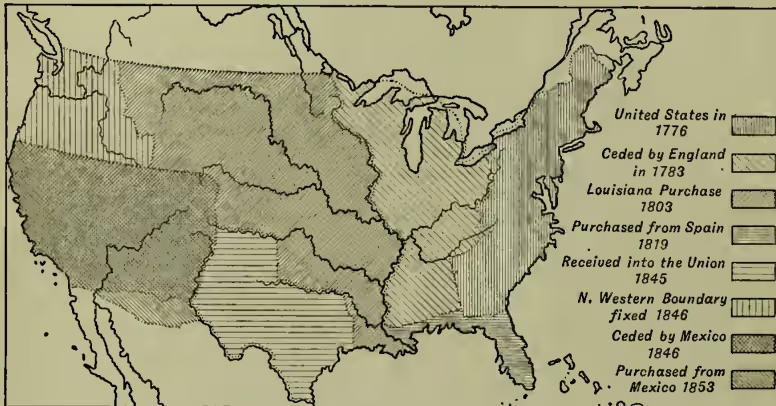
North was in part compensated for this great increase of probable slave territory by the acquisition of that part of Oregon lying south of the 49th parallel, to which the United States had various claims. It was decided to let the people of each portion of the territory acquired from Mexico settle the question of slavery for themselves: this was called 'squatter sovereignty,' though the phrase may not have come into common use until about 1854. In 1850 California, to which the discovery of gold had attracted a rush of immigrants, was admitted as a non-slave state. To pacify the South, the Fugitive Slave Law (q.v.) was passed, which directed the Federal authorities to return slaves who had escaped to the North. The execution of this act first awakened the people of the North to the gross evils of slavery, and the abolitionists, who had been in existence since 1830, now began to make converts.
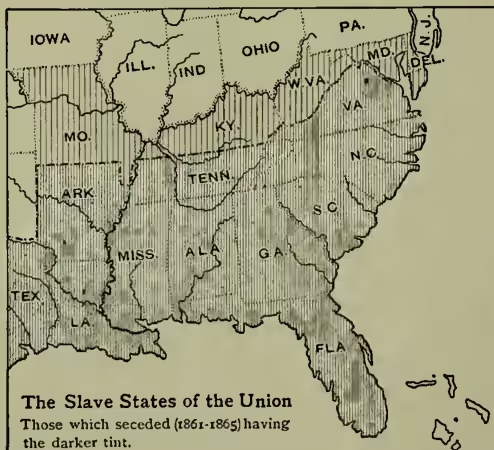
In 1854, in defiance of the Missouri Compromise, the principle of 'squatter sovereignty' was applied to the two great territories lying north of 36° and as far as 30°—Kansas and Nebraska. The spirit of the North at last was aroused, anti-slavery men poured into Kansas (q.v.), waged war against the slave party there, and organised the state on a non-slave basis—though it was not admitted as a state until 1861. This struggle led to the formation of a new party in the North opposed to slavery, with democracy at the bottom and nationalist in spirit. This party adopted as its name that of Jefferson's old party, Republican, and grew with marvellous rapidity. In 1856 a presidential election was held; the Democratic candidate Buchanan was elected by a majority of the electoral vote, but Frémont, the Republican candidate, had a large popular vote. In 1856-57, in his opinion on the Dred Scott Case, (q.v.), Chief-justice Taney stated, among other things, that a slave, or the descendant of a slave, could never be a citizen of the United States, and that the Missouri Compromise was unconstitutional. In 1860 the Democratic party was split into two sections, the southern or ultra-slavery Democrats and the northern or conservative Democrats. The southerners demanded the recognition by the party of the duty of congress to protect slavery; the northern Democrats could not possibly agree to this. In the face of a divided party, the Republicans elected their candidate, Abraham Lincoln, president. The North was now much stronger in population and wealth, and growing stronger every day. If the South re- mained in the Union it would soon be at the mercy of the North. The extreme southern states determined to secede; hoping, no doubt, that the North-west and California would either join them or remain neutral. But the newer states had been largely settled by foreigners, to whom the United States had been a star of hope for many years, until frugality enabled them to emigrate thither. They had no state pride, but were intensely loyal to the country which had received them and given them a chance in life.
The North-west, California, and after a struggle Missouri, Kentucky, and Maryland cast in their lot with the North and East: about eight or nine millions in the South stood against twenty or twenty-two millions in the North, with the resources of wealth and increased production on the side of the latter. The people of the South, however, were bred to command and to the handling of arms. From the first the government of the southern confederacy was despotic in practice. Such resources as it possessed were, therefore, at once used with effectiveness, while the North, unused to arms, and accustomed to do everything by committees or boards, and comparatively ignorant of war, was unable to make good use of its resources for at least two years. At first everything went against the North, and for a while it seemed as if it would be obliged to fight England and the South at the same time. This was due to the seizure and removal from a British vessel of two southern political agents on their way to Europe (see TRENT AFFAIR).
In the beginning the sympathies of France, and still more of England, were on the side of the South. This was due in some measure to political and sentimental reasons, but in the case of England, at least, it was due partly to the cotton famine which followed the closing of the southern ports by the northern naval forces. In January 1863 President Lincoln, by proclamation, declared the slaves in the part of the South then in rebellion free. The character of the struggle was at once changed in the eyes of foreigners, and the sympathy of the outside world turned gradually to the North. Nevertheless the southern agents in England were able to fit out a vessel, the Alabama (q.v.), to destroy the northern shipping interests.
In April 1862 Admiral Farragut captured New Orleans on the Lower Mississippi, and on July 4, 1863, General Grant captured Vicksburg, which commanded the navigation of the middle course of the river. In this way the Confederacy was cut into two parts, and the control of the great stream was in the hands of the North from source to mouth. After the defeat of the Army of the Potomac at Chancellorsville, May 3, 1863, the Confederates attempted for a second time an invasion of the North. The Union army, now commanded by George G. Meade, met them at Gettysburg in south-western Pennsylvania, and on July 1, 2, and 3, 1863, after a most stubborn and bloody conflict, forced them back. Gettysburg and Vicksburg were the turning-points of the war. Soon after Grant was placed in command of all the armies of the United States, and for the remainder of the war operations were conducted on a systematic plan. General Meade retained command of the Army of the Potomac, to Sherman being confided the operations in Tennessee and Alabama. On September 2, 1864, Sherman entered Atlanta, Georgia. Sending a portion of his army back under General Thomas, he marched from Atlanta to Savannah on the Atlantic seaboard, and then turning north carried his army to Goldsboro. Thomas performed his work admirably, destroying the last army of the Confederates in the west at the battle of Nashville in December 1864. Meantime Grant with the Army of the Potomac, under the direct command of Meade, advanced towards Richmond, fighting the terrible battles of the Wilderness, Spottsylvania, and North Anna, and besieged the Confederate army in the lines of Petersburg. The siege lasted through the winter of 1864-65. Grant continued to extend his lines towards the south and west, thus cutting the Confederates off from their source of supplies. On the 2d of April the Confederates broke out through Petersburg, and attempted to escape towards the south and west. By almost superhuman endeavours Sheridan placed his cavalry and an infantry corps across their track, and on April 9, 1865, the Confederate army of North Virginia surrendered at Appomattox Court-house, and about two weeks later the last Confederate army which had been confronting Sherman surrendered. President Lincoln was assassinated during the closing days of the war. The war had cost the nation some $10,000,000,000 and the lives of some 600,000 men, besides perhaps as many more wounded. But it had settled the question whether the United States was a nation or merely an aggregate of nations, and had rescued the South from the incubus of slavery. The seceded states were again taken into the Union, on conditions contained in the 13th, 14th, and 15th amendments to the constitution, abolishing slavery, and giving the negro the right to vote. It cannot be said that these conditions have accomplished their object, as the negro vote is in one way or another completely neutralised, while at the same time the South retains a representation in the House of Representatives based on its total population.
In 1867 the United States purchased Alaska from Russia, the principal result of which up to the present time has been recurring complications with Great Britain as to the right to capture Seals (q.v.). The nation found it difficult to settle down to peace after the war. The army was easily disbanded, although an organisation known as the Grand Army of the Republic was formed, and the 'soldier's vote' is an element with which the politicians annually reckon. Enormous sums of money have been paid for pensions—about 150 million dollars in one year (1891). Another legacy of the war was the tendency towards corruption and the formation of 'rings' throughout the states and cities, as well as in the national government. The South is rapidly becoming a prosperous manufacturing community. A great reform has been made in the civil service towards the overthrow of the spoils system of Jackson; and the greater part of the national debt has been paid off. From Lincoln onwards till 1884 the presidents (see list at PRESIDENT) had all been Republicans—Johnson, Grant, Hayes, Garfield, and Arthur. In 1884 the reconstituted Democratic party elected Cleveland over Harrison. In 1888 the Democrats made the campaign on a basis of a reformed tariff, in the direction of less protection. The Republicans won, Harrison becoming president; and by the McKinley Bill and other measures reformed the tariff in the direction of greater protection. Trusts and combinations of capitalists everywhere resulted; while the relations of labour to capital became strained. Laws were passed excluding Chinese labour and rendering difficult the landing of paupers and of aliens under contract. In 1891 a House overwhelmingly Democratic was elected. In 1892 the contest again turned on tariff, and the elections resulted in the return of the Democratic candidate, Cleveland, by a very large majority over Harrison. The Sherman Silver Act (superseding the Bland Act) was repealed in 1893; in the same year the Behring Seals Arbitration promised the settlement of a persistent source of difficulties with Britain. A commercial crisis was marked by the rise of the 'Populists' (see GRANGERS), and a great march on Washington of the unemployed, as also by labour riots in Chicago. President Cleveland's intervention in the dispute between Britain and Venezuela (December 1895) implied an extension by Mr Olney of the 'Monroe Doctrine,' and threatened trouble, obviated by arbitration. A scheme for settling all difficulties between Britain and the United States by arbitration was agreed on by the President and Lord Salisbury, much altered in the House of Representatives, and rejected by the Senate (1896-97). In 1896 the contest, largely on the Silver question, resulted in the election of McKinley (q.v.), supported by many Democrats, over the silverite and Democratic Bryan (q.v.). McKinley's presidency was rendered notable by an increased tariff, the raising of the Behring and the Venezuela questions, the war with Spain, and the colonial expansion dealt with above (at p. 381), and the temporary settlement of the Alaska boundary (see ALASKA). McKinley was elected for another term in 1900.
The notices in this work of the various presidents and many of the leading statesmen (Webster, Seward, &c.), soldiers (Gates, Greene, Grant, Sherman, Lee, &c.), sailors (Decatur, Farragut, Porter, &c.; also Ericsson), as well as the several states and the leading cities, may be referred to, and the following articles among others:
| Abolitionists. | Fisheries, p. 648. | Negroes. |
| Agriculture. | Flag, p. 665. | Pensions. |
| Alabama (The). | Franklin. | Perfectionists. |
| Alien. | Freesoilers. | Petroleum. |
| Americanisms. | Frémont. | Pisciculture. |
| André. | Fugitive Slave Law. | Pocahontas. |
| Apaches. | Garrison, W. L. | President. |
| Arnold, B. | General. | Prisons, pp. 425-6. |
| Brown, John. | Grangers. | Privateer. |
| Bull Run. | Greenbacks. | Protection. |
| Bunker Hill. | Immigration. | Reputation. |
| Burgoyne. | Independence Day. | Sioux. |
| Canada, p. 695. | Iroquois. | Slavery. |
| Chart. | Knights of Labour. | Spiritualism. |
| Civil Service. | Know Nothings. | State Rights. |
| Congress. | Ku-Klux Klan. | Sumter, Fort. |
| Cornwallis. | Liquor Laws. | Tammany Society. |
| Cotton. | Lynch Law. | Temperance, p. 120. |
| Dairy Farms. | Modocs. | Tobacco. |
| Danites. | Molly Maguires. | Universities. |
| Democrats. | Mormons. | Vigilance Societies. |
| Dollar. | Mound Builders. | Vinland. |
| Eagle. | National Debt. | Whisky Insurrection. |
| Eliot, John. | National Hyms. | Women's Rights. |
| Emigration. | Naturalisation. | Yankee. |
The best compendious history is Gay's 'Bryant's United States.' On the earlier period the histories of Bancroft and Hildreth remain the most important connected works. For the later period the works of Henry Adams, McMaster, Schouler, Hildreth, and Von Holst should all be consulted. The historical works of Francis Parkman, Doyle, Frothingham, Brown, and Fiske may also be named; while the accounts in Lecky's England in the Seventeenth Century and Mahon's History of England are of great value. For the documents, see Federal and State Constitution, Colonial Charters and other Organic Laws, and Treaties and Conventions between the United States and other Powers, issued by the United States government. The leading works on the constitution are those of Story, Kent, Wharton, Curtis, Cooley, De Tocqueville, and Bryce. For the innumerable special works, biographies, and bibliographical details, see Winsor's Narrative and Critical History of America. And there are recent works on the history, parts of it, or on the constitution, by E. J. Payne (1892), Goldwin Smith (1893), Henry Adams (1890-92), W. M. Sloane (1894), J. C. Ropes (1894), C. Ellis Stevens (1895), E. B. Andrews (1895 and 1897), J. W. Moore (1895), Roger Foster (1896), and Professor Channing (1896).
AMERICAN LITERATURE.
In the absence of populous centres and of leisure for the æsthetic arts, the American colonist was as dependent upon the mother-country in letters as in politics. And although from the Stuart restoration there are indications of a divergence in social and political temper, which in the long-run must find expression in a distinct American literature, yet the literary emancipation of America was much slower than the political.
I. Before the middle of the 18th century there was in the colonies no literature worthy of the name. Massachusetts and Connecticut had some vigour of intellectual movement, which was controlled by men who had enjoyed the academic advantages of the English universities, or of the substitutes for these they had established in America in Harvard (1638) and Yale (1700) colleges. But it is rare that moral and spiritual earnestness have the wisdom to enlist beauty of form in their service. These good men had no perception of intimate relations between goodness and beauty. This is especially evident when they attempt verse. Their Bay State Psalm-book (1640; rev. ed. 1650) takes rank among the worst and most tasteless books of a class which abounds in such. Mrs Anne Bradstreet (1612-72) was greeted as 'the tenth Muse,' in recognition of verses which exhibit some of the faults but none of the excellences of the fanciful school of Donne and Cowley.
The influence of the new English prose of Steele and Addison made itself felt slowly. It did very little for the style of Jonathan Edwards (1703-58), who was notable as a naturalist, metaphysician, and divine. Much better in point of literary form, although with just as little purpose of achieving it, is the Quaker John Woolman (1720-73), whose Journal (1774; ed. by Whittier, 1871) delighted Lamb and Edward Irving. A better representative of the prevalent temper of the colonies, and more ambitious of literary distinction, is Benjamin Franklin (1706-90). In him the thrift and shrewdness of that later day displaces the Puritan enthusiasm; and we learn from his Autobiography (1817; ed. by Bigelow, 1868) that he formed his style on the accepted models of the new English prose.
II. From the rise of Franklin into influence until the close of the second war with Great Britain Philadelphia was the intellectual and literary centre of the country, as it was the largest and most thriving centre of population. The pseudo-classic school dominated American taste, and Pope was reckoned the greatest of poets. The ambition of the most patriotic American writer was to rival the authors of the mother-country in the forms then accepted by both; and America lingered far behind in the movement for the introduction of more delicate and melodious cadences of verse.
The struggle for independence was the occasion of some strong and able writing on political topics, but of nothing whose literary quality entitles it to a place beside the speeches of Chatham and the pamphlets of Burke. Thomas Paine (1737-1809) showed himself a master of popular English to an extent which gives him rank close to Defoe and Cobbett. His style has vitality, and has done much to keep his writings on politics and religion from oblivion, in spite of their shallowness and frequent coarseness. The war did not produce a single respectable song. Philip Freneau (1752-1832) is the only patriotic lyrist worthy of mention; but his fluency and his occasional felicities have not secured him any continuous popularity. Francis Hopkinson (1737-91) wrote 'The Battle of the Kegs,' and other clever satirical skits; and his son, Judge Joseph Hopkinson (1770-1842), wrote in 1798 the first national song, 'Hail Columbia!' John Trumbull (1750-1831) applied the metre and manner of Hudibras to the chastisement of the Tories in his M'Fingall (1782), and won great popularity. The struggle over the adoption of the national Constitution in 1787-89 brought into play more ability in political writing than did the war. The first political classic of America, The Federalist, is a series of papers in which Hamilton, Madison, and Jay advocated and explained the new scheme of government. To Hamilton also is ascribed President Washington's 'Farewell Address' (1796), another political classic.
Philadelphia for a time was the seat of the new government. She had the most enterprising publishers, the best periodicals, the widest circle of readers; and her people loved to speak of her as the 'Athens of America.' Authors from other parts of the country made her their home, or sent their books to her publishers, and their contributions to her magazines. Dr Benjamin Rush (1745-1813) may be said to have continued the Franklin tradition in the same practical and tolerant spirit, and with the same regard for public utility, but with far less literary faculty. The first professional man of letters, Charles Brockden Brown (1771-1810), wrote a series of novels—Wieland (1798), Ormond (1799), Arthur Mervyn (1799-1800), and Edgar Huntley (1801)—which were republished in England, and are known to have exerted a great influence over Shelley. They belong to the dominant school of 'Monk' Lewis and Mrs Radcliffe, but are sufficiently individualised by their clear, nervous style, rising at times to eloquence, and by their power of imaginative portraiture, to claim recognition. That they were written with great rapidity explains their lack of symmetry and their defective method.
Outside of Philadelphia New England was most productive. She gave that city Joseph Dennie, editor of the Portfolio, the most important literary periodical of the time. It was in Dennie's group that Tom Moore found a congenial welcome. Dr Timothy Dwight of Yale College wrote forgotten epics, and the hymn, 'I love Thy kingdom, Lord.' Joel Barlow (1775-1812), also of Connecticut, is not remembered through either his epic of 7000 lines, The Colombiad (1808), or his humorous poem on 'Hasty Pudding.' Thomas Green Fessenden of New Hampshire (1771-1837), in his humorous idyll, 'The Country Lovers,' struck a note which may have suggested Lowell's verses, 'The Courtship.'
III. About the year 1816 pre-eminence in literature began to pass from Philadelphia to New York, just about the time when the completion of the Erie Canal put that city in the way of benefiting by the growth of the west. But the cause of the transfer is found in the superior susceptibility of a group of New York authors to the new literary influences represented by Wordsworth, Byron, and Scott, which the critics of the rival city treated with contempt.
Washington Irving (1783-1859) had already written Knickerbocker's New York (1809), the most American of his books, and the first classic piece of American humour. His residence in England in 1815-32 brought him into contact with the Romantic movement in literature. In The Sketch Book (1819), Bracebridge Hall (1822), and Tales of a Traveller (1824), he showed the new influence; and he transplanted this Romantic tendency to the New World in his tales of colonial life on the Hudson. A subsequent residence in Spain awoke his interest in the popular traditions of that country, and its history during its period of American discovery. But history and biography were not his proper work, and only his Life of Goldsmith (1849) can be called successful, while his elaborate Life of Washington (1855-59) never won a place for itself. His works widened the horizon of American literature, and raised the conception of literary form and method, but they had not the vigour required to give it permanent direction. They still delight those who appreciate the quiet beauty of their style, the lambent Addisonian humour, and their genial spirit; but they lack robustness and sympathy with the age.
No want of the American quality can be charged upon James Fenimore Cooper (1789-1851), although he also received the literary impulse from Scott. His novels, The Spy (1821), The Pioneer (1823), and The Last of the Mohicans (1826), laid the foundation of a new literature by showing the imaginative interest which attaches to the pioneer life and to the Indian character; and his naval tales, beginning with The Pilot (1823), made an impression equally vivid. He wrote too much, however, to write well, and to avoid repeating himself; and he unduly idealised both the sailor and the red man. Among his contemporary imitators are James Kirke Paulding (1779-1860), in the mass of whose satirical and whimsical works are found The Dutchman's Fireside (1831) and Westward Ho! (1832); John Pendleton Kennedy of Baltimore (1795-1870), whose Swallow Barn (1832), Horse-shoe Robinson (1835), and Rob of the Bowl (1838) show him a student also of Irving's humour, thus supplying an element lacking in Cooper himself; and William Gilmore Simms (1806-70), a South Carolina planter, who cultivated literature in an uncongenial atmosphere, with fair success.
William Cullen Bryant (1794-1878), before he made New York his home in 1825 had already done much of his best work as a poet, and had illustrated his passage from the school of Pope to that of Wordsworth. He has the English poet's contemplative sympathy with the greatness and the calm of nature; but his first-hand intimacy with her subtlest moods, his almost uniform loftiness of imagination, and his severe self-restraint forbid us to class the author of 'Thanatopsis' and 'To a Water-fowl' as any man's disciple merely. He lacked only warmth of passion and continuous growth to become the greatest of American poets, and the last he missed by making poetry only one avocation of a busy life. Less of a voice and more of an echo is Fitz-Greene Halleck (1790-1867), who imitated Byron's lighter manner in Fanny (1821), and reminds us of Scott's best verse in Marco Bozzaris (1827). Joseph Rodman Drake (1795-1820) transferred fairyland to the banks of the Hudson in his Culprit Fay (1816), and justified Halleck's fine dirge over his untimely death.
Contemporary are two groups of hymn-writers. Of those who contributed to Dr Nettleton's Village Hymn-book (1824) Mrs Lydia Huntley Sigourney (1791-1865) was a facile writer, recalling Mrs Hemans, and like her possessed of a thin vein of true poetry. To the prayer-book collection of the Protestant Episcopal Church (1826) Bishops George Washington Doane and Henry Ustick Onderdonk, Dr William Augustus Muhlenberg, and Francis Scott Key furnished original hymns of merit. The last had already (1814) written 'The Star-spangled Banner,' the florid national anthem of America.
IV. A new period begins about 1838, with the transfer of literary pre-eminence to New England, and especially to Boston, and lasts until the war for the Union. America now came into contact with other literatures than that of England, and the broader culture thus attained was accompanied with a more vigorous independence. A literary class arose, so that letters no longer were the ornament of a learned profession or secondary work of an editor. The first impulse to better things came from the study of Coleridge, which led on to that of the poets, critics, and philosophers of Germany, and thus put an end to the dominance of the sensualistic 'common-sense' philosophy of Locke. Dr James Marsh of Middlebury, Dr Channing, and Emerson were the first to show this new influence.
Like Channing, Ralph Waldo Emerson (1803-82) is more important as a personal influence and inspiration than as a man of letters. His doctrine of the sovereignty of the individual conscience met the needs of a time of general revolt against the social and intellectual traditions. He denied the validity of any lines the conscience did not draw for itself; and, although he combined with this the recognition of an Over-soul, this phase of his teaching made less impression, as the Over-soul is an impersonal something, which is at once identical with and different from the individual. After the appearance of Nature (1836) and his Essays (1841-44) his home at Concord was the centre to which pilgrims came to find his secret of lofty serenity in full view of the puzzles of the universe. His prose is vastly more important than his verse, which is uneven and often faulty in structure, but with many fine lines and felicitous phrases. His prose has been called a 'difficult staccato'; the sentences do not fuse into paragraphs, but read as if there were at the end of each a pause for a reply. Under his audacities lies the shrewdness of New England, and the homely mother-wit of his own people.
The group around Emerson, called the Transcendentalists, were of various magnitudes and qualities. Henry David Thoreau (1817-62) found in intimaey with nature an escape from the pettinesses of men; Amos Bronson Alcott (1797-1888) undertook the reform of education on the principle that all important truth was to be found in the intuitions of children; Margaret Fuller-Ossoli (1810-50), the 'Zenobia' of Hawthorne, made most impression by her conversational faculty; Jones Very (1813-80) wrote poetry 'by inspiration' during the years 1836-39. His poems, which Emerson edited, are narrow in range, but have a delicate wild-flower beauty of their own. These and others contributed to The Dial (1840-43), and most of the group took part in the famous Brook Farm (q.v.) experiment in communism.
On the outskirts of the group, as an interested and curious spectator, stood Nathaniel Hawthorne (1804-64), a religious and social conservative, with a passion for the study of the abnormal, which we may trace to his early environment at Salem, where one of his ancestors had been judge in witchcraft time. His works give us life as seen in 'the moonlight of romance,' and stand in curious contrast to his own life as office-holder and man of affairs in a world he really held at arm's length while attending to its routine. His Twice-told
Tales (1837-42) already surpassed all previous American writing in the field of prose fiction; and The Scarlet Letter (1850) secured his position as the greatest of American prose writers. His art is thoroughly idealist—character, incident, and situation being subordinate to the haunting idea of the story he is telling. His style is one of exquisite purity, delicate humour, and a genuine pathos.
Hawthorne stands almost alone as a great master of fiction at this time. Miss Susan Warner (1819-85) wrote tales which gave pleasant glimpses of life in central New York, but overburdened them with didactic elements. Mr Edmund Quincy (b. 1808) in Wensley, a Story without a Moral (1854), gave a promise which was not kept. The Rev. Sylvester Judd (1813-53) made a display of ill-regulated power in Margaret (1845), which explains Lowell's encomium of the book and the public neglect. The Rev. Robert T. S. Lowell (1816-91) in The New Priest in Conception Bay (1858) shows a command of both pathos and humour, but the polemic purpose detracts from the general interest. This is not true of a still more polemic novel, Uncle Tom's Cabin (1852), by Harriet Beecher Stowe (1812-96), which struck at slavery at its most vulnerable point, and rendered the greatest service that a single book ever did to any great cause. But as works of art The Minister's Wooing (1859) and Oldtown Folks (1869), two of her stories of New England, are superior. George William Curtis (1824-92) shows keen satiric power in The Potiphar Papers (1854), and equal beauty of fancy in True and I (1856).
Of the poets of this period Henry Wadsworth Longfellow (1807-82) filled the largest space in contemporary attention, and thus rendered the greatest service to his countrymen in awakening the love of beauty, and extending the taste for pure art to a wider circle than was reached by any other American. He is the first and chief representative in American verse of that great Romantic movement which Irving in a different way reflects in his prose. As such he was drawn to the past and the distant for his favourite themes, and echoes but faintly the life of the present. The Golden Legend (1851), a study of mediæval life, is his most perfect poem; and his version of Dante's Divine Comedy (1867) is that to which he gave longest and most loving labour. His Poets and Poetry of Europe (1845) amplified the resources of American thought and taste, while exhibiting his own cosmopolitanism. It is not surprising to find that in Kavanagh (1849) he belittles the idea of a national literature, preferring Goethe's conception of a world-literature. Even in handling American subjects he turns to Europe for metrical forms and for illustrations. But his artistic grace, and an undefinable winningness in his verse as in his temper, made his countrymen uncritical of any defects.
A greater poetic force and a wider range of movement is seen in James Russell Lowell (1819-91). A scholar of wide learning, and a luminous critic of other men's work, he yet was free from the bookish tone of Longfellow. He wrote of man and of nature at first-hand. His poetry reflects the deepest life of his time, especially of the great struggle with slavery; and it covers the widest range of tone, from the pure æstheticism of his first work to the intensity of 'The Present Crisis' (1845) and the 'Harvard Ode' (1865), and again to the racy fun of The Biglow Papers (1848 and 1867). These last mark the highest point reached by American humour, and they also open the series of dialect-writing.
With more monotony, but inferior to none in poetic passion and affluence of imagination, John Greenleaf Whittier (1807-92) takes his place as a lyric and idyllic poet. Burns's poems early gave direction to his genius, and helped him to become the poet-laureate of abolitionism, so that much of his verse is its battle-cry. But like Burns he was at his best in the idyll, and his Snow-Bound (1866), although pitched in a key somewhat too high, is full of true and tender beauty.
Oliver Wendell Holmes (1809-94), the last survivor of the group, made his reputation as the wittiest and one of the most polished of American poets, and then, in his forty-eighth year, entered upon a new field of prose writing in his Autocrat of the Breakfast-table (1858), with a success which all but eclipsed his poetry. In both he displays those lasting excellences of 18th-century writing which have won admirers and imitators among younger American writers and critics. His verse is characterised by epigram and sparkle, but seldom rises to passion.
Lesser poets of New England are Dr Thomas Williams Parsons (1810-92), whom the study and translating of Dante led into the Roman Catholic Church, and whose lyric gift was of the rarest; the Rev. Charles Timothy Brooks (1813-83), who laboured chiefly in translation from the German; Julia Ward Howe (b. 1819), an ornate and impassioned lyrist; Richard Henry Dana (1787-1879), a gifted nature, whose delicate reserve prevented his making the impression he might.
Notable poets were not confined to New England. Edgar Allan Poe (1809-49) represented in his verse, and maintained in his critical writing, the principle, then a novelty, of 'Art for Art's sake,' against the didacticism of his contemporaries. From Coleridge and Shelley he had learned the possibilities of melodious cadence, and put the lesson to use in verse that is perfect in its rhythmic flow. His weird tales, in which a powerful imagination and a fine artistic sense deal with motives of horror and melancholy, have exerted a wide influence in European literature (Baudelaire).
Yet Walt Whitman (1819-92) has attracted nearly as much attention in Europe for the opposite reasons. In his Leaves of Grass (1855) he carried Emerson's sovereignty of the individual into art and morals, casting aside the restraints of rhyme and rhythm as 'feudal,' and glorifying mere animalism. It is natural for those who think democracy a milder form of anarchism to recognise in his work the peculiarly American form of verse. In single lines, and in a few whole poems, he shows that he had a poetic gift which might have got him a lasting recognition if it had been put to wiser use.
Bayard Taylor (1825-78) is best known as a writer of travels, but he carried with him the poet's eye. His greatest work is his scholarly rendering of Goethe's Faust in the metres of the original (1870-71). Other notable translators are F. H. Hedge, The Prose Writers of Germany (1847); William H. Furness, Schiller's Song of the Bell (1849); and Charles G. Leland, Pictures of Travel (1855), The Book of Songs (1863), and other works of Heine. Mr Leland is a literary virtuoso, finding delight in all the byways of letters—Pidgin-English, Hans Breitmann's Teutonic English, the Gypsies, &c.
Theology in the hands of its best writers resumed something of its earlier relations to literature. William Ellery Channing (1780-1842) carried the gentle spirit of a Protestant Fénelon into the polemic time of the severance of Unitarian from Orthodox, and taught men that 'God is Love.' Theodore Parker (1810-60) applied hard-headed logic and resonant rhetoric to the compromises of both church and state, sharing with Channing in the honours of the anti-slavery struggle. Horace Bushnell (1802-76), 'the Tennyson among the theologians,' laboured as a devout and original thinker to bring the Puritan divinity into harmony with the humaner thought of our age; a mission undertaken in a different way and with less depth of insight by Henry Ward Beecher (1813-87) as a popular preacher and essayist.
Political eloquence as early as Fisher Ames (1759-1808) sought to win by beauty of form. That of Henry Clay (1777-1852), Daniel Webster (1782-1852), and John C. Calhoun (1782-1850) belongs to an era before that which we are considering. But the succession of political orators was ably sustained by Charles Sumner (1811-74), Wendell Phillips (1811-84), Anson Burlingame (1820-70), Edward Everett (1794-1865), Robert Toombs (1810-85), and Alexander H. Stephens (1812-83). It used to be said that 'eloquence was dog-cheap with the Abolitionists,' and it also might be said of poetry. But the movement has not left much prose of lasting merit. Channing, Emerson, Parker, Beecher, Phillips, and Garrison were its best-known writers. Mrs Lydia Maria Child (1802-80) sacrificed her literary career by her Appeal in Behalf of that Class of Americans called Africans (1833).
Thanks to the influence first of Coleridge and then of the Germans, literary criticism entered upon a new phase, learning to contemplate every work of art as an organic whole and in the light of its leading idea. Poe and Margaret Fuller did excellent work in exposing the weakness of mere literary pretenders, and even the faults of the strong. Henry Reed (1808-54), the friend and editor of Wordsworth, studied Shakespeare and other English poets. Henry Norman Hudson (1814-86) worthily opens the series of American Shakespearian specialists. Francis J. Child (1825-96) edited the Boston collection of the British poets, and, in the English and Scottish Ballads (1857-59) with which it opens, laid the foundation of his fame as the chief master of that subject.
In history the achievements of the period have great merit. The spirit of research in both American and related fields was stimulated by contact with German scholarship. With George Bancroft (1800-91) American history puts on a thoroughness and a dignity worthy of the subject; but his History of the United States of America from the Discovery of the Continent (1834-82; revised ed. 1883-84) is florid in style, and not always free from prejudice. Richard Hildreth (1807-65), in contrast to Bancroft's optimism, writes the History of the United States (1849-52; revised ed. 1854-55) in a tone of severe criticism, and with leaning toward the Federalists. John Gorham Palfrey (1796-1881) has written a History of New England (1858-90) of solid but not brilliant merits. Charles Wentworth Upham has made a special study of Salem Witchcraft (1831; enlarged ed. 1867), which is exhaustive if not judicial. William Hickling Prescott (1796-1859), following the example of Irving, devoted himself to the Spanish side of American history, and that of Spain in the period when her relations with the American continent were most intimate, beginning with Ferdinand and Isabella (1837). He has a clear, graphic style, and is master of the art of lively and picturesque narrative; but, in spite of his scrupulosity in research, later scholarship has called in question many of his conclusions. His friend and biographer, George Ticknor (1791-1871), was past the prime of a life of scholarly research when he published his History of Spanish Literature (1849), which European scholarship recognises as the best. John Lothrop Motley (1814-77) took as his theme the heroic age of the Dutch nation, throwing himself into the struggle with Spain so fervently as at times to obscure his judgment; but the vigour this imparts to his histories makes up somewhat for lack of simplicity. Francis Parkman (b. 1823) published two works in this period.
In biography America abounds, but the art of writing a good book of this class seems to be the last her authors have acquired. Mr Ticknor's Life of Prescott (1864) and Mrs L. M. Child's Isaac T. Hopper, a True Life (1853), seem to deserve mention for their literary quality. The Memoirs of Margaret Fuller-Ossoli (1852) are disappointing, although in part by Emerson, J. F. Clarke, and W. H. Channing, and have been superseded by Colonel T. W. Higginson's briefer work. The Autobiography of Peter Cartwright (1856), a frontier circuit-preacher, was a favourite with Mr Lowell.
In the literature of travel Richard H. Dana, junior (1815-82), takes the first place with his Two Years before the Mast (1840). Longfellow's Outre Mer (1835), Emerson's English Traits (1856), Bryant's Letters of a Traveller (1859-60), and Mrs Stowe's Sunny Memories of Foreign Lands (1854) are not the best work of these authors. George William Curtis (1824-92) in his books on Egypt and Syria (1851-52) gives us travel pictures full of feeling and fancy. Frederick Law Olmsted (b. 1821) writes with genuine charm in his Walks and Talks of an American Farmer in England; and his books describing his tour through the southern states on the eve of the war are of permanent value as by 'a credible person with eyes.' J. Lloyd Stephens' Travels in Yucatan (1849), Elisha Kent Kane's Arctic Explorations (1854-56), Dr Edward Robinson's Biblical Researches in Palestine (1841-56) are valuable for their contents rather than their literary art. The last opened a new era in its department. George Stillman Hillard (1808-79) is the author of a fresh and readable book on a much bewritten country, Six Months in Italy (1853); and beside it may be placed H. T. Tuckerman's Sicily (1852). Hawthorne's writings of this kind belong to the next period. But the most prolific and in many respects the best traveller is Bayard Taylor, whose first work was Views Afoot (1846).
V. The year 1860 is a dividing line in the history of American literature, as of politics. The great social convulsion it ushered in had a powerful effect on the intellectual development of the country; and the intense sense of nationality then awakened has been reflected more adequately in literature than in any other form of art. On the other hand, the war showed the Americans the variety as well as the magnitude of their country, and thus awakened an interest in local peculiarities of character and speech which are seen to give colour and flavour. At the same time it destroyed the pre-eminence of the former literary centres by arousing in new communities the ambition to excel in literature as in other forms of art. Although many of the great writers of the Boston circle lived on and wrote, they opened no new vein; and the younger attained no marked superiority over their rivals elsewhere. New York, by virtue of its advantages as a distributing centre, has attracted men of letters to residence, but has not created any distinct public interested in their presence.
The new scientific spirit, which dates from the appearance of Charles Darwin's Origin of Species (1859), has affected literature in many ways, but especially in teaching to view life as a whole and in its complexity, and in showing that every object of study represents a stage in a development and must be understood in the light of its past. Along with this there has been an increased love of prose fiction—the form of imaginative art that most easily complies with these scientific demands.
In poetry there is no name of the new age that can be put beside the group which begins with Bryant and ends with Holmes. Yet every part of the national area has made an important contribution. The north Atlantic states, the first home of American culture, keep the lead with
Henry Howard Brownell (1820-72), George H. Boker (1823-90), Richard Henry Stoddard (b. 1825), John T. Trowbridge (b. 1827), Edmund Clarence Stedman (b. 1833), Thomas Bailey Aldrich (b. 1836), John White Chadwick (b. 1840), Edmund Rowland Sill (1843-87), Samuel Willoughby Duffield (1843-87), John Boyle O'Reilly (1844-90), Richard Watson Gilder (b. 1844), George Parsons Lathrop (b. 1851), Henry Cuyler Bunner (b. 1855), Richard Burton (b. 1859), Frank Dempster Sherman (b. 1860), Clinton Scollard (b. 1860), and Charles Henry Lüders (1869-91). The south offers Theodore O'Hara (1820-67), Henry Timrod (1829-67), Father Abram J. Ryan (1839-86), Paul H. Hayne (1840-87), Sidney Lanier (1842-81), and A. C. Gordon (b. 1855). In the inland states we find John James Piatt (b. 1835) and his gifted wife, John Hay (b. 1838), Bishop John L. Spalding of Peoria ('Henry Hamilton,' b. 1840), James Maurice Thompson (b. 1844), William Carleton (b. 1845), Eugene Field (b. 1850), and James Whitcombe Riley (b. 1854). The Pacific coast is represented by Francis Bret Harte (b. 1837), Joaquin Miller (b. 1841), and John Vance Cheney (b. 1848).
It is noteworthy that the better education of women begins to furnish its results in the increase of writers of that sex. As poets they take almost an equal rank with their brethren singers. Phoebe Cary (1824-71) and her sister Alice Cary (1820-71), Adeline D. T. Whitney (b. 1824), Margaret Junkin Preston (b. 1825), Lucy Larcom (b. 1826), Rose Terry Cooke (1827-92), Helen Hunt Jackson (1831-85), Harriet Elizabeth (Prescott) Spofford (b. 1835), Mary Emily Bradley (b. 1835), Celia Thaxter (b. 1836), Edna Dean Proctor (b. 1838), Sarah Chauncey Woolsey ('Susan Coolidge,' b. 1845), the Jewess Emma Lazarus (1849-88), Edith Matilda Thomas (b. 1854), Louise Imogen Guiney (b. 1861), and the Goodale sisters, who wrote good verse in their teens, constitute a group of genuine achievement and lofty promise.
The new poetry has less of the passion of humanity than that which preceded, the tension of the war having been followed by a reaction. It studies nature more closely, and almost with the naturalist's eye. It exhibits superior technical finish. It generally contemplates the problems of existence in a less hopeful spirit, and with a new sense of their complexity. To designate the ablest is not an easy task, but Lanier, Riley, and Sill, Miss Larcom, and Mrs Jackson certainly are not the rearmost. Mr Lanier aimed at musical effects in verse to which he did not entirely attain. Mrs Jackson loves riddles, but they are worth the solving. Mr Sill inspires regret that his rare genius closed its career just as its best became possible. Miss Larcom, who began her career in the measuring-room of a Lowell factory, shows the influence of her friend Whittier on an original imagination. Mr Riley touches the popular heart by the humanity of his varied verse.
In America, as elsewhere, prose fiction has wrested from poetry the place of pre-eminence, and by its popularity has enlisted the pens of many who are better fitted for other work. The first American novelists are William Dean Howells (b. 1837), Francis Marion Crawford (b. 1845), Frances Hodgson Burnett (b. 1849), Henry James (b. 1843), George W. Cable (b. 1844), F. Bret Harte (b. 1839), Mary Noailles Murfree ('Charles Egbert Craddock,' b. 1850), Frank Stockton (b. 1834), and Louisa May Alcott (1832-88). Mr Howells has portrayed American life with a fidelity to both its brighter and its duller sides which has led others as well as himself to class him with the Realists; but he never gives us photography in the place of art. In brief, half-dramatic sketches he is incomparable. Mr Crawford shows a much greater range, grasping with a firm hand the most varied forms of old-world life, making both situation and character vivid in interest, but avoiding American subjects. Mr James, like Mr Howells, sometimes writes of 'those who delight to dwell in Boston,' but hardly in an American spirit. His strength is in psychological analysis. Mrs Burnett, an American by adoption, writes with equal power and pathos of life on both sides of the ocean, and passes with firm step from the political coteries of the capital to the mountaineers of North Carolina. Mr Cable and Miss Murfree discovered to literature the picturesque life of the Louisiana creole and the east Tennessee mountaineer. Mr Stockton carries American humour into story-telling with distinguished success. Miss Alcott lifted the art of writing stories for the young to a higher level.
The tendencies thus illustrated run through American fiction. From the life of the city to that of the frontier, from the brightest fun to the gravest humour, from philosophic analysis to story-telling for childhood, it covers the whole life of the nation. New England in stories of local colour still holds the first place, especially through the short tale created by the demand of the magazine, and endowed with a larger choice of motives than is the elaborate novel of love and marriage. Rose Terry Cooke (1827-92), Annie Trumbull Slosson (b. 1838), Elizabeth Stuart Phelps-Ward (b. 1844), Sarah Orne Jewett (b. 1849), and Mary E. Wilkins are of this class. The cities other than Boston fare worse, although New York has Richard Burleigh Kimball (b. 1816), Henry Cuyler Bunner (b. 1855), Henry Harland ('Sidney Luska,' b. 1861), and Constance Cary Harrison (b. 1835). The south offers us Thomas Nelson Page (b. 1853) and Joel Chandler Harris ('Uncle Remus,' b. 1848); and the interior, Edward Eggleston (b. 1837), Mary Hallock Foote (b. 1847), and Edward W. Howe (b. 1834), who draws with hard and faithful lines the harsh life of the prairie town. In the group headed by Miss Alcott, the writers for the young, Adeline D. T. Whitney (b. 1824), Rebecca Sophia Clarke ('Sophie May,' b. 1833), Sara Jane Lippincott ('Grace Greenwood,' b. 1823), Sarah Chauncey Woolsey ('Susan Coolidge,' b. 1845), Mary Mapes Dodge (b. 1840), Louisa Chandler Moulton (b. 1835), and George Cary Eggleston (b. 1837) are noteworthy.
Humour is an element almost universal in American fiction, but its especial representatives are Charles Dudley Warner (b. 1829), Charles Farrar Browne ('Artemus Ward,' 1833-67), Samuel C. Clemens ('Mark Twain,' b. 1835), Mary A. Dodge ('Gail Hamilton,' b. 1838), and Robert J. Burdette (b. 1844). Edward Everett Hale (b. 1822) shows equal power to provoke tears in 'The Man without a Country' and laughter in 'My Double and How He Undid Me.'
History and biography have profited through the popularity of the evolution theory, the growing interest in sociological problems, the patriotic impulses stirred by the war, and the diffusion of the literary culture which fits to undertake a work of this class. In many cases contact with German methods has been helpful. Of the picturesque school, Motley and Parkman continued to write after 1860, the latter doing most of his best work since that date. His books on the struggle between France and England for the New World, by their vividness of description, their grasp of the leading issues at stake, and their soundness of judgment, have put him at the head of American historians. Writing on the period of the independence of the republic, James Schouler and Henry Adams fix attention most upon government and politics, while John Bach Macmaster gives much space to social life and usages, showing how picturesque and interesting literary art may make the everyday annals of a democratic people. The Narrative and Critical History of America, in eight large volumes (1886-89), edited by Justin Winsor (b. 1831), covers the whole continent. Like the Memorial History of Boston (1880-82), edited by the same writer, it aims at expert discussion of each branch and phase of its subject, and dispenses with literary unity. John Fiske's Critical Period of American History, 1783-89 (1888), and his Discovery of America (1892) exhibit scientific thoroughness and clearness. Local history, especially that of New England and of the separate commonwealths of the Union, has come to be a branch of literature; and various series of biographies of statesmen, men of letters, religious leaders, &c. have shown that this difficult branch of literary art is at last naturalised in America.
The war for the Union naturally produced a deluge of books of very various degrees of merit. The first place may be assigned to the Personal Memoirs of Ulysses S. Grant (1885), in which the great captain narrates with modesty and candour the events in which he played so notable a part. The memoirs of Generals Lee and Sherman, the monumental biography of President Lincoln by his secretaries, the Life of William Lloyd Garrison by his sons, and James Gillespie Blaine's Twenty Years of Congress are of prime importance to the student of the time; and beside them stand the formal histories of the war by Henry Wilson, John W. Draper, Horace Greeley, and the Comte de Paris.
John Foster Kirk's Charles the Bold (1864-68), Eugene Schuyler's Peter the Great (1884), Lea's Sacerdotal Celibacy (1867; rev. ed. 1884) and Inquisition of the Middle Ages (1887), Hosmer's Life of Sir Harry Vane (1888), Herbert Tuttle's History of Prussia (1884-88), Ropes's biography of Napoleon I. (1885) and that by Prof. W. M. Sloane (4 vols. 1895-97), Mahan's books on the influence of sea-power on history, especially France and England (1890-97) and his Life of Nelson (1897), and Stillman's Union of Italy (1898), are contributions by Americans within this period to the history of countries other than their own.
In church history, besides the voluminous work of Philip Schaff, we have two well-written handbooks by George Park Fisher and William M. Blackburn. American church history is greatly neglected, there being no general work that has either historic worth or literary merit, and hardly a readable denominational history. That of the Protestant Episcopal Church, by S. D. McConnell, is an exception. The best work in this field is biographical, and even here the application of literary method is exceptional.
In the literature of travel America wins most honour from the work of her adopted citizens, Henry Morton Stanley (b. 1840) and Paul Belloni Du Chaillu (b. 1835). Lowell, Howells, Lathrop, Mrs Jackson, Hawthorne and his wife, James, Aldrich, Hale, Miss Procter, Story, Warner, Clemens, Hay have all been contributors to this branch. American travel turns with most affection to England—James Mason Hoppin, Old England (1867); Richard Grant White, England Without and Within (1881); William Winter, Shakespeare's England (1886); or to Italy—C. Eliot Norton, Travel and Study in Italy (1860); W. D. Howells; W. W. Story, Roba di Roma (1862); James Jackson Jarvis, Italian Rambles (1883); or to Palestine—William McClure Thomson, The Land and the Book (1860 and 1880-85); William Cowper Prime, Tent Life in Palestine (1859); Henry Clay Trumbull, Kadesh-Barnea (1884). Out of these beaten tracks lie Eugene Schuyler's Turkestan (1877), Raphael Pumpelly's Across America and Asia (1870), William Eliot Griffis' The Mikado's Empire (1876), Franz Hassaurek's Four Years among the Spanish Americans (1866), Percival Lowell's Chosón (1886) and The Soul of the Far East (1888), and Julian Hawthorne's Saxon Studies (1876). In the closely related field of nature-study, John Burroughs (b. 1837), Charles Conrad Abbott (b. 1843), Harriett (Mann) Miller (b. 1831), and Elaine Goodale (b. 1863) have done admirable work.
In philology George Perkins Marsh (1801-82), William Dwight Whitney (1827-94), Basil Lanneau Gildersleeve (b. 1839) are but the most eminent names in a group which commands European respect by its achievements in oriental, classical, Romance, and Teutonic fields. Scientific works generally do not fall within the scope of this sketch.
The literary quality of theological writing has been benefited by contact with the Oxford and Broad Church movements of England, and with German masters both in this field and in those of philosophy and philology. From Oxford came the recognition of the intimate relations of beauty to truth and goodness, and disgust for sordidness and meanness in worship. Its influence is seen even in men like Philips Brooks, the first of American preachers, who have no sympathy with the ideas of the Tractarians, and in the general improvement of the hymnals of the American churches. In writers like Elisha Mulford, The Nation and The Republic of God; Newman Smyth, Old Faiths in New Light, The Orthodox Theology of To-day, and Christian Ethics; James Freeman Clarke, Orthodoxy, its Essential Truths and Formal Errors, and Ten Great Religions; Samuel Johnson, Oriental Religions; Henry Clay Trumbull, The Blood Covenant and Friendship the Master Passion, are seen the broadening influence of modern philosophy and sociology on religious thought. In philosophy the era has been notable for naturalisation of the most various schools of thought in America, that of Hegel having the most vogue with the specialists in philosophy, and that of Herbart with the educators. Plato, Berkeley, Schopenhauer, Trendelenburg, Lotze, Wundt, Ulrich, Rosmini, and Spencer have each their following, the last being represented by John Fiske (Cosmic Philosophy) and E. L. Youmans. But in most cases these writers care but little for the literary quality of their work, Elisha Mulford, Francis Bowen, Noah Porter, James McCosh, Josiah Royce, and Thomas Davidson (the exponent of Rosmini) being exceptions.
In literary criticism America has made great advances in the arts of just appreciation. Of Mr Lowell's later work in this field it might fairly be said that every new essay was an event. Edward Percy Whipple (1819-86), Edmund C. Stedman, W. D. Howells, Thomas S. Perry (b. 1845), Fred H. Hedge, Richard H. Stoddard, Moses Coit Tyler (b. 1835), Charles F. Richardson (b. 1841), Thomas R. Lounsbury (b. 1838), are only the most prominent names in this field. William John Rolfe (b. 1827) and Horace Howard Furness (b. 1833) have taken high rank as Shakespeare critics.
The present age is one of golden mediocrity in nearly every department. There is danger that it may degenerate into an era of narrow specialists, and to that foreign influences, especially that of Germany in the universities, are tending. There is room to hope that the national energy is but resting and gathering strength for a greater and more productive era.
See M. C. Tyler, History of American Literature (2 vols. 1878; new ed. 1881); John Nichol, American Literature (1882); C. H. Richardson, American Literature (2 vols. 1887-88); Stedman's Poets of America (1885); the 'American Men of Letters' series; the Cyclopaedia of American Literature, edited by Duyckinck (2 vols. 1856; new ed. 1888); and the Library of American Literature, by Stedman and Hutchinson (11 vols. 1887-89).