Insects are numerically the largest class of animals, occupying among Invertebrates a position in many ways similar to that held by birds in the backboned series. Widely separated as birds and insects are in structural rank, they have many common characters: both are very rich in species, and exhibit marvellous variety within narrow range; both are capable of true flight, are on an average very active in habit, and abound in illustrations of gay colouring; both have highly developed sensory and nervous organs.
Like other Arthropoda (q.v.), insects have jointed bodies and limbs, an enveloping cuticle of Chitin (q.v.), a ventral chain of ganglia, and a dorsal brain. Like Peripatus (q.v.)—a survivor of the ancestral stock—and like the lower class of Myriopods, insects breathe by air-tubes or tracheæ, and are therefore included under the title Tracheata. But, contrasted with Peripatus and Myriopods, insects have made two great steps of progress: the body is centralised, with locomotor limbs reduced to three pairs (whence the term Hexapoda), and all the typical average forms have wings. The concentration is seen in the reduced number of rings or body-segments, in the absence of developed appendages on the hind-body (or abdomen) of the adults, in the complexity of the mouth-appendages, and in the gathering together of the ventral nerve-centres. In many cases, however, the progress is emphasised only in the fully-formed insects, for the caterpillar in the absence of wings, with less compact nervous system, with more numerous and primitive appendages, &c., recapitulates an ancestral stage.
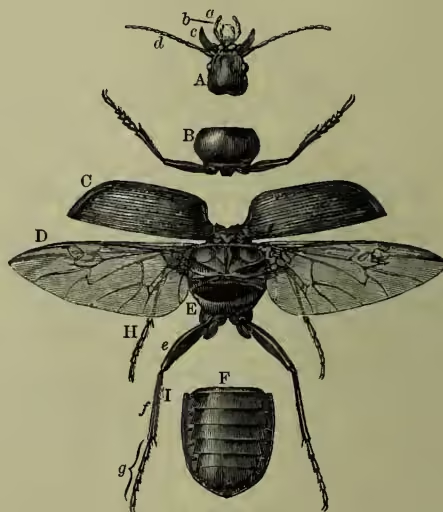
To sum up, insects are Arthropods, which are usually winged in adult life, breathe air by means of tracheæ, and have frequently a metamorphosis in their life-history. The adult body is divided into (1) a head, with three pairs of appendages (= legs), plus a pair of pre-oral outgrowths, the antennæ or feelers; (2) a thorax, with three pairs of jointed legs, typically plus two pairs of dorsal, compressed sacs—the wings; (3) an abdomen, without legs, except in so far as these are rudimentarily represented in stings, ovipositors, and the like. It is impossible at present to give any secure estimate of the number of insects, though it is probably safe to say that they exceed all other animals taken together. Over 80,000 species of beetles or Coleoptera and about 15,000 moths and butterflies have been recorded; and Speyer estimates the total census at 200,000, while M'Lachlan concludes that future entomological industry will raise the sum total of insect species to a million.
Structure and Functions.—The anatomy and physiology of insects will be discussed together, and that as tersely as possible, referring to the articles ANT, BEE, BUTTERFLY, &c. for illustrations, and to the works cited for details.
Form.—The body of an insect consists of a distinct, undivided head, probably composed of four obscured segments, of a thorax with three divisions (pro-, meso-, and meta-thorax), and of an abdomen typically with eleven rings. In detail, however, the varieties are legion; thus, the thin-waisted wasp contrasts with the cockroach, the lank gnat with the compact bug, the graceful May-flies with the somewhat ungainly locusts, the minute midges with the Goliath beetles and humming-bird moths.
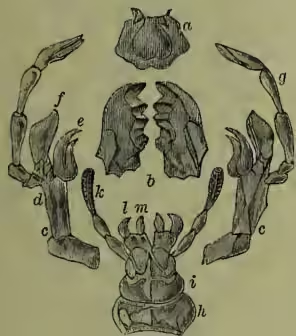
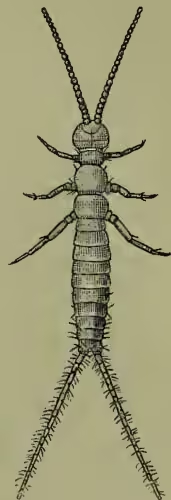
Appendages.—The jointed feelers or antennæ, which are outgrowths of the head, not strictly comparable to legs, have often numerous nerve-endings, and seem to be used in smelling, as organs of touch and guidance, and also in caressing or in communicating impressions to friends. Exactly comparable with legs are the three pairs of mouth-appendages, projecting downwards or forwards from the head, to which they are jointed and from which they are worked by muscles. The first pair—the mandibles—have but one joint, and are without the lateral 'palp' present in the crustacean organs of the same name. They are biting and chewing organs, and are more or less reduced in those insects which suck. Next come the first pair of maxillæ, which have jointed 'palps.' The second pair of maxillæ are united at their base, and form the so-called labium, also provided with palps. In the different orders, and in association with the diverse diet, these three pairs of mouth-organs vary greatly, as may be seen by comparing those of cockroach, house-fly, moth, and bee. In connection with the three pairs of legs on the thorax, it is necessary in identifying insects from a manual to become familiar with the division of the limb into coxa, trochanter, femur, tibia, and tarsal joints, are seen on that region in the adults. Such hints we find in the lowest wingless insects (Thysanura), and at least plausibly in stings and ovipositors.
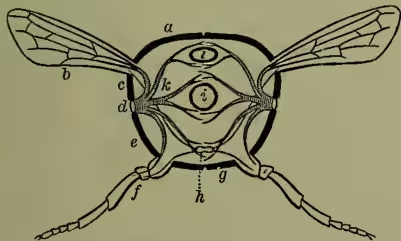
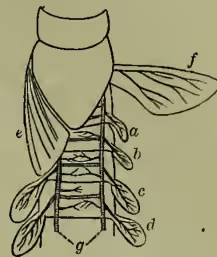
Wings.—The adult insect usually bears two pairs of dorsal outgrowths or wings on the two posterior rings of the thorax. These are flattened sacs, really double, worked by muscles, traversed in various patterns by 'veins,' which include air-tubes, nerves, and vessel-like continuations of the body-cavity. They are undeveloped in some passive females, and are likewise absent from many parasitic forms, such as lice and fleas. In these cases the wings have been lost, while they have never been attained by the lowest insects—the Collembola and Thysanura. When at rest the wings are usually folded in various ways, but the dragon-flies and some others keep them expanded. The two pairs may be almost alike, as in bees and butterflies; those in front may be merely covers (elytra) for the hind pair, as in beetles, or contorted rudiments in the little bee-parasites (Strepsiptera); the hind pair may be linked to the fore pair, as in Hymenoptera, and are rudimentary 'balancers' or 'halteres' in flies. They are often hairy or scaly, or gorgeous with pigment, or occasionally odiferous. Professor Eimer has shown that the colour- ing and marking of butterfly wings serve as indices of the progress and relationship of species. As to their origin, it seems plausible to compare them to the tracheal outgrowths seen in some aquatic larvæ, and to regard them as primarily respiratory and secondarily locomotor. One may venture to suggest that the additional respiratory efficiency derived from such outgrowths would increase the total activity of the insect, and more or less directly lift it into the air.
Locomotion.—Insects are emphatically locomotor animals. 'They walk, run, and jump with the quadrupeds; they fly with the birds; they glide with the serpents; and they swim with the fish.' Even the limbless larvæ of many forms move deftly, contracting their bodies, and utilising jaws, hairs, and tubercles to help them along. Some will even jump to a relatively enormous height of six inches or more, by taking their tails in their mouths and letting go suddenly. The limbed larvæ, and especially the true caterpillars, often move with great rapidity; a few jump, and many climb; others utilise their silken threads in spider-like fashion; while the young dragon-flies propel themselves along by the forcible expulsion of water. Even some pupæ move about, but the triumphs of locomotion are seen in the adult insects. Reference must be made to such a work as the Introduction of Kirby and Spence, and recourse had to actual observation, if any adequate conception be desired of the variety of ways in which insects walk, run, climb, swim, burrow, and fly. In connection with the flight of insects it may be noticed that the movement of the wings does not essentially differ from that of birds, that motion in a vertical direction is particularly easy, that steering is more difficult, especially since the very lightness of the bodies of insects make them liable to be blown about by the wind. Marey calculates the approximate number of wing-strokes per second at 330 for the fly, 240 for the humble-bee, 190 for the hive-bee, 110 for the wasp, 28 for the dragon-fly, 9 for a butterfly (see FLYING).
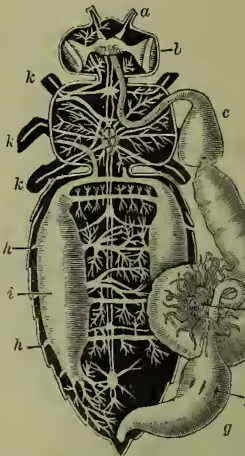
Skin.—Insects resemble other Arthropods in having a firm chitinous cuticle formed from the epidermis or hypodermis (see CHITIN, CUTICLE). The cuticle bears scales, tubercles, and hairs, of which the last are sometimes olfactory or otherwise sensory. In spite of the ensheathing armature there are often glands in connection with the skin—witness the salivary glands opening near the mouth in almost all insects, the silk or spinning glands of many larvæ, especially of such as make cocoons, the odoriferous glands of bugs and beetles, the poison-glands of the stinging ants, bees, and wasps, the wax-glands of some Aphides, Coccus insects, and bees. Before the full size is reached there are skin-castings or moultings, often numerous. The muscular system is almost always highly developed. The muscles which work the legs and mouth-organs, raise and depress the wings, influence the intake and expiration of air, control the circulation, and move the segments of the body on one another are most important. The nervous system consists, as in other Arthropods, of a complex dorsal brain or supra-œsophageal ganglionic centre, supplying eyes and feelers, and of a double ventral chain of nerve-centres. From the first ventral (or sub-œsophageal) ganglia, connected with the brain by a ring round the gullet, the mouth-appendages are innervated. In many insects the ventral chain is centralised in a few ganglia, and is usually more concentrated in the adults than in the larvae.
Sense-organs.—Except in fleas, lice, and the lowly Collembola, adult insects have compound eyes. These are often associated with simple eyes or ocelli, which are all that ever appear in larvae or in the three sets of insects mentioned above. Blind insects also occur along with other blind animals in the darkness of caves. Auditory organs are represented in almost all orders by peculiar nerve-endings ('chordotonal' and 'tympanal' organs) superficially disposed on various parts of the body. On the tactile antennæ, and probably also on the maxillary palps of various insects, there are specially innervated skin cells and hairs believed to be olfactory in function; while others more within the mouth are credited with gustatory sensitiveness. The skin of insects seems in certain regions to be sensitive to the differences of light and shade, so much so that some speak of a sixth or 'dermatoptic' sense. Much experiment and observation is still required on the senses of insects, and we can only mention such general facts as the following. There is sometimes both optic and auditory sensitiveness to impressions which are beyond the range of human sight and hearing; in flower-visiting and other insects there is abundant evidence of sensitiveness to fragrance and colouring, and smell probably aids greatly in that prompt recognition of friends, kindred, or foes which the social insects so well illustrate; there seems little doubt that the power of forming distinct images of external objects, after our fashion of seeing, is very slight in insects. The student should refer to the work of Sir John Lubbock on The Senses of Animals (Inter. Science Series, 1888). Similarly, to return to the functions of the nervous system, we can only notice that, in addition to the numerous and often subtle instincts which are ingrained in the constitution of many species, there is indubitable intelligence, as seen in the reasonable adaptation of means to novel ends; that, as in other animals, the intelligence is greatest in the social insects—especially the ants and bees, where it is associated with complex though very small brains. There is also plain evidence of emotion—e.g. in the love-making and parental affection of many insects. See ANT, BEE, BUTTERFLY, INSTINCT, and especially the works of Lubbock and Romanes.
Alimentary System.—The alimentary canal always consists of fore-, mid-, and hind-gut (see GUT), of which the first and the last portions are lined by a thin layer of chitin continuous with the external cuticle. But the length and structure vary not a little in different insects, to some extent in association with the differences of diet. The fore-gut includes mouth, pharynx, and gullet, of which the latter may be swollen into a crop, or bear an appended pouch (so-called sucking stomach), or be continued into a gizzard with hard grinding plates. The mid-gut is glandular, digestive, and absorptive; it often bears saccular outgrowths or glandular cæca, and has, as its (endodermic) origin implies, no chitinous lining. In Coleoptera, for instance, its length, which is usually inconsiderable, varies inversely with the nutritive and digestible qualities of the food. The hind-gut is often coiled, terminally expanded in the rectum, and in that region sometimes associated with glands. Its general function is absorption, while from it there spring excretory tubes or Malpighian vessels (see infra). As to the food of insects, many are vegetarians, many carnivorous, a few mix both diets: many feed on the juices of living organisms, others only on putrescence; many actively rifle flowers of their nectar and pollen, or hunt for other insects with great activity, while not a few are external or internal parasites upon higher animals; the ant-lion digs a pit into which its unwary prey may fall, while dragon-flies attack their winged booty with open violence; among ants some milk the aphides, while others are so degenerate in prosperity that they are actually fed by their slaves. Nor should it be forgotten that some of the higher insects lay up stores of food, usually with parental instinct for the sake of their young, and that the eggs are often laid in the midst of the food suited to the larval appetite, even in cases where the adults may perish before the young are hatched.
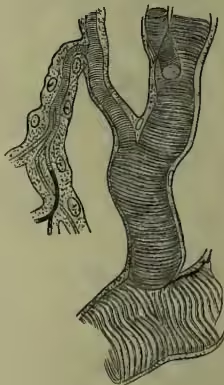
Respiratory System.—Insects when resting often show panting movements in the abdomen, which is swayed by muscles whose activity is the chief condition of the circulation of air throughout the body. For in all insects the whole body is penetrated by air-tubes or tracheæ, which send fine branches into all the organs and tissues. These tubes are really ingrowths from the skin, and are lined by chitin, raised in what appear to be spiral thickenings which keep them elastically tense.
In most cases these tracheæ open to the exterior by paired apertures or stigmata on the breast and abdomen, often guarded by hairs and very variously disposed. There are never more, and usually fewer, than ten pairs of openings, though primitively there was probably a pair to each segment. In aquatic larvae the tracheæ do not open (if they did the insect would drown), but are spread out on lateral or terminal expansions (tracheal gills), through the thin skin of which the oxygen dissolved in the water is absorbed (see DRAGON-FLY, EPHEMERA, GILL). The very efficient respiration of insects is one of the facts to be kept clearly in view in estimating the general activity of their life.
Here we may notice that many insects produce sounds which often express a variety of emotions. Thus, we have the whirr of rapidly-moving wings, as in flies; the buzz of leaf-like appendages near the openings of the tracheæ in many Hymenoptera; the scraping of legs against wing-ribs, as in grass-
hoppers; the chirping of male crickets, produced by rubbing one wing against its neighbour; the shrill piping of the male Cicadas, which have a complex drum-like instrument; the voice of the death's-head moth, due to the emission of air from the mouth; and the tapping of the death-watch knocking on external objects. In some cases, where not simply automatic, the sounds serve the alluring purpose of love-songs; they may also express fear, anger, and (according to Kirby) even sorrow, or they may give alarm and convey tidings.
Circulatory System.—As the tissues are riddled with air-tubes, the need for definite blood-vessels is greatly lessened, and so the circulatory system is slightly developed in comparison with the literally thorough respiratory arrangements. The blood—which is colourless, yellow, greenish, or even reddish, with amoeboid cells—flows for the most part along lacunæ without definite walls. There is, however, a central organ, the dorsal blood-vessel or heart.
Within the body-cavity of the insect there is often a characteristic mass of tissue known as the 'fat-body.' This is an important accumulation of reserve material, most abundant in the larval stages. In some cases the fat-body of the larva is rich in fat and poor in waste (urate) crystals, while that of the pupa is the reverse, showing that the material is used up in the reconstruction or metamorphosis. In a few insects, such as Fireflies (q.v.) and glow-worms, part of the fat-body seems to become the seat of phosphorescence, the light of which is in many cases a brilliant love-signal. See PHOSPHORESCENCE.
The excretory system consists of a set of fine tubes, or it may be threads, which grow out from the upper part of the hind-gut, and wind about often at great length in the body-cavity. The component cells contain abundant waste-products. In different insects the excretory or malpighian tubes vary greatly in number (2-150), and also in the manner of their connection with the gut. The usual type of invertebrate kidney—the nephridium—though persistent in Peripatus (q.v.), is not clearly discoverable in insects.
Reproductive System.—The sexes are always separate in normal insects; and the Hermaphroditism (q.v.) which casually crops up is in most cases only superficial. In both sexes the reproductive organs are paired, and the products pass out by paired ducts. The latter—the oviducts of the female or the vasa deferentia of the male—always open near the end of the abdomen, and, except in the Ephemeroidea, by a single aperture: it is possible that they represent modified 'nephridia.' Accessory external and internal structures in the males may assist in copulation or in making the spermatozoa into packets; of similar structures in the females the most important are the occasional external ovipositors or egg-laying organs, and the internal seminal receptacle in which the spermatozoa received from a male are stored up, and serve to fertilise successive sets of eggs. In the queen-bee this store has been known to last for two or three seasons, while Lubbock tells of an aged queen-ant which laid fertile eggs thirteen years after the last union with a male.
Male and female insects are usually somewhat different in external appearance. The males are, on an average, more active, smaller, and more brightly coloured than the females. Extremes are seen in male and female Coccus insects (q.v.); in the sexes of Glow-worm (q.v.); in a few Butterflies (q.v.), such as Orgyia, where the female is wingless; or in the curious bee-parasites Strepsiptera, where the female virtually remains a grub. As some insects have an elaborate courtship, in which the females choose their mates, and as some males fight their rivals, there can be little doubt that Sexual Selection (q.v.) has accelerated the evolution at once of beauty and strength, while natural selection (see DARWINIAN THEORY, EVOLUTION) may have retarded the evolution of gay colouring in the females to whom conspicuousness is especially disadvantageous in parentage. Neither position is inconsistent with that which regards the characters of the two sexes as natural and necessary expressions of their respectively dominant constitutions. See Darwin, Descent of Man; Wallace, Darwinism; Geddes and Thomson, Evolution of Sex.
Peculiarities in Reproduction.—(a) Virgin birth or parthenogenesis occurs normally, for a variable number of generations, in two butterflies and a beetle, some Coccus insects and Aphides, certain saw-flies and gall-wasps; it occurs casually in the silk-moth and about a dozen other Lepidoptera, partially or voluntarily in the drone-bearing of honeybees, seasonally in Aphides (q.v.), and in larval life in some midges (e.g. Chironomus). (b) Where parthenogenesis occurs for a period and is thereafter followed by ordinary sexual reproduction, as in Aphides, we have to deal with one of the many forms of Alternation of Generations (q.v.). (c) A few insects are exceptional in being viviparous, bringing forth their young alive. This is again illustrated by Aphides, and also by a few flies, by the little bee-parasites Strepsiptera, and by some beetles. (d) Many insects are exceedingly prolific—e.g. aphid, silk-moth, and queen-bee. A climax is reached in the queen-termites which for a time goes on laying thousands of eggs 'at the rate of about sixty per minute!'
Development of the Egg.—The ovum of insects, as it passes down the ovarian tubes, is enclosed in a firm chitinous envelope, with a minute aperture or micropyle (sometimes with more than one), through which a male element or spermatozoon penetrates before the ovum leaves the mother. The segmentation which follows fertilisation is for the most part peripheral (centrolecithal; see EMBRYOLOGY), while the centre of the egg is occupied by a relatively passive yolk with scattered nuclei. The result of segmentation is a sphere or ellipsoid of cells enclosing the core of yolk, and on the ventral surface of the sphere or ellipsoid the embryo
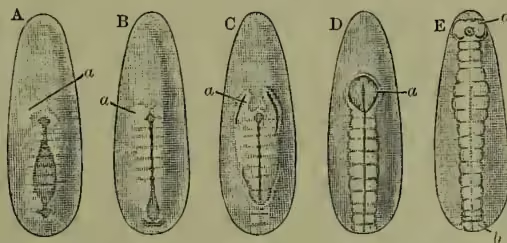
The anterior end is uppermost; a, head lobes; b, the last of the body-segments, which are seen becoming more marked throughout the series; round about the embryonic area the amniotic folds develop. begins to be mapped out. This development we cannot here follow, but it is important to notice one unique fact, that the embryo is arched over by a double fold, constituting the internal amniotic and outer serous membranes, so called from their resemblance to the similar ensheathing envelopes in the embryos of higher vertebrates. See Lang's Lehrbuch der Vergl. Anatomie (vol. ii. Jena, 1889), where a summary of results and literature will be found.
Metamorphosis.—(1) In the lowest insects—the old-fashioned, wingless Thysanura and Collembola —the young form which emerges from the egg-shell is in all respects a miniature adult. Without striking change, by growth and moultings, it becomes an adult. From this entire absence of metamorphosis we readily pass to the life-histories of cock-roaches and locusts, of lice and most bugs, where the newly-hatched young are very like the parents. The reproductive organs are, of course, undeveloped, and there are no wings, but the latter are not attained even by the adult lice. All the above forms may be called ametabolic—i.e. without marked change or metamorphosis.
(2) In Cicadas there is a slight but most instructive difference between larvæ and adults. The full-grown insects live among herbage, the young live in the ground, and with this diversity of habit is associated at least this much difference in structure, that the anterior legs of the larva are adapted for burrowing. Furthermore, the larval life ends in a quiescent stage, or, in other words, the adult form is attained after a period of pupation. But the story becomes more complex when we pass to the Dragon-fly (q.v.), the Ephemera (q.v.), and their relatives, where the metamorphosis is slightly greater, inasmuch as the larvæ are aquatic, with closed respiratory apertures, and with tracheal gills, while the adults are winged and aerial, and breathe by open tracheæ. Such insects are said to have an incomplete metamorphosis, and are called hemimetabolic.
(3) Very different, however, is the life-history of all the other insects, such as butterflies and beetles, flies and bees. From the egg-shell there emerges a larva (maggot, grub, or caterpillar), which lives a life of its own, growing and resting and moulting, often very active in its movements and voracious in its diet. Having accumulated a rich store of reserve food in its fat-body, the larva becomes for a longer time more or less quiescent, becomes in fact a pupa, nymph, or chrysalis. In this stage, often within the shelter of a spun cocoon, great transformations occur: wings bud out, appendages of the adult pattern appear, reconstruction and centralisation of organs are effected; and finally, out of the pupal husk there emerges an imago or miniature fully-formed insect. These have a complete metamorphosis, and are called holometabolic.
The larvæ of these higher insects with complete metamorphosis differ greatly in different orders. Thus, the 'maggots' of flies (without distinct head, feelers, ocelli, &c.) are distinguished from the 'grubs' of bees (with distinct head), and both from the caterpillars of butterflies, &c., which have limbs as well as head. The limbless maggots and grubs are degenerate, the caterpillar is the more normal type. It is technically called an 'eruciform larva,' in contrast to that of most Ametabola and Hemimetabola—the 'campodeiform larva,' which is not even worm-like, but like one of the lowly Thysanuran insects (Campodea), with the regions of the body well defined, with biting mouth-parts, with locomotor thoracic limbs, &c.
But beyond distinguishing the above two great types of larva (campodeiform and eruciform), and also the maggot, grub, and caterpillar forms of the latter, little more is possible in this general survey, for the larvæ vary enormously, according to their own mode of life—parasitic or roving, aquatic or terrestrial, carnivorous or herbivorous—and according to the peculiarities of the adult forms. We must note, however, the changes in connection with the mouth-organs, especially as these form part of the basis of classification. 'The mouth-parts may be similar in all stages of life, and then are either adapted for biting (Menognatha—i.e. jaws persistent) or for sucking (Menorhyncha—i.e. proboscis persistent); or else they are adapted in the larva for biting, in the adult for sucking, the change commencing in the pupa, and rarely affecting the larval stage (Metagnatha—i.e. jaws changed).' See Brauer's classification in Hatchett Jackson's edition of Rolleston's Forms of Animal Life (1888).
The Internal Metamorphosis.—One of the most interesting and difficult problems with regard to insects concerns the transition from the larval to the adult structure. In those forms which have no metamorphosis, or only an incomplete one, the organs of the larva develop continuously into those of the adult. It is far otherwise in the complete metamorphosis of the higher insects. There the internal changes are as marked as the external; in fact, there is a gradual reconstruction of organs during the later larval, and especially during the pupal stages. Most of the larval organs are absorbed by amœboid cells, and their debris utilised in building up new structures. To a certain extent the development of new organs takes place by substitution; that is to say, parts of the larval organs which have not been specialised form the foundations of the adult structures. Of special importance is the appearance in the larva of 'imaginal discs' from which the wings, limbs, and epidermis of the imago or perfect insect arise. It must not, however, be supposed that the transition involves any abrupt change; the absorption, disappearance, and replacement of organs is gradual throughout. Yet almost the entire musculature, a great part of the tracheal system, the larger portion of the mid-gut, and many other parts of the larva disappear and give place to the corresponding organs of the adult which are adapted to a new mode of life. In pursuing this study the reader will best begin with Martin Duncan's Transformations of Insects, Lubbock's Origin and Metamorphoses of Insects ('Nature' series, Lond.), and then pass to the cited work of Lang and the literature there quoted.
General Life.—Under this title we can do little more than mention some general aspects of the life of insects. (a) While insects are predominantly active animals, we find in contrasting the orders, or better still, the families, abundant illustration of the antithesis (to be read throughout the animal series) between activity and passivity. Thus might the female cochineal insect represent in its torpid, sessile life one extreme, and the exceedingly busy humble-bee another. (b) In the majority of cases the adult insect is short-lived, and dies within the year; an adult Ephemid may be literally the fly of a day, but from this there are many gradations leading up to the rare cases of a queen-bee five years old, or an aged queen-ant of thirteen. The total length of life, including the metamorphoses, varies not a little with the climate of different countries and the weather of different years, and the life is prolonged in those insects which hibernate, passing the winter in a lethargic state hardly deserving the name of life (see HIBERNATION, LIFE; Weismann's essay on 'The Duration of Life' in Heredity, 1889; and another essay by Ray Lankester on Comparative Longevity, 1870). (c) It is worthy of notice that reproduction in a great number of insects of both sexes is shortly followed by the nemesis of death, love being in such cases at once the climax and end of life. (d) In connection with the influence of climate and seasons the occurrence of different or 'dimorphic' summer and winter broods in some Lepidoptera should be noticed (see Weismann, Studies on the Theory of Descent, Meldola's trans. Lond. 1880-82; and Scudder's Butterflies, New York, 1881). (e) Nor can we do more than refer to separate articles for description of the fascinating social life of many ants, bees, wasps, and termites. (f) The prolific multiplication of insects is kept within bounds by the limitations of food-supply and weather, by the warfare between insects of different kinds, by the appetite of higher animals, such as fish, frogs, ant-eaters, insectivores, and, above all, birds. As among other animals, we find among insects abundant illustration of peculiarities which have for their result at least the protection of their possessors. The leaf-insects, walking-sticks, moss-insects, humming-bird moths, scale-insects, &c. are striking examples of a protective mimicry in form and colouring which is illustrated in great variety and frequency throughout the class. Many larvæ, as well as adults, show especially in colour a sympathetic relation to their environment, while others, such as Caddis-flies (q.v.), are masked by the external coverings with which they clothe themselves. Many insects are saved by their hard skins, by their disgusting odour or taste, by their deterrent discharges of repulsive fluids, by their assumption of 'terrifying attitudes,' by the simulation of death, or by active resistance with their manifold weapons. See MIMICRY; and Wallace's Darwinism (1889) and literature there cited.
Classification.—There is as yet a want of unanimity about the classification of insects. A basis is usually found in the degree of metamorphosis, the characters of the wings, the structure of the mouth-organs, and the nature of the genital and excretory ducts. On many points future embryological research will shed light. All that we shall do here is to give the general grouping adopted by Brauer. See cited text-books of Hatchett Jackson and of Lang.
| C. |
|
| B. | |
| AMETABOLA: | |
| Menorrhyncha. | |
|
|
| A. | |
| AMETABOLA | |
| and | |
| HEMIMETABOLA: | |
| Menorrhyncha. | |
|
|
| 0. | |
| Collembola and Thysanura.—Primitive wingless insects. |
Distribution in Space.—Insects are represented almost everywhere. The majority are indeed terrestrial and aerial, and especially at home in warm and temperate countries, but in the Arctic regions and in hot springs, at great heights above the snow-line and in underground caves, and most surprisingly even in the sea there are insect inhabitants. The Challenger explorers found one or more species of the genus Halobates (among the Hemiptera) which seemed to be quite pelagic. The limits of distribution are in great part those of climate and of the requisite food, for insects have great possibilities of dispersal, not only in their often extensive flight and liability to be swept along by winds, but through the conveyance of the dormant eggs or even grubs from one shore to another within floating logs. Thus, tropical insects are brought on floating logwood from across the Atlantic, while locusts have been known to fly or to be blown in safety across more than 300 miles of sea. See GEOGRAPHICAL DISTRIBUTION, and works there cited.
History.—Insects must have appeared in comparatively early times, for a cockroach-like wing has been found even in Silurian strata. Primitive dragon-flies and also lace-flies (Neuroptera) occur in the Devonian, cockroaches and walking-sticks
(Orthoptera) in the Carboniferous rocks. There seems much reason to believe that the Palæozoic insects were mostly generalised, 'synthetic' types, prophetic of, rather than referable to, our modern orders. In the Trias Orthoptera abound; the first distinct beetles appear in the Lias, where other higher insects with complete metamorphosis also occur. See especially Scudder in Zittel's Palæontologie (1885).
Pedigree.—As to their genealogy, suffice it to say that the wingless Collembola and Thysanura, at the base of the insect series, doubtless represent primitive forms; these lead us back to some of the less specialised myriopods, and these again to Peripatus (q.v.), the sole surviving genus of the ancestral Prototraceata. Peripatus links the air-breathing Arthropods to the ringed worms or Annelids, uniting, for instance, in its structure the tracheæ of an insect and the kidneys or nephridia of a worm. See Lubbock's Origin, &c., of Insects, and then the papers of Brauer, Emery, Packard, &c. cited by Hatchett Jackson.
Economic Import.—Insects come into contact or collision with human interests in a great variety of ways. As far as they are concerned, the struggle between man and animals is by no means over. Strong in numbers, many of them are directly or indirectly injurious to man and his property to an extent which frequently affects the prosperity of a nation. Direct injuries to man's person are familiarly illustrated in the parasitism of fleas, lice, and other more or less intimate 'boarders,' but these are less important than the share the mosquito seems to have in the loathsome disease Elephantiasis arabum. The annoyance of midges is patent, but we feel the delicacy of the threads in life's web when we remember that the house-fly may disseminate the germs of bacterial disease. Personal injuries, however, are dwarfed when we think of those done to property, and especially to crops and herds, by voracious or by parasitic insects. Clothes-moth and furniture-borer, vine-insect and Colorado beetle, the bot-flies which attack sheep, cattle, and horses are familiar illustrations of formidable pests. It should also be noted how the hostile insects which infest forest trees and vegetation generally may occasion changes which have far-off effects on the fauna, scenery, and even climate of a country-side. In connection with injurious insects reference should be made to such articles as APHIS, BOT, CORN INSECTS, HESSIAN FLY, LOCUST, PHYLLOXERA, TSETSE, WEEVIL, &c.; to the well-known and inimitable Introduction to Entomology, by Kirby and Spence; to the admirable works of Miss Ormerod; and to the researches of Riley, Packard, and others, in the Bulletins of the United States Entomological Commission. From either of the last-named sources a guide to the vast literature of this important department of entomology may be obtained.
As to the other side of the account, we cannot ignore our indebtedness to live-bee and silk-moth, to cochineal and lac insects, which furnish us with their unique and valuable products. Others again are indispensable and indefatigable scavengers; many wage effective war upon their injurious kindred; while a few, such as locusts and some larvæ, are even used as food. All these benefits, however, seem small in the light of the great fact that the majority of plants are dependent upon insects, as the unconscious bearers of the pollen essential to the normal cross-fertilisation of flowers.
Plants and Insects.—Referring to the article FLOWER for a statement of the importance of insects in the cross-fertilisation of flowers, we are safe in saying that neither the flowers nor their constant visitors can be understood apart. Many insects, however, injure plants without any compensating benefit, and in this connection must be noted the frequent occurrence of protective structures in plants, which help to dismiss hostile intruders. On the other hand, there are numerous cases in which plants and insects (especially ants) form a mutual partnership. Such 'myrmecophilous' plants are saved by their bodyguard of ants from unwelcome visitors, and the benefit is sometimes returned (to speak metaphorically) by the growth of special shelters or 'domatia,' tenanted by the partner-insects. See GALLS, INSECTIVOROUS PLANTS, and the literature cited at FLOWER; also Kerner's Flowers and their Unbidden Guests (trans. Lond. 1878); and for references to the works of Delpino, Belt, Huth, &c., on 'myrmecophilous plants,' see Schimper's Wchselbeziehung zwischen Pflanzen und Ameisen (1888).
History of the Study of Insects (Entomology).—Insects had their due place in Aristotle's zoological system, and since thoughtful observation began have been studied with much constancy. Malpighi (1628-94), whose name is perpetuated in connection with the excretory tubules, was the first to give a thorough description of an insect's (the silk-moth's) anatomy. His contemporary Swammerdam got further in his investigation of insect metamorphoses. Ray (1628-78) and Linnaeus (1707-78) helped to infuse system and order into entomology, while the works of Réaumur (1683-1757) are classical models of carefulness. Rösler von Rosenhof, Bonnet, De Geer, Schäffer, Fabricius, and Lyonnnet were among the illustrious entomologists of the 18th century. Cuvier (1769-1832) began the study of insects in early youth with an enthusiasm which he never lost, and was wont to trace to the precision gained in his dissections of insects no small part of his success as an anatomist. Savigny's comparison of the mouth-appendages of insects and other Arthropods was an important step on a path often pursued since; and among the great entomologists of the first half of the 19th century, all more or less influenced by Cuvier's example, were Latreille, Kirby, Dufour, Burmeister, Audouin, Blanchard, Lacordaire, and J. O. Westwood. But beyond this the embarrassment of illustrious names makes compressed history more and more difficult; suffice it to notice the recent progress made in the study of the minute structure—e.g. of the sense-organs of insects—in experimental analysis of the sensory powers, in elucidating a natural classification, in deciphering the history both of fossil forms and of the individual organism.
Kirby speaks enthusiastically of the wealth contained in a well-stored cabinet of insects, of the problems suggested by the study of their anatomy and physiology, but rightly urges that 'we must behold insects when full of life and activity, engaged in their several employments, practising their various arts, pursuing their amours, and preparing habitations for their progeny; we must notice the laying and kind of their eggs; their wonderful metamorphosis; their instincts, whether they be solitary or gregarious, and other miracles of their history.' Then we shall echo the words of Pliny, and of all entomologists: 'In these beings so minute, and as it were such nontentities, what wisdom is displayed, what power, what unfathomable perfection!'
As reference has been made throughout the article to special works, it will be enough here to mention some of the general books—(a) zoological text-books, such as those of Claus, Gegenbaur, Huxley, Lang, and Hatchett Jackson's edition of Rolleston: (b) encyclopædia articles by Newport in Todd's Cyclopædia of Anatomy and Physiology, and M'Lachlan in Encyclopædia Britannica: (c) to the more popular natural histories—Cassell's (edited by Martin Duncan) and the Standard or Riverside (edited by J. S. Kingsley): (d) to general works—W. Kirby and W. Spence, Introduction to Entomology (4 vols. 1815-26; 1 vol. Lond. 1856); J. O. Westwood, Classification of Insecta (2 vols. 1839-40); Packard, Guide to the Study of Insects (New York, 1878); V. Graber, Die Insekten (2 vols. 1877); L. Camerano, Anatomia degli Insetti (1882); W. F. Kirby, Elementary Text-book of Entomology (1885): (e) for literature, Hagen's Bibliotheca Entomologica, the Naples Zool. Jahresbericht, and the Zoological Record.