Roumelia (Turk. Rum Ili, 'land of the Romans'—the inhabitants of the Western Roman empire, or Byzantine Greeks, being known to the Turks as 'Romans'), a name which once applied generally to the whole of ancient Thrace and part of Macedonia. The province aptly enough called Eastern Roumelia is now incorporated with Bulgaria (q.v.). In central Asia Rum or Rumi means the peoples of western Asia; but the Sultan of Turkey is Rum-Padishah. In Turkey itself Rum means now usually the Greek nation and the Greek Church.
END OF VOL. VIII.



22501632025
Bay 181


CHAMBERS'S
ENCYCLOPÆDIA
A DICTIONARY
OF
UNIVERSAL KNOWLEDGE
NEW EDITION
VOL. IX
ROUND TO SWANSEA

WILLIAM & ROBERT CHAMBERS, LIMITED
LONDON AND EDINBURGH
J. B. LIPPINCOTT COMPANY, PHILADELPHIA
1901
All Rights reserved.
Q - RCF
YK / CHA
The following Articles in this Volume are Copyrighted by J. B. LIPPINCOTT COMPANY in the United States of America :
RUSSIA.
SHERIDAN, P. H.
ST LOUIS (Missouri).
SHERMAN.
ST PAUL (Minnesota).
SHIPBUILDING.
SAN FRANCISCO.
SILK.
SCANDINAVIAN MYTHOLOGY.
SILVER.
SCOTT, SIR WALTER.
SLANG.
SEWAGE.
SODA.
SEWARD, W. H.
SOUTH CAROLINA.
SEWING-MACHINE.
SPAIN.
SHAKERS.
SPIRITUALISM.
SHAKESPEARE.
SUGAR.
SHELLEY.
SUMNER.

Among the more important articles in this Volume are the following:
| ROUND TOWERS..... | Dr JOSEPH ANDERSON. | SIDNEY, SIR PHILIP..... | F. T. PALGRAVE. |
| ROUSSEAU..... | Rev. H. G. GRAHAM. | SIEGE..... | Lieut.-Col. H. D. B. DUNLOP. |
| ROWING..... | W. B. WOODGATE. | SIGNALLING..... | JAMES BOLAM. |
| RUBENS..... | J. M. GRAY. | SILK..... | Sir THOMAS WARDLE, F.C.S. |
| RUGBY..... | HENRY LEE WARNER. | SILURIAN SYSTEM..... | Professor JAMES GEIKIE. |
| RUNES..... | Canon ISAAC TAYLOR. | SIMON MAGUS..... | Rev. J. SUTHERLAND BLACK, LL.D. |
| RUSSIA..... | Prince KROPOTKINE. | SISTERHOODS..... | MARIA TRENCH. |
| SACRIFICE..... | Rev. JAMES STRACHAN. | SKATING..... | T. MAXWELL WITHAM. |
| ST ANDREWS..... | D. HAY FLEMING. | SKULL..... | Dr DAVID HEPBURN. |
| SAINTE-BEUVE..... | P. HUME BROWN, LL.D. | SLANG..... | CHARLES GODFREY LELAND. |
| ST LOUIS..... | C. S. YOST. | SLAVS..... | W. R. MORFILL. |
| SAINT-SIMON, DUC DE. | THOMAS DAVIDSON. | SLEEP; SOMNAMBULISM | Dr A. W. MACFARLANE. |
| SALISBURY..... | A. R. MALDEN. | SLOYD..... | JOHN STRUTHERS. |
| SALISBURY, LORD..... | FREDERICK GREENWOOD. | SMITH, ADAM..... | JOHN HILL BURTON. |
| SALMON..... | ARCHIBALD YOUNG. | SMOKE..... | ROBERT IRVINE. |
| SALT; SILVER; SODA.. | A. GALLETLY. | SMOLLETT..... | DAVID HERBERT. |
| SALVATION ARMY..... | BRAMWELL BOOTH. | SNAIL; SLUG..... | T. D. A. COCKERELL. |
| SAMOA..... | C. P. LUCAS. | SNAKES; SPIDERS..... | Professor J. ARTHUR THOMSON. |
| SAND, GEORGE..... | Professor SAINTSBURY. | SNOW..... | R. T. OMOND. |
| SAN FRANCISCO..... | Dr W. C. BARTLETT. | SOAP..... | JOHN MACARTHUR. |
| SANSKRIT..... | Professor ECCELING. | SOCIALISM..... | THOMAS KIRKUP. |
| SAVINGS-BANKS..... | URQUHART A. FORBES. | SOCRATES; SOPHISTS.. | Professor D. G. RITCHIE. |
| SCAND. MYTHOLOGY.... | Professor RASMUS ANDERSEN. | SOILS..... | JOHN HUNTER, F.C.S. |
| SCARLATINA..... | Dr LUNDIE. | SOLICITOR..... | FRANCIS WATT. |
| SCHILLER..... | J. T. BEALBY. | SOLON..... | ROBERT P. DAVIDSON. |
| SCHLEIERMACHER..... | Professor PFLEIDERER. | SOMERSETSHIRE..... | F. N. WORTH. |
| SCHNITZER (Emin Pasha) | Dr R. W. FELKIN. | SONNET..... | THEODORE WATTS-DUNTON. |
| SCHOLASTICISM..... | P. HUME BROWN, LL.D. | SOPHOCLES..... | Professor LEWIS CAMPBELL. |
| SCHOOL INSPECTORS.... | JOHN KERR, LL.D., H.M.I.S. | SOUND; SPECTRUM..... | Professor KNOTT. |
| SCHOPENHAUER..... | Professor WILLIAM CALDWELL. | SOUTHAMPTON..... | Captain S. C. N. GRANT, R.E. |
| SCHUBERT..... | HARRY WHITEHEAD. | SOUTH AUSTRALIA..... | JAMES BONWICK. |
| SCHUMANN..... | Professor FRANKLIN PETERSON. | SOUTH CAROLINA..... | Professor N. B. WEBSTER. |
| SCOTLAND (History).... | Professor GEORGE GRUB. | SOUTHEY..... | F. HINDES GROOME. |
| " (Language). | Dr J. A. H. MURRAY. | SPAIN..... | Rev. WENTWORTH WEBSTER. |
| " (Literature). | P. HUME BROWN, LL.D. | " (Lang. and Lit.). | H. BUTLER-CLARKE. |
| SCOTT, GENERAL..... | Professor J. P. LAMBERTON. | SPENCER, HERBERT.... | Professor SORLEY. |
| SCOTT, SIR WALTER.... | ANDREW LANG. | SPENSER, EDMUND..... | Professor HALES. |
| SCOTTISH PHILOSOPHY. | Professor SETH. | SPINAL CORD..... | Dr ALEXANDER BRUCE. |
| SCULPTURE..... | CHARLES WHIBLEY. | SPINNING..... | JAMES PATON. |
| SCULPTURED STONES.... | Dr JOSEPH ANDERSON. | SPINOZA..... | EMANUEL DEUTSCH. |
| SEA; SOUNDING..... | Sir JOHN MURRAY. | SPIRITUALISM..... | ALFRED RUSSEL WALLACE. |
| SEAL; SOLE..... | J. T. CUNNINGHAM. | SQUIRREL..... | W. E. HOYLE. |
| SEA-SERPENT..... | Dr ANDREW WILSON. | STAËL, MME. DE..... | THOMAS DAVIDSON. |
| SEAWEEDES..... | R. J. HARVEY GIBSON. | STANLEY, DEAN..... | Professor STORY. |
| SECULARISM..... | G. J. HOLYOAKE. | STANLEY, H. M..... | JOHN S. KELTIE, F.R.G.S. |
| SÉVIGNÉ, MME. DE.... | THOMAS DAVIDSON. | STATE RELIGION..... | Canon CURTEIS. |
| SEWAGE..... | BALDWIN LATHAM, M.Inst.C.E. | STATUTES..... | Sir PETER BENSON MAXWELL. |
| SEWARD..... | Professor W. HAMILTON KIRK. | STEAM-ENGINE..... | Professor A. B. W. KENNEDY, F.R.S. |
| SEWING-MACHINE..... | Mrs CARRIE B. KILGORE. | STEAM-HAMMER..... | Professor T. H. BEARE. |
| SEX..... | Professor J. ARTHUR THOMSON. | STEEL..... | W. MATTIEU WILLIAMS. |
| SHAKERS..... | Mrs CARRIE B. KILCORE. | STEELE, SIR RICHARD. | AUSTIN DOBSON. |
| SHAKESPEARE..... | Professor DOWDEN. | STERNE, LAURENCE.... | H. D. TRAILL, D.C.L. |
| SHEEP..... | JAMES MACDONALD. | STOCK-EXCHANGE..... | R. MABSON, of the Statist. |
| SHEFFIELD..... | Rev. ALFRED GATTY, D.D. | STORMS..... | Dr BUCHAN. |
| SHELLEY..... | Professor DOWDEN. | STRAFFORD..... | F. HINDES GROOME. |
| SHERIDAN, R. B..... | Mrs OLIPHANT. | STRATFORD DE REDCL. | STANLEY LANE-POOLE. |
| SHERMAN; SHERIDAN. | General GRANT WILSON. | STRAWBERRY..... | R. D. BLACKMORE. |
| SHIELDS, N. AND S.... | W. W. TOMLINSON. | SUGAR..... | THOMAS BAYLEY. |
| SHIPBUILDING..... | DAVID POLLOCK. | SUICIDE..... | Dr CLOUSTON. |
| SHORTHAND..... | Sir ISAAC PITMAN. | SUMATRA..... | H. A. WEBSTER. |
| SIAM..... | J. S. BLACK, H.B.M. Legation. | SUMNER..... | JOHN FOSTER KIRK, LL.D. |
| SIBERIA..... | Prince KROPOTKINE. | SUN; STARS..... | Rev. E. B. KIRK. |
| SICILY..... | W. DUNDAS WALKER. | SUNDAY-SCHOOLS.... | ROBERT COCHRANE. |
| SIDDONS, MRS..... | R. W. LOWE. | SURGERY..... | Dr J. P. STEELE. |
The Publishers beg to tender their thanks, for revising articles, to the Principal of St Bees, the Rector of Stonyhurst, the Superiors of the two orders of Christian Brothers in Ireland, the Head-masters of St Paul's, Shrewsbury, and Sherborne Schools, and the town-clerks of Scarborough, Southport, Stafford, Stirling, Stockport, Swansea, &c.; to the Factor of St Kilda; to the Secretary of the Sunday-school Union; to Mr RICHARD SAVAGE, for revising 'Stratford-on-Avon'; to Mr E. T. COOK, for revising 'Ruskin'; to Mr R. B. HALDANE, M.P., for revising 'Adam Smith'; and to Mr HERBERT SPENCER, for revising the exposition of his philosophy.
MAPS AND PLATE FOR VOL. IX.
| PAGE | |
|---|---|
| RUSSIA..... | 32 |
| SCOTLAND..... | 237 |
| SOUTH AUSTRALIA (WITH TASMANIA)..... | 589 |
| SPAIN..... | 597 |
| SPECTRA, TABLE OF..... | 617 |
CHAMBERS'S
ENCYCLOPÆDIA
A DICTIONARY OF UNIVERSAL KNOWLEDGE

Round, in Music, a short vocal composition, similar to the catch, and like it, peculiar to England. It is in the form of an infinite Canon (q.v.) at the unison or octave, each part in succession taking up the subject at a regular rhythmic interval, and returning from the conclusion to the commencement, and so on, ad libitum, till an agreed-on pause. These rounds or roundlays are usually termed 'merry,' and many of them deserved the name something too well. The most ancient specimen now extant of vocal composition in polyphony is the famous Rota or Round, 'Sumer is icumen in,' of the 13th century. As specimens may be quoted the ancient and well-known 'The Great Bells of Osney,' 'Row the Boat, Whittington,' Aldrich's 'Hark the Bonny Church-church Bells,' or the well-known 'Three Blind Mice.' There were collections by Ravenscroft, Pammelia (1609), Deuteromelia (1609); Hilton (1652); and Playford (1667). See Metcalfe's Rounds, Canons, and Catches of England, with introduction by Rimbault.
Round Churches (see ROMANESQUE ARCHITECTURE) are represented in England by the Temple Church (see TEMPLARS); St Sepulchre's at Northampton (q.v.); the Church of the Holy Sepulchre at Cambridge (q.v.); and the Church of Little Maplestead in Essex.
Roundheads, the nickname given by the adherents of Charles I. during the Great Rebellion to the Puritans, or friends of the parliament, who, with Prynne, denounced the 'unloveliness of love-locks,' and were understood to distinguish themselves by having their hair cut close, while the Cavaliers wore theirs in long ringlets.
Round-robin (Fr. rond, 'round,' and ruban, 'ribbon'), a name given to a protest or remonstrance signed by a number of persons in a circular form, so that no one shall be obliged to head the list. It is said to have originated in a usage of the French officers. The most memorable round-robin in literary history is that sent by Burke, Gibbon, Sir Joshua Reynolds, Joseph Warton, and others to Dr Johnson, requesting him to amend the epitaph for Goldsmith's monument, and suggesting that it should be written in English, not Latin. Johnson took it kindly, but told Sir Joshua, who carried it to him, that he would 'never consent to disgrace the walls of Westminster Abbey with an English inscription.'
Round Table. See ARTHUR, and ROMANCES. By the Round Table Conference is meant an ineffectual series of meetings begun in January 1887, for the purpose of arranging terms for a reunion of the Gladstonian or Home Rule section of the Liberal party and the Liberal Unionists, the members being Lord Herschell, Mr Morley, Mr Chamberlain, Sir W. V. Harcourt, and Sir George Trevelyan.
Round Towers. Tall narrow circular towers tapering gradually from the base to the summit, found abundantly in Ireland, and occasionally in Scotland, are among the earliest and most remarkable relics of the ecclesiastical architecture of the British Islands. They have long been the subject of conjecture and speculation, but there can be now no doubt that they are the work of Christian architects, and built for religious purposes. They seem to have been in all cases attached to the immediate neighbourhood of a church or monastery, and, like other early church-towers, they were capable of being used as strongholds, into which, in times of danger, the ecclesiastics could retreat with their valuables. In the Irish records, for two centuries after 950 A.D., they are invariably called Cloithcach or bell-towers, and are often mentioned as special objects of attack by the Northmen. About 118 towers of this description are yet to be seen in Ireland, twenty of which are entire or nearly so; and Scotland possesses three similar towers—at Brechin, Abernethy, and Eglishay in
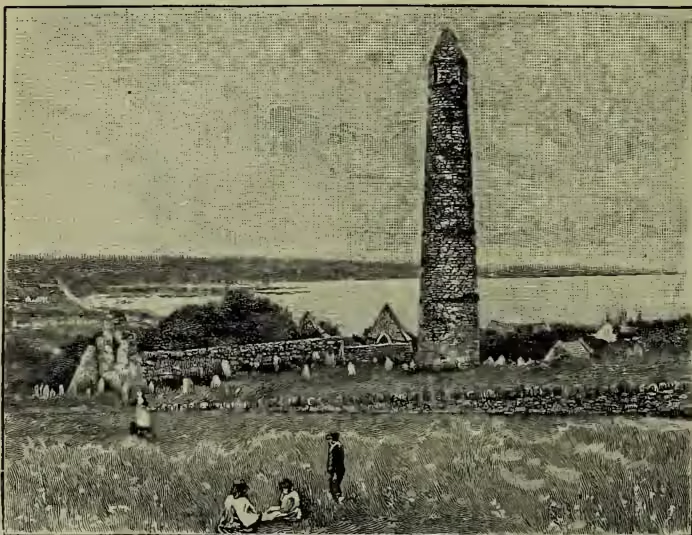
(From a Photograph by J. Lawrence, Dublin.)
Orkney. They are usually capped by a conical roof, and divided into stories, sometimes by yet existing floors of masonry, though oftener the floors have been of wood. Ladders were the means of communication from story to story. There is generally a small window on each story, and four windows immediately below the conical roof. The door is in nearly all cases a considerable height from the ground. The figure represents the tower at Ardmore, County Waterford, which is one of the most remarkable of those remaining in Ireland. Rising from a double plinth course at the bottom to a total height of 95 feet, it is divided into three stages by external bands at the offsets, corresponding to the levels of three floors within, the fourth being also marked by a slight offset. Most of these towers, however, have only a slight batter externally from top to bottom. Some, like that of Devenish, are carefully and strongly built of stones cut to the round, and laid in courses, with little cement; others, such as those at Cashel and Monasterboice, have the stones merely hammer-dressed and irregularly coursed; others, again, like those of Lusk and Clondalkin, are constructed of gathered stones untouched by hammer or chisel, roughly coursed, and jointed with coarse gravelly mortar; while in others, as at Kells and Drumlane, part of the tower is of ashlar, and the rest of rubble masonry. The average height of these towers is from 100 to 120 feet, the average circumference at the base about 50 feet, and the average thickness of the wall at the base from 3 feet 6 inches to 4 feet; the average internal diameter at the level of the doorway is from 7 to 9 feet, and the average height of the doorway above the ground-level about 13 feet. These doorways always face the entrance of the church to which the towers belonged. All the apertures of the towers have inclined instead of perpendicular jambs, which is also an architectural characteristic of the churches of the same period, and the sculptured ornamentation of the apertures or walls of the towers is in the same style as that of the churches. Dr Petrie was inclined to think that a few of these remarkable structures may be as old as the 6th century, but they are now assigned to a period ranging from the 9th to the 12th centuries. The source whence this form of tower was derived, and the cause why it was so long persisted in by the Irish architects, are points, however, on which there is not the same unanimity of opinion. Two round towers, similar to the Irish type, are to be seen in the yet extant plan of the monastery of St Gall in Switzerland, of the first half of the 9th century; and, in the Latin description attached to the plan, they are said to be ad universa superspicienda. The church and towers as rebuilt at that date are no longer in existence; but Miss Stokes has pointed out a passage in the life of St Tenenan of Brittany which shows that this type of round tower detached from the church was in use on the Continent in the 7th century, 'wherein to deposit the silver-plate and treasure of the church and protect them from the sacrilegious hands of the barbarians should they wish to pillage the church.' Lord Dunraven has traced the type from Ireland through France to Ravenna, where there are still six remaining out of eleven recorded examples. Hulsch considers the detached round towers or campaniles of the Ravenna churches to be of the same date as the churches themselves, or mostly earlier than the close of the 6th century; but Freeman, on the other hand, maintains that they are all later than the days of Charlemagne, as the local writer Agnellus, writing soon after his time, describes the churches of Ravenna much as they are, but says nothing of bell-towers. Suffolk and Norfolk contain more round-towered churches than does all the rest of England, probably because the flint there prevalent is worked into this form more readily than any other stone. A modern round tower is O'Connell's monument in Glasnevin Cemetery, which is 160 feet in height.
See Dr G. Petrie's Ecclesiastical Architecture of Ireland (Dublin, 1845); vol. ii. of Lord Dunraven's Notes on Irish Architecture (Lond. 1877); Dr J. Anderson's Scotland in Early Christian Times (Edin. 1881); and Miss Stokes's Early Christian Art in Ireland (Lond. 1887).
Roundway Down, a hill about 1½ mile N. of Devizes, in Wiltshire, the scene of Waller's defeat by the royalists under Lord Wilmot in July 1643. Waller was besieging Devizes when Wilmot came up to relieve the town, whereupon he turned at once to meet him, but was quickly crushed between Wilmot on the one side and a sally of the garrison on the other. Waller escaped, but only with the loss of his artillery and most of his men.
Round Worms (Nematoda), a class of worms in which the body is elongated and more or less cylindrical. Most are parasitic, such as Ascaris lumbricoides and Oxyuris vermicularis, common in man, and numerous species of Tylenchus, which infest plants. Many genera, however, live in water or in moist earth, and many of the parasites are free-living during part of their life. They are called round worms, in contrast to the flat worms or Plathelminthes, such as tapeworms and flukes. For classification, see THREAD-WORMS.
Roup is one of the most serious diseases which the poultry or pheasant keeper has to fight, because in it there is generally an affection other than the mere cold which develops and makes it apparent. It is usually found that the system is scrofulous, which is the milder form; but sometimes it takes a diphtheric development, and this is the most severe and deadly disease known to poultry-keepers.
Whether scrofulous or diphtheric, it is highly contagious, and very seldom is any bird in a yard attacked without nearly all the others being also affected. The difference between ordinary cold and roup is very easy to determine, though the symptoms are in some respects the same. But when it is merely cold the running at the eyes and nostrils is not at all offensive, whereas it is strongly so in the case of roup from scrofula, the breath being most repulsive. This fact, as well as the swelling of the face, may be taken at once to determine when it is roup. The cause may generally be sought for in bad feeding, housing, or ventilation, which have charged the blood with scrofulous matter, and the outward symptoms are induced by cold. When first noticed the birds affected should at once be isolated, in order to prevent the spreading of the disease, which will speedily follow if all are kept together. The treatment must be dual, namely to cure the cold and to remove the scrofula from the blood. For the former any of the roup pills sold can be used, or it may be removed by homeopathic tincture of aconite given three or four times a day, the birds being kept in a warm and draughtless place. The scrofula is not so easily eradicated, and will require patience. Ordinary-sized pills made of powdered charcoal 10 parts, dried sulphate of iron 1 part, and capsicum 1 part, made up with butter, and given twice a day, form an excellent medicine, when the roup proper in its more active state is removed. To do this, however, it is desirable to clear the mouth, nostrils, and eyes from the mucus which accumulates there and which will suffocate the bird if not removed. In milder cases it is enough to wash the parts with vinegar and water, but in more severe cases it is better to use solution of chlorinated soda, as it is much more effective. Should the nostrils be very full of mucus, a small bent syringe should be filled with the solution, which must be inserted into the slit in the bird's mouth, through which the liquid is forced, and will effectually clear the passages. It is most essential in returning the birds to the house again to see that they are entirely recovered. When diphtheric roup is present the matter assumes a more serious aspect, because of the danger not only to other birds, but also to human beings, who have been known to contract this fell disease from birds. For that reason the greatest care must be taken, and, except in the case of very valuable fowls, it is much safer to kill those affected and bury them in quicklime. The outward symptoms in diphtheric roup are not nearly so apparent at first sight, because less prominent; still, the bird is noticed to be dull and lethargic. Unless checked the disease runs its course in a few hours, and the bird dies. Very often it is not known that diphtheric roup is present until several deaths have taken place. Its presence is easily distinguished by the skin-like substance formed over the throat. Treatment is doubtful, and Professor Whalley recommends that it should take the heroic form of dabbing the throat with carbolic acid, which will kill or cure.
Roup, in Scotland. See AUCTION.
Rous, FRANCIS, was born at Halton, Cornwall, in 1579, and educated in Oxford at Broadgate Hall, now Pembroke College. He was a member of the Long Parliament, sat in the Westminster Assembly of Divines, and in 1643 was made provost of Eton. He died at Acton, 7th January 1659, his writings having been collected two years before. Wood is abusive even beyond his wont to 'the old illiterate Jew of Eaton' and his 'enthusiastic canting.' His metrical version of the Psalms was recommended by the House of Commons to the Westminster Assembly, and is still substantially the Presbyterian Psalter. It is easy to abuse his version—Sir Walter Scott's verdict was that, though homely, it is 'plain, forcible, and intelligible, and very often possesses a rude sort of majesty, which perhaps would be ill exchanged for mere elegance.'
Rousseau, JEAN BAPTISTE, a great lyric poet of France, was born at Paris, 6th April 1670, the son of a shoemaker who gave him a sound education. At an early age he became acquainted with Boileau, and began to produce pieces for the theatre, with but little success. Among his earliest patrons were Breteuil and Tallard, and the latter carried him in his suite to London. His turn for satire soon brought him troubles as well as reputation, and some lampoons upon the literary frequenters of the Café Laurent, chief of whom were La Motte and Saurin, brought down upon his head a quarrel that distressed the remainder of his life. Defeated by La Motte in 1710 in his canvass for T. Corneille's chair at the French Academy, he was soon after taken by everybody for the author of a fresh series of scurrilous and indecent couplets. He charged Saurin with writing them and attempting to foist the paternity upon him, and raised an action against him. Failing to make good the charge, he found himself in 1712 condemned in absence to perpetual banishment par contumace. Henceforth he lived abroad under the patronage of the Comte de Luc, French ambassador to Switzerland, and afterwards of Prince Eugene and the Duc d'Aremberg. At Brussels he made the acquaintance of Voltaire, but from a friend the latter soon became a bitter enemy. Rousseau visited England, and there published in 1723 a new edition of his works. He was never successful in getting his banishment annulled, although once at least he visited Paris incognito. He died at Brussels, March 17, 1741. Rousseau was not a great, only a supremely clever poet. His sacred odes and cantates were splendidly elaborate, frigid, and artificial; his epigrams, on the other hand, are bright, vigorous, sharp, with stinging satire, and unerring in their aim.
Editions are by Amar (1820) and A. de Latour (1869). See also his Œuvres Lyriques, by Manuel (1852), and Contes inédits, by Luzarche (Brussels, 1881).
Rousseau, JEAN JACQUES, was born on June 28, 1712, in Geneva, where his family had been settled since 1550, when Didier Rousseau, a French Protestant, sought shelter from persecution. His mother died immediately after his birth, and he was left to the companionship of his father, Isaac Rousseau, a watchmaker and dancing-master, a man selfish and sentimental, passionate, dissipated, and frivolous. In 1722 his father having involved himself in a brawl fled the city to escape imprisonment, and left him to the charitable care of his relations. When he was thirteen his uncle apprenticed him to a notary, who soon found him utterly incompetent, and sent him back as a fool; and thereafter he was apprenticed to an engraver, whose cruelty during the three years he lived with him, he says, made him stupid by tyranny, cunning from fear, and wretched by ill-treatment. One evening, having rambled beyond the city walls till the gates were closed, he was too terrified to face his master, and resolved never to return, but to seek elsewhere his fortune. Now, in 1728, began his adventurous and vagrant career, for the details of which his Confessions form our chief authority, in which with picturesqueness and charming vivacity, with marvellous frankness, if not with scrupulous accuracy, he tells the story of his life. As he wandered on he was entertained by a priest of Savoy, eager for proselytes from heresy, and Jean Jacques, pretending to be eager to espouse the Catholic faith, was sent off to Madame de Warens at Annecy, who should look after the
Calvinistic vagrant. By her he was hospitably received and then transmitted to a hospice in Turin filled with some fellow-catechumens; and soon initiated into the faith and duly baptised, he was discharged with a few francs in his pocket. He in vain sought work as an engraver, till a shop-keeper's wife gave him employment, and to her he acted in the double capacity of servant and lover, till on her husband's return he was kicked out of doors. He next became footman to a Comtesse de Vercellis, and on her death not long after he took service again as lackey to Comte de Gouvon, and as nondescript secretary to the abbé, his master's son, till he became intolerable both to his masters and his fellow-servants, and was summarily dismissed.
Now in 1731 he travelled back to Madame de Warens, who welcomed him and installed him as permanent inmate of her house. Madame de Warens or, as her name was otherwise written and pronounced, Vorrans or Vuarrans, lived apart from her husband a very independent life, having a pension, which late investigation suggests may have been earned by acting as a political spy. She was twenty-eight years old, pretty and piquant, kindly in disposition, not rigid in morals, but rich in sentiment. She was clever and flighty, dabbling in chemistry and alchemy, dabbling also in commercial speculations which made her the dupe of adventurers, and indulging in religious speculations which combined Deism in creed with Roman Catholicism in worship. To her Jean Jacques, now nineteen years old, became pupil and friend, factotum, and ultimately lover, through nearly nine years. This period was diversified by adventurous interruptions: he at one time set himself up in Lausanne as a teacher of music though hardly able to play a tune, and as a composer though not able to write a score; became secretary to an archimandrite of the Greek Church, collecting subscriptions to recover the Holy Sepulchre; and then went to Paris as servant to an officer. Thereafter he returned to live with Madame de Warens at Chambéry, and from 1736 at Charnettes, in which lovely retreat his happiest and idlest years were spent, in desultory reading with his maman, in music, indolence and sentiment. This attachment and companionship ceased ingloriously at last when on returning from recruiting his health at Montpellier he found himself supplanted in the heart of Madame de Warens by one Vintzenried, whom he describes as a journeyman wig-maker, ugly and a fool, who as a lover was tyrannising over his facile mistress, mismanaging her affairs and dissipating her money. In disgust in 1740 Jean Jacques quitted his beloved Charnettes, the idyllic memories of which lived in his heart, as by his picturesque description they live immortal in literature. He became now tutor in Lyons to the sons of M. de Mably, the brother of the famous Condillac and of the once well-known Abbé de Mably, where he taught with lamentable incapacity.
In 1741 he set off to seek his fortune in Paris, with a little money, some letters of introduction to Parisian notables, and a system of musical notation by which he expected to make his reputation. He had to live in a dirty, shabby inn, and to earn a meagre livelihood by copying music, while his musical system was pronounced by the Academy of Sciences 'neither useful nor original.' After a sojourn of eighteen months at Venice, where he acted as cheap secretary to the embassy till he quarrelled with the ambassador, he returned to his inn, his copying, and a secretaryship with M. de Francueil. Meanwhile he had formed a companionship with a girl he found acting as drudge at the inn, called Thérèse le Vasseur, utterly illiterate, densely stupid, plain-featured, mean and vulgar, although he imagined her possessed of every grace in body, mind, and soul. By her he had five children, each in turn deserted and consigned by him to the hospital for foundlings. He had gained acquaintance with men of letters, with D'Alembert and Diderot, as needy as himself; and when they were producing the famous encyclopædia he wrote articles, of which the most notable were those on music and political economy. His first distinguished appearance in literature was in 1749 by a Discourse on Arts and Sciences, written successfully for a prize offered by the Academy of Dijon on the problem whether science and the arts have corrupted or purified morals. Here with bold paradox he denounces fiercely and eloquently letters, arts, sciences, and all culture as alike proofs of and causes of corruption. The audacious independence of his thought, the freshness of his brilliant style, made him at once celebrated in literary and welcome to fashionable circles of society. In 1753 he next made himself distinguished as a composer by his opera the Devin du Village, full of novel and sparkling airs (one of which, slightly modified, is the well-known hymn-tune called Rousseau's Dream), which was first played with success before the court at Fontainebleau, and when performed in Paris achieved for him a popularity which was not sustained by subsequent efforts. It was in the same year that there appeared his Discourse on the Origin of Inequality, which, though unsuccessful in winning the prize from the Academy at Dijon, was successful in establishing his position as a writer in France. In this discourse he argues that all civilisation is a state of social degradation, that all science and literature, all social institutions and refinements are forms of degeneration from the primeval savage life, which, with all its ignorance and brutishness, he audaciously pronounces the state of human simplicity and perfection. All property is asserted to be derived from confiscation, all wealth is a crime, all government is tyranny, all social laws are unjust.
His brilliant denunciation of society made him the more attractive in society; but hating alike the company of wits and of courtiers, and despising fashionable conventions, he lived poorly, dressed meanly, and acted churlishly to show his independence, with that morose self-consciousness, blended with vanity, which was becoming with him a disease. Gladly he accepted from Madame d'Épinay the offer of a retired cottage, the Hermitage, on the skirts of the forest of Montmorency, near her own château Clevette. There he retired with Thérèse, her obnoxious mother, and his meagre chattels. Still earning his living by copying music, which produced about £60 a year, he employed his days amidst the woods of Montmorency with conceiving and writing his romance, The New Héloïse, inspired in the composition of its rapturous passages by a passion he had formed for Madame d'Houdetot, the sister of Madame d'Épinay. His suspicious temper fostered misunderstandings with his patroness, and bitter quarrels with her friend Baron Grimm, and with his own warm friend Diderot; and he quitted the beloved Hermitage with reluctance for a cottage at Montlouis not far off, where he found kind friends in the Duke and Duchess of Luxemburg. In 1760 the New Héloïse was published, and was instantly received with applause, and Rousseau became the idol of the sentimental though artificial society of Paris. His work was followed in 1762 by the treatise on the Social Contract, published in Amsterdam in order to escape French censorship; and there two months later also appeared Émile. By the first work the recluse rose to the first rank. as a writer of the romance of sentiment; by the second as a political socialist; by the third as an educationist.
But the views in Émile on kings and government made him obnoxious to the state, and the parliament condemned the author to be arrested and his book to be burned; while its deistic teaching in the Savoyard vicar's confession made him hateful to the church, and called forth a denunciatory pastoral from the Archbishop of Paris. Rousseau in terror fled from France, and found shelter at Motiers, an obscure village in Neuchâtel, where he was safe under the tolerant rule of Frederick the Great, and the friendship of the Earl Marischal, George Keith, the governor of the province. Although he lived unobtrusively in botanising rambles, in making lace, and in writing his aggressive Letters from the Mountain, and his powerful reply to the Archbishop of Paris, religious rancour followed him to the remote and peaceful Val de Travers. The ministers stirred up the villagers against the heretic, and to escape their open hostility he took flight in 1764. A residence of delicious quietude in St Pierre on Lake Bienne was ended by threat of prosecution from the government of Berne; and he accepted the offer of a home in England, given through David Hume. Under the charge of the good-natured historian, the irritated and sensitive fugitive came to England in January 1766. During about eighteen months he lived at Wootton in Staffordshire, solitary and quiet: here he busied himself with botany and his Botanical Dictionary, and especially in composing his Confessions, in which he determined to write his memoirs, to expose his enemies, to reveal himself—in spite of every fault, which he resolved to own—as one of the very 'best of men.' His suspicious nature, his morbid distrust and fears, had increased with his trials and his years. He had quarrelled with almost every friend, imagining the worst meaning in the best of motives; he believed that his truest friends, like Hume, acted with the most sinister designs, that the English government sought his life, and that he was everywhere dogged by spies. Suddenly he quitted Wootton, and, crossing the Channel, got a shelter from the doctrinaire Marquis de Mirabeau, and then from the Prince de Conti at Trye; and there he lived, under the name of 'M. Renon,' till he fancied that he was insulted by the domestics and that he was suspected of poisoning a servant. After various shifty changes he lived at Monquin, a retired, quiet spot, where he composed those later parts of his Confessions, in which each incident is coloured by his gathering delusions as to the motives of every one with whom he came in contact. In 1770 he returned to Paris, and remained unmolested, following his old life as copyist at ten sous a page, in a fifth story in the Rue Plâtrière, maintaining a surly independence, distrusting his friends, rebuffing admirers, insulting his customers. During these years, in different moods of mind and changing conditions of his broken health, he wrote the wild, half-mad dialogues, Rousseau juge de Jean Jacques, in which he vindicates his character in a strain which casts doubt on his sanity, and his Récories du Promeneur Solitaire, which, in singular contrast, are calm in their tone, idyllic in their beauty, and perfect in their style. Still the delusions increased, and his mental misery deepened till he even craved for shelter in a hospital; everywhere he felt watched by spies, hated by the very children in the streets. In 1778 he accepted the last of these many offers of shelter, and retired to a cottage given him by M. de Girardin on his estate at Ermenonville, 20 miles from Paris. There he suffered from the misconduct of Thérèse, and from inveterate delusions, till, with a suddenness which has given much ground for suspicion of suicide, Jean Jacques Rousseau died on July 2, 1778. His body now rests in the Panthéon.
If the character of Rousseau can be learned from the judgment of his friends and foes, it can be also discovered from his own writings, which tell the story of his life—his Confessions, his Letters, his Récories. We may receive his own version of many of his own acts with doubt, and his interpretation of the acts of others with reserve, while details in the Confessions are known to be in many cases inaccurate; but as a picture of the man they are strikingly truthful. He is moved by a daring determination to conceal nothing, believing that every defect will only show the intrinsic beauty of his character as patches show off better the complexion of the face. Therefore he tells his ignoble intrigues and his paltry actions, how he deserted his companion when he fell in a fit, how he basely accused a poor girl, his fellow-servant, of theft to conceal his own dishonesty. He exhibits his jealousies and his hates, his lofty sentiments and his petty practices, his unbounded confidence in himself not only as a man of genius, but as a man of supreme rectitude. In spite of the worst he confesses and the worst charged against him by others, he needs commiseration in his faults, as arising from a mind disordered, and he deserves respect for his sincerity of thought, his independence of conduct in spite of its coarseness, his spirit of reverence, and his generosity of heart and hand. As a writer his influence has been exercised in diverse directions. His New Héloïse, suggested alike in its clumsy form of letters, its didactic passages, and its fervid romance by Richardson's novels, stirred by its strain of passion a spirit of sentiment in the society and literature of France, Germany, and Italy; by its idyllic pictures and exquisite descriptions it awakened a new admiration for nature in its grand and wild aspects, and touched the fashionable world with interest in rural life and in its simple ways. Amidst all its falsetto passion, it taught an artificial society the rights of the poor and the duties of the rich. The Social Contract proceeds on the premise that the basis of society is an original compact by which each member surrenders his will to the will of all, on the condition that he gets protection or defence; and arguing that the community is the true sovereign, that each member of it has equal power and right to make its laws, Rousseau arrives at the conclusion that kings are usurpers, that no laws are binding to which the whole people's assent has not been gained. True to his own Genevan traditions and tastes, he considers a republic in which all the people have personal votes as alone valid, and his doctrines of liberty, equality, and fraternity were adopted by leaders of the people, were carried by demagogues to logical extremes he never dreamt of, and became war-cries of the Revolution. By Émile, in which the man who abandoned his own offspring becomes the instructor of the age on the nursing of infants, the rearing of children, and the education of youth, with keen observation of life he pointed out the defects of common methods in the nursery and the school-room. The work had marked results in discouraging the faults and neglects in artificial society towards children, and in indicating a more natural and less pedantic method of training and developing the physical, mental, and moral faculties; and his ideas on this head (while many absurdities and whimsicalities in the book were avoided) were in large measure carried out by educationists like Froebel and Pestalozzi, and affected the educational methods of all Europe. By his famous chapter on the Savoyard vicar's confession he gave a confession of his own deistic faith, which disgusted
Voltaire, D'Alembert, and D'Holbach by its strain of religious fervour and conviction, and horrified the church by its scornful denial of orthodoxy and supernaturalism. Meanwhile it kindled in France a spirit of severest theism instead of cynical scepticism or blank denial, and inspired Revolutionists like Robespierre with the doctrine that belief in a God is essential for society and the state.
See Musset-Pathay, Histoire de la Vie et les Œuvres de J. J. Rousseau (1821); Streckeisen-Moulton, Rousseau; Ses Amis et ses Enemis (1865); St Marc Girardin, J. J. Rousseau, sa Vie et ses Œuvres (2 vols. 1875); John Morley, Rousseau (2 vols. 1873; 2d ed. 1886); Berthoud, Rousseau au Val de Travers (1870); Moreau, Rousseau et le Siècle Philosophe (1870); Desnoiresterres, Rousseau et Voltaire (1874); Dernières Années de Madame d'Épinay, edited by Percy and Maugrat (1881); the present writer's monograph in the 'Foreign Classics' series (1883); Jansen, Rousseau als Musiker (1885); Mahrenholtz, Rousseaus Leben (1889); Möbius, Rousseaus Krankheitsgeschichte (1889); Madame de Warens et Rousseau, by François Mugnier (1890); Carteret, Rousseau jugé par les Français d'Aujourd'hui (1890); Rousseau's Lettres Inédites, edited by H. de Rothschild (1892); Chuquet's study in the 'Grand Ecrivains' series (1893); besides essays on Rousseau as a pædagogue by Quick and others.
Rousseau, PIERRE ETIENNE THÉODORE, one of the most distinguished of the modern landscape-painters of France, was born in Paris on the 15th April 1812, the son of a well-to-do merchant tailor of the city, a native of Salines in the Jura. There were several artists among his mother's kinsmen; and one of these, Alexandre Pau de Saint Martin, having seen a landscape, 'The Signal Station on Montmartre,' which the boy painted at the age of fourteen, gave him some instruction, and persuaded his parents to abandon their intention of entering their son at the Ecole Polytechnique for an engineer, and to place him, instead, under Rémond the landscape-painter. The classical ideal and methods of this artist were little to the liking of his pupil, who next worked under Guillon-Lethière, and in the Ecole des Beaux-Arts; but his best teachers were the old masters in the Louvre, and his happiest hours were those spent in sketching from nature in the environs of Paris. In 1830 he was painting in Auvergne and Normandy, and he studied landscape in nearly every district of France; but by 1833 he had begun sketching in the Forest of Fontainebleau, which ever after was his favourite painting-ground, and where he finally settled, in the village of Barbizon, in 1848. He first exhibited in the Salon of 1831, and in 1834 his 'Border of the Forest of Compiègne' gained a third-class medal and was bought by the Duke d'Orleans; but in the following year his 'Descent of Cows in Autumn,' painted in the Jura, afterwards purchased by Ary Scheffer, and 'The Alley of Chestnut Trees,' one of his finest works, were rejected—in excellent company—through the influence of Bidault and Rochette, the president and secretary of the Academy. Some twelve years of more or less complete neglect and discouragement followed, and left such baneful effects upon a mind naturally proud and melancholic as may account for the petulance and acerbity which marked certain passages of Rousseau's later life. But in 1848 the painters themselves assumed the management of the Salon exhibitions: he was elected one of the jury; and in the following year he resumed exhibiting, and gained a first-class medal. His works were prominently hung in the Exposition Universelle of 1855; as also in that of 1867, when he was president of the jury, and the only landscape-painter who won a grand medal. Soon afterwards he was appointed an officer of the Legion of Honour; but before he was decorated he had been attacked by paralysis, and, after lingering six months, he died on the 22d of December 1867.
Though Rousseau was most deliberate in his art methods, and would often keep his canvases long in hand, altering and retouching them, he was yet an exceedingly prolific, if a somewhat unequal, painter. At his best his works are characterised by true dignity and originality of style, by noble richness of colouring, and are informed by deep sentiment and emotion. His productions now command immense prices, his 'Early Summer Morning' having sold in New York, at the Probosco sale in 1887, for $21,000. See Sensier, Souvenirs de Théodore Rousseau (1872); and D. C. Thomson, The Barbizon School (1890).
Rousselaere. See ROULERS.
Roussillon, formerly a province of France, surrounded by Languedoc, the Mediterranean, the Pyrenees, and the county of Foix. It now forms the French department of Pyrénées-Orientales. In ancient times the capital was Ruscino, which stood in the vicinity of the modern Perpignan.
Routh, MARTIN JOSEPH, was born of Yorkshire ancestry at St Margaret's South Elmhurst, Suffolk, on 18th September 1755. His father, a clergyman, in 1758 settled as schoolmaster at Beeccles, whence Martin in 1770 went up to Queen's College, Oxford. In 1771 he was elected a deany, in 1775 a fellow, and in 1791 president, of Magdalen. He took deacon's orders in 1777, but priest's not till 1810, when he was presented to the rectory of Tylehurst, near Reading, worth £1000 a year; ten years later he married Eliza Agnes Blagrave (1790-1869). He died at Magdalen, 22d December 1854, in his hundredth year.
A little shrunken figure, with 'such a wig as one only sees in old pictures,' he had grown very deaf, but till well after ninety retained his eyesight and marvellous memory, could walk six miles and climb a stiffish hill, mount the library steps, and study till past midnight. Newman and Bancroft were among his later friends and acquaintances; the earlier had included Dr Parr, Samuel Johnson, and Porson. He was a great patristic scholar when patristic scholars were few, a Caroline churchman, a liberal Tory, a lover of his dogs and canary and joke, a mighty book-buyer to the last—his 16,000 volumes he bequeathed to Durham University. For just seventy years he was publishing, but his works number only six; and two of these are editions of Burnet ('I know the man to be a liar, and I am determined to prove him so'). He will be remembered by his Reliquiae Sacrae (5 vols. 1814-48), but still more for his sage advice, 'Always verify your references, sir.' And Dr Routh it was who in 1783 induced Dr Scabury of New York to apply for consecration as bishop of Connecticut, not to the Danish Church, but to the Scottish episcopate. See Burgen's Lives of Twelve Good Men (1888).
Roveredo, a town of the Austrian Tyrol, stands close to the left bank of the Adige, 14 miles S. of Trent by rail. It has been since the 15th century the centre of the Tyrolean silk industry; it has also leather and tobacco factories, and carries on an active transit trade. Pop. 8864. Here the French defeated the Austrians, September 3-4, 1796. Rosmini was born here in 1797. See Bertanza, Storia di Roveredo (1883).
Rovigno, a seaport of Austria, stands on the west side of the peninsula of Istria, opposite the mouth of the Po and 40 miles S. by W. of Trieste. The neighbourhood produces olive-oil and the best Istrian wine. The tunny and sardine fisheries, with oil-pressing and the preparation of pastes and tobacco, are the chief industries. Pop. 9722.
Rovigo, a city in Italy, 27 miles by rail S. of Padua, has a cathedral (1696), an academy of sciences, a library of 80,000 volumes, and a picture- gallery. Pop. 7560.—The province has an area of 643 sq. m. and a pop. (1898) of 247,626.
Rovuma, a river of East Africa, rises on the east side of Lake Nyassa, flows eastward, and enters the Indian Ocean, after a course of more than 450 miles, a little north of Cape Delgado. During the greater part of its length it forms the boundary between the German and the Portuguese East African possessions. It was first ascended by Livingstone and Kirk in 1862.
Row (pron. Roo), a village of Dumbartonshire, on the east shore of the Gare Loch, 2 miles NW. of Helensburgh, which is included within the parish, and with which it is connected by railway (1894). The saintly John M'Leod Campbell (q.v.) was minister of Row from 1825 till his deposition for alleged heresies in 1831.
Row, JOHN (c.1525-80), a Scottish Reformer, was born near Stirling, studied at St Andrews, and in 1550 was sent by the Scottish clergy as their representative to Rome. While in Italy he took the degree of Doctor of Laws at Padua. In 1558 he returned to Scotland, and next year abandoned the Roman faith. In 1560 he aided in compiling a Confession of Faith and the First Book of Discipline, became minister of Perth, and sat in the first General Assembly of the Church of Scotland. He was four times moderator, and took a share in preparing the Second Book of Discipline.—His eldest son, JOHN ROW, was born at Perth in 1568, studied at Edinburgh, became minister of Carnock in 1592, and died in 1646. He wrote a dull and prolix but reliable History of the Kirk of Scotland, which was at length printed by the Maitland Club (2 vols. 1842) and the Wodrow Society (edited by David Laing). The work extends from 1558 to 1637, but was continued after his death (1580) to 1639 by his second son, JOHN ROW (1598-1672), rector of Perth grammar-school, minister at Aberdeen, moderator of the provincial assembly there in 1644, and, by appointment of Monk's commission of colonels, principal of King's College in 1651. Like his father and grandfather a learned Hebraist, he published in 1634 Hebraica Linguae Institutiones, and in 1644 Chilias Hebraica seu Vocabularium.
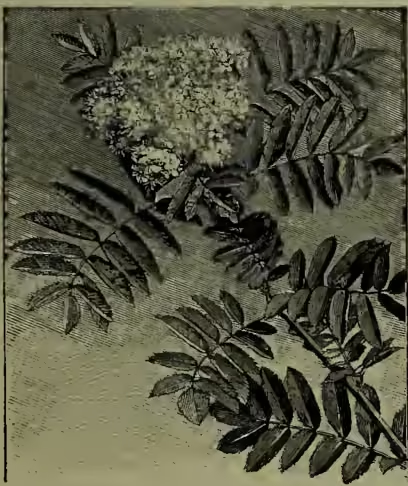
Rowan Tree, MOUNTAIN ASH, or QUICKEN TREE (Pyrus aucuparia; Sorbus aucuparia of many botanists), a tree belonging to the natural order Rosaceæ, abundant in Britain, especially in the Highlands of Scotland, and in many parts of continental Europe. It does not attain a great size, but is one of the most ornamental trees that occur in British woodlands. The wood is valued for its compactness and fine grain, and is capable of taking a high polish. In the superstitions of the Scottish Highlands, and also of the Lowlands, a peculiar importance was assigned to the rowan tree, a mere twig of which was supposed to have great efficacy in scaring away evil spirits. The fruit (Rowan berries) is sometimes used for preserves. It has much acidity, and a peculiar bitterness. In some parts of northern Europe the berries are dried and ground into flour as a substitute for wheaten flour in times of scarcity of the latter. By fermentation they yield an agreeable liqueur, and by distillation a powerful spirit. In Russia a tincture is formed of the ripe berries, which is greatly esteemed as a stomachic. It is made by filling a cask two-thirds full with berries, which have been carefully picked and cleaned. The cask is then filled up with brandy, gin, or rum, and allowed to stand in a cool cellar for twelve months, when the liqueur is run off, and is found impregnated with both the colour and the flavour of the fruit. The fruit of the rowan tree is generally red, but there is a variety with yellow fruit, and a very nearly allied species, P. americana, a native of North America, has purple fruit.
Rowe, NICHOLAS, dramatist and translator, a contemporary and friend of Congreve, Pope, Addison, and Steele, was the son of a sergeant-at-law, and was baptised at Little Barford, in Bedfordshire, June 30, 1674. He was educated at Westminster under Busby, and studied law in the Middle Temple; but early inheriting a small competency by the death of his father, he devoted himself to literature. Between 1700 and 1714 he produced eight plays, of which three were long popular, and deservedly: Tamerlane (1702), The Fair Penitent (1703), and Jane Shore (1714). The character of Lothario in The Fair Penitent was the prototype of Lovelace in Richardson's Clarissa Harlowe, and indeed the name is still the proverbial synonym for a fashionable rake. Rowe translated Lucan's Pharsalia, and his work, says Dr Johnson, 'deserves more notice than it obtains, and as it is more read will be more esteemed.' His edition of Shakespeare (7 vols. 1709-10) at least contributed to the popularity of his author. Rowe's comedy, The Biter (1705), lived only to be damned as it deserved. Rowe, we are told, had no heart, yet his vivacity and engaging manners procured him many friends and several lucrative offices. The Duke of Queensberry made him his Under-secretary of State. In 1715 he succeeded Tate as poet-laureate; and the same year he was appointed one of the surveyors of customs to the port of London; the Prince of Wales made him Clerk of his Council, and the Lord Chancellor Parker secretary of Presentations in Chancery. He died December 6, 1718, and was buried in Westminster Abbey.
Rowing. The oarsman sits with his face to the stern of the boat, his feet planted flush against his 'stretcher' or footboard, and the handle of his oar in his hands, the loom of the oar resting in the rowlock, the 'button' being inside the thowl-pin. He should sit upright, with a rigid back, and do his work mainly with his back and legs, using his arms as couplings between his body and the oar-handle, and only bending them towards the finish of his stroke. To row a stroke, swing the body forward from the hips straight towards the toes; extend the arms rigidly, brace the shoulders, and keep the head up. The hands should be holding the oar-handle about inches apart. The grasp should be with fingers and not fist—i.e. the lower knuckles of the hand should be very slightly bent, almost straight, the hold being retained by the upper joints of the fingers and by the thumb. This mode of holding the oar gives freer play to the wrist-joints for the 'feather,' of which more anon. The body being thus extended, and the legs opened at the knees to allow the body free swing forward, and the hands thus grasping the oar-handle, then the stroke is begun by raising the hands enough to allow the blade of the oar to sink into the water square. (It is most important that the blade should be square to the plane of the surface of the water; otherwise, as soon as the stroke commences, the blade fails to preserve its own plane, and sinks too deep, or springs out of water, according as the face of it is inclined at an obtuse or acute angle to the water.) When the oar has been thus lowered into the water, by raising the hands over the stretcher, the stroke should commence—sharply, by bracing the muscles of back, loins, shoulders, and legs, and throwing the body backwards, swinging from the hips, the feet firmly pressing against the stretcher, the arms rigid; so that the weight of the body is eased as much as possible off the seat, and is transferred to the oar-handle and the stretcher. When the body has reached the perpendicular, in the swing, back the arms should begin to come in. The action of bringing them in should be from the shoulders, the elbow-joints gradually bending, but the forearm remaining as near as possible parallel to the water. The 'biceps' should not be exerted, else the forearms bend upwards, the hands rise, and the blade buries. The body should not 'wait' for the arms and hands to overtake it: it should be still swinging back till the hands overtake it.
When the hands reach the breast-bone they should be sharply dropped about two inches: this raises the oar out of the water. After this drop of hands they should be turned sharply from the wrists till the knuckles touch the body. This turn produces the 'feather.' If the turn is made too soon, before the hands have reached the chest, the action is faulty, and produces what is called 'feather under water,' by turning the oar edgewise in the water instead of after the oar has left the water. So soon as the drop and turn of wrists has ended and 'feather' has been performed, the 'recovery' should commence. The body should instantly, and without 'hang' or delay, commence to swing forward again like a pendulum. The hands should at the same instant be shot out and the arms extended, reaching their extension by the time that the body has once more attained the perpendicular in its forward swing. The swing should continue forward till full reach has been attained for a new stroke; then once more the hands should be raised, the oar lowered into the water, and a new stroke rowed. In rowing behind another oarsman the eyes should catch the back in front of the oarsman, who should take time and swing from it—keeping 'eyes in the boat.' The oarsman at first finds it difficult to 'govern' his blade—i.e. to keep it in the right plane—and at the correct elevation or depression, according to whether he is rowing the stroke or is 'recovering.' In time his wrists become more apt, and time their action to the ever-varying positions of the body. The more he attains to a correct grasp of his oar-handle the easier will be the play of his wrists, and the greater facility will he find in regulating the plane of his blade. It has been said before that the blade should be 'square' to the water throughout the stroke. So it appears to the oarsman; but in well-constructed boats the 'thowl' is slightly inclined in the direction in which the oarsman is looking; this inclination gives the oar-blade a correspondingly slight inclination forward, making it describe a trifle less than a rectangle with the water, and so obviates any tendency to row 'deep.' It will suffice if the beginner thinks of keeping his blade 'square;' and the small deviation from the square, reducing the angle that is effected by the slope of the thowl for his benefit, will then be produced naturally by the mechanism of his work. If this inclination of the thowl is made too great the oar has a tendency to fly out of the water.
To stop the way of a boat she should be 'held.' This is done by laying the blade flat, and thus slightly sinking the edge which lies towards the direction in which the boat is travelling. This causes the blade to bury at an acute angle to the plane of the water. This checks the way until it is reduced enough to allow the oarsman to turn the blade square, reverse way, and to 'back' water. If he tries to back water with any pace on, before he has first 'held' the boat, the resistance to his blade not only risks fracture, but is likely to be beyond his strength, to lay him flat on his back, and to make him 'catch a crab.' In backing water the process of the stroke, described above, should be reversed, so far as circumstances will allow—i.e. the oarsman has no stretcher to press against, and is 'pushing' with his weight instead of 'pulling.' In most 'tub' boats, and in all racing boats, straps are laid across the stretcher, to hold the feet at the instep, and so to facilitate recovery. The strap should only be used as an adjunct to recovery, not as the sole means: the loins should play their part in swinging the body forwards; and the arms, by being rapidly shot out, should aid the action of the loins. If a tyro is found to rely too much on his strap, a mentor may with advantage remove the strap until proper use of the loins has been effected.
Sculling.—In sculling each hand holds one scull, instead of there being two hands on one oar as in 'rowing.' The principles of action of body, legs, and arms are the same as in rowing, except that the body, when sculling, may with advantage be swung farther back at each stroke than in rowing. The grip of a scull should be on the same principle, as regards holding in fingers and not in fist. The thumb should not clasp under the handle, but cap the butt of the scull with the top joint. In rowing this would be wrong; but in sculling it is found to secure the better hold, and to give freer play to the wrists for feathering. It is important that both hands should work together, both blades entering and quitting the water together, and both wrists feathering simultaneously. If one hand is later than the other the course of the boat is distorted at each stroke.
BOAT-RACING.—Virgil, in Æneid, v., describes a boat-race between four Trojan galleys; and the word 'regatta' is of Italian origin. But boat-racing may be said to be almost exclusively an Anglo-Saxon sport. Germans of late have slightly taken it up, but 95 per cent. of the sport is found in Britain and her colonies and the United States.
Eton and Westminster schools practised boat-racing in the early part of the century; thence the pastime seems to have spread to the universities. One of the earliest races of the century was between Westminster boys and the 'Temple' crew, in six oars, the boys winning. As early as 1815 college 'bumping' races in eight oars had begun at Oxford. In those days only three or four colleges manned eight. Cambridge adopted a similar sport at much the same date, or a year or so later. In 1829 the first Oxford and Cambridge match was rowed—Hambledon lock to Henley Bridge. The next was in 1836, Westminster to Putney; after that at intervals till 1856, since which date these matches have been annual. Up to 1898 Oxford had won 32 and Cambridge 22 of them. There was one 'dead heat' (1877). Also, five times have the U.B.C.'s been drawn together in the same heat for the 'Grand Challenge' at Henley, of which Oxford won 3 and Cambridge 2 encounters; and once Oxford beat Cambridge in an encounter for the 'Gold Cup' at the now extinct Thames regatta of the 'forties.' 'Outriggers' were first used by the two university crews in 1846. Sliding seats were first used by them in 1873. 'Keelless' eights were first used by them in 1857. In 1845 the Putney to Mortlake course was first adopted for these matches. Outriggers are a contrivance for artificially extending the gunwales of a boat, so as to give the required leverage for the oar in the rowlock, while the rest of the hull is narrowed to offer less resistance to the water. The earliest application of the principle was with wooden outriggers on the Tyne before 1836. Iron outriggers were first used by H. Clasper for a Tyne firm in a Thames regatta in 1844.
Professional Racing.—The earliest recorded professional champion sculling race was in 1831, when one Campbell, Thames waterman, beat one Williams for the championship of the Thames from Westminster to Putney. In 1847 the Putney to Mortlake course was first adopted for these watermen's matches. In 1859 the title first left the Thames, and was won by R. Chambers of the Tyne. It oscillated between the representatives of these rivers, aliens and colonials now and then competing unsuccessfully, until 1876, when E. Trickett of Australia beat J. Sadler of the Thames. Since that date the sculling premiership has oscillated between Canada and Australia; E. Hanlan of Toronto, W. Beach of Sydney, and W. Searle of Sydney being the most noted holders. In 1889 Searle the holder died; and there being no tribunal to decide which two of various aspirants had the first claim to compete for the vacancy, or how many must compete before a new premier could be recognised, some doubt arose as to which, M'Lean or Stansbury of Australia or O'Connor, United States, had the best claim at this moment to the honour.
The 'Amateur Sculling Championship' is symbolised by the 'Wingfield Sculls,' established in 1830. The trophy now carries with it the amateur championship of England. The holder has to meet the best of all challengers once a year, on a date fixed by a committee of old champions, about July, or to abandon in favour of the best challenger.
Regattas.—Henley regatta was founded 1839. In 1886 the course was changed as to some 300 yards of its length, to avoid a corner which gave unfair advantages. It is now a three days' meeting, and comes off early in July each year. The prizes are 'Grand Challenge,' for best eight oars; 'Stewards' Cup,' for best four oars; 'Ladies' Plate,' for college and school eights; 'Thames Cup,' for second-class eights; 'Wyfold Cup,' for second-class fours; 'Visitors,' for college and school fours; 'Silver Goblets,' for any pair of oarsmen; and 'Diamond,' for sculls. By first and second class eights and fours are meant the classes which usually compete at the races referred to—e.g. no one who rows for 'Grand Challenge' may row for 'Thames Cup' the same year; nor if he rows for 'Stewards' four may he row in a Wyfold crew; and as the 'Grand' and 'Steward' are the more valuable prizes, the better eights and fours usually elect to do battle for them, and the weaker reserve themselves for the lesser races. There are other regattas of less importance—e.g. 'Metropolitan,' on the Thames tideway, Kingston-on-Thames, Walton-on-Thames, Moulsey, Reading, &c.; and provincial regattas at Tewkesbury, Bridgnorth, Worcester, Tyne, Durham, Burton-on-Trent, Bedford, &c.
The best regattas affiliate themselves to the 'Amateur Rowing Association,' a sort of jockey club of oarsmanship, the object of which is to pro- mote rowing, and to put a stop to performances inconsistent with amateur status—e.g. rowing for money prizes, and the introduction of competitions against artisans, mechanics, &c. Such classes, by making a business of muscular toil, have an advantage for muscular development over amateurs, whose more sedentary vocations give them less opportunity for developing muscle. At the same time it is the opinion of good judges that at the present day the best amateur oarsmen would in rowing defeat the best professional oarsmen. In sculling, apparently, the best colonial professional scullers are still superior to the best British amateur scullers; but the British professionals are probably no better than, if so good as, the average amateur Wingfield sculler of the present day. The Amateur Rowing Association publishes a code of regatta rules. All regattas which are affiliated to the Amateur Rowing Association adopt this code. Oarsmen who row at regattas where this code is not in force become thereby ineligible to row afterwards at regattas where it holds good.
Professional Regattas and Prizes.—A professional regatta for watermen was revived in 1890 and promises to continue. It is under the patronage of the leading amateurs of the day. There were similar regattas between 1843 and 1849 inclusive, again between 1854 and 1866 inclusive, and again between 1868 and 1876 inclusive. In the other years not specified no local professional regattas were conducted by leading amateurs; but in 1876-77-78 a 'speculative' regatta for gate-money and traffic purposes was got up by the Steamboat Company and contingent railways. 'Doggett's Coat and Badge' is an old-established race dating from 1719. Mr Doggett, a comedian, provided it. It is for watermen's apprentices; the winner gets an ornamental red coat, a silver badge, and 'freedom' of the Thames—i.e. his fees for taking up his freedom as a waterman are paid for him. No one who is not 'free' of the Thames may ply for hire upon it to carry passengers. This regulation dates from days when the Thames was more of a highway for passenger rowing boats than it now is. Watermen's wherries then plied from numerous stairs, and it was important that none but competent and certified oarsmen should have the charge of passengers. There are other coats and badges extant, given at divers times by philanthropists to encourage watermen's apprentices. An apprentice has to serve seven years to a waterman before he is qualified to be 'free' of the river.
Bumping Races.—In 'bumping' races at the universities the various boats start in line, 120 feet apart, by signal of cannon. The order of starting depends on order of precedence in the last previous race, whether the same year or the year before. If a boat is touched from behind in the race, both boats row into the bank, and the 'bumped' boat loses a place and changes order next time with the boat that so 'bumped' it. The head boat of the river at Oxford holds a challenge cup given in 1862 by the late Mr G. Morrison.
Time Races.—At Oxford and Cambridge, owing to the narrowness and curvatures of their respective rivers, other races, such as for four oars or sculls, are rowed as 'time' races. The boats start two at a time, 80 yards apart, their respective winning-posts are the like distance apart, and their respective arrivals at their goals are announced by pistol shots.
Level Racing Rules, &c.—In regattas and matches boats start abreast, and in modern times to ensure equal starting the rudder of each competitor is held from a starting-boat, one for each racing crew, moored in line. 'Fouling' is not allowed; each boat has to keep its own water; the umpire is sole judge of the course and of fouling, and usually follows the race in a fast eight or steam-launch.
All boats abide by their accidents—e.g. of broken gear or upsets.
Sliding Seats.—The use of sliding seats began in 1871 in England. Americans had previously used but thought little of the novelties. A Tyne crew, captained by F. Taylor, matched against another Tyne crew, used such seats in a match, November 1871, and won with them. Next year four Henley crews adopted them with marked success, and the London Rowing Club used them in a winning match v. Atalanta Rowing Club, of New York. In 1873 they became universally adopted. Leading amateur clubs prohibit use of slides by their beginners, till swing on fixed seats has been first mastered, else there is a tendency in a tyro to sacrifice swing to slide. Slide should conclude with swing. The slide should be held till the body is nearly or quite perpendicular in the swing back. Then the slide may be released, and the legs should be extended gradually, the extension to terminate contemporaneously with the oar reaching the chest.
Faults in Rowing.—A 'coach' or tutor of a crew endeavours to cure faults by admonition, so as to get his crew into 'form' and style. Uniformity of oars and of action of bodies has much to do with pace in a racing boat, though, of course, strength is also an important factor. Still a strong oar who mars uniformity among his comrades often does more harm than good, and is well replaced by a lighter and neater oarsman. Among salient faults may be specified 'rowing out of time,' by letting the oar enter or leave the water too soon or too late; 'rowing light'—i.e. not covering the blade; 'rowing deep'—i.e. burying the shank as well as the blade of the oar; 'feathering under water;' 'sliding too soon' or too suddenly. Among 'faults of swing' are 'hanging' with the body before recovery, or when forward before dropping the oar in; delay in shooting out the hands; 'bending the arms' too soon; bending the back in the middle of the stroke instead of swinging from hips; hunching the shoulders; 'screwing'—i.e. not swinging straight in a line with the keel; 'meeting the oar'—i.e. swinging to meet the oar-handle instead of rowing it well home; 'rowing short'—i.e. not swinging to full reach forward.
Stroke and 'No. 7.'—A 'stroke' is selected to set a good style to the men who are to copy him. Hence style more than rough strength is of importance for this post. A stroke should be lively in swing; sharp in catching hold of the first part of the stroke; long in reach; even in swing; even in time, like a pendulum; a good judge of the pace of stroke which he is rowing; capable of 'spurting'—i.e. of quickening the pace of stroke when extra speed is needed, and this without getting short in reach. Thirty strokes a minute is a fair practice stroke. In racing for a mile or mile-and-half course as many as forty-four a minute can be rowed long by good crews. Over a four mile course thirty-seven a minute, well rowed at full length of reach, is about as much as can be done, excepting a final 'spurt.' 'No. 7' is second to none in importance in an eight oar. He couples stroke to the crew. The best man in the team should if possible be placed here; a weak No. 7 takes many points of merit off a crew, and cripples the work of good but rough men behind him.
Steering.—Four oars are now rowed without coxswains, except in junior or second-class races. One of the oarsmen steers with levers attached to his stretcher and connected with the rudder by wires. In an eight, a coxswain is an important factor; he should have nerve and judgment, and be capable of reminding his crew of faults, when, as in a race, no 'coach' or mentor can attend them. The main art in steering is to keep the boat in a straight course by gentle touch and adjustment of the rudder lines, not by hard pulls, which tend to spoil equilibrium, and to bring the boat round too sharply. In going round a curve the bows should not be expected to point in the direction required. They must of necessity point outwards, because the boat lies as a tangent to a curve.
Rowing Clubs.—Among leading amateur rowing clubs, besides the universities, may be mentioned the Leander, the London Rowing Club, Thames Rowing Club, Kingston, Moulsey; these usually supply the competitors at Henley, together with the universities. There are good provincial clubs at Durham, Worcester, Bridgnorth, Bedford, Huntingdon, Burton, &c. Among schools Eton, Radley, Westminster, Magdalen (Oxford) Bedford 'Grammar' and Bedford 'Modern' supply good oarsmen—Eton especially. Of university crews nearly one-half are made up on the average of old Etonians.
Training.—'Condition' promotes endurance in a contest, whether of horse or man. Hence training is an important item in preparation for a boat-race. Hard work trains; regulated diet keeps the oarsman up to this hard work, and puts on extra muscle to replace fat which hard work has sweated off. Five weeks is a minimum time for full training where oarsmen have been out of work for some time; a shorter period may suffice if they have not been inactive for long. Professionals usually train for three months before a match. The usual rules are early rising—say 7 A.M.—a short morning walk, bath, breakfast, morning row (if studies or business hours admit of it), luncheon or mid-day dinner, afternoon or evening row (according to season of year), late dinner or supper, a short post-prandial stroll, a cup of gruel or chocolate, and bed for nine hours. After each row the body should be well washed and rubbed down. As to diet. For breakfast: beef or mutton, cold or broiled; some fish, if wanted; an egg; watercress or lettuce; and two cups of tea; stale bread or toast. Luncheon: cold meat and some green food; or broiled meat and vegetables. Dinner: fish; joints of beef or mutton; vegetables—any greens, asparagus, spinach, a potato or two, &c.; now and then a modicum of poultry as an extra course; stewed fruit; rice or plain farinaceous pudding. Drink: at luncheon or dinner, ale, claret and water, or champagne. A pint at each meal usually suffices; in sultry weather a little more fluid may be allowed, in which case it is best to let the extra supply be water only. Oranges or strawberries are allowed for dessert, and a glass or two of claret or one of port. Pork and veal are tabooed, as being indigestible in the large quantities which hungry men consume. Such is modern training. In earlier decades less liberality was allowed. Steaks, chops, and plain joints formed the staple supplies, and the hobby was to have them 'underdone,' almost to semi-rawness. This system often produces disorder of blood, resulting in boils, the effect of too much animal food without sufficient green meat. Professionals still adhere to old creeds of training more tenaciously than do modern amateurs.
See Rowing by Rowe and Pitman (Badminton series, 1898); Rowing by Lehmann (Isthmian series, 1897); Boating (1888), Rowing and Sculling (1889), and Oars and Sculls (2d ed. 1889), by the present writer.
Rowlandson. THOMAS, caricaturist, was born in the Old Jewry in July 1756. He was sent to Paris at fifteen, and here he studied art and gained a taste for the pleasures of the town. The over-indulgence of a wealthy French aunt first taught him improvidence, and the £7000 she left him he quickly gambled away, once continuing at the gaming-table, we are told, for thirty-six hours continuously. Yet he maintained his uprightness of character, hated debt, and when he had played the fool turned to his work as his resource. He travelled over England and Wales, often visited Plymouth, Portsmouth, Southampton, and especially Yarmouth, and, being a humorist to the marrow, enjoyed life to the full in his tavern, with his tankard and his pipe, and the company of friends like Moreland, Gillray, and Bunbury. He died April 22, 1827. Rowlandson took little pains over his work, yet his drawings never lack the essential elements of his strength, variety, and humour. He possessed rare dexterity of touch, fertility of imagination, and knowledge of the human figure, and, though he was not seldom vulgar, he was never feeble. He was a relentless hater of Napoleon to his fall, belittling his greatness by countless travesties; and though he took his part in many of the political contests of his day, he was never a mere party satirist. His strength lay in broadly human humour, as seen at its richest among the lower orders of the population, as in his famous Vauxhall drawing. Some of his best-known works are his Imitations of Modern Drawings (1784-88), and his caricature illustrations to Syntax's Three Tours, the Dance of Death, the Military Adventures of Johnny Newcome, Sterne's Sentimental Journey, Peter Pindar, the Bath Guide, Munchausen's Travels, &c.
See Joseph Grego's exhaustive Rowlandson the Caricaturist (2 vols. 1880).
Rowley, WILLIAM, an actor and playwright under James L., of whose life but little is known, save that he was honoured by collaborating with such illustrious dramatists as Dekker, Middleton, Heywood, Webster, Massinger, and Ford, most probably for his skill in stage situation, not less than the amiability of his character. Four plays connected with his name are extant: A New Wonder, a Woman never vexed (1632, in vol. xii. of Dodsley); All's Lost by Lust, a tragedy (1633); A Match at Midnight (1633); and A Shoemaker a Gentleman (1638).
Rowley Regis, a town of Staffordshire, 3 miles SE. of Dudley, within whose parliamentary limits it partly lies. The parish church dates from the 13th century, but was rebuilt in 1840 (the tower in 1858). There are collieries, ironworks, stone-quarries, potteries, implement-works, and breweries. Pop. (1851) 14,249; (1891) 30,791.
Rowton Heath, a battle of the Great Rebellion, fought under the walls of Chester, September 24, 1645. After the crushing disaster of Naseby the king fled to Wales, and next formed the desperate project to march northwards to Montrose. The city of Chester was then being besieged by Sir William Brereton, but the king succeeded in finding an entrance, and charged Sir Marmaduke Langdale to raise the siege. The parliamentarians had just been reinforced by Poyntz's Yorkshire horse when Sir Marmaduke attacked them. He was utterly defeated, with a loss of 300 killed and 1000 prisoners, and the disaster, added to Philiphaugh, stripped the unhappy king of his last hope.
Roxburghe Club. See BOOK-CLUB.
Roxburghiaceæ, a natural order of monocotyledonous plants, perhaps better called Stemonaceæ. The species are very few, natives of the hotter parts of the East Indies. The stems of Roxburghia (Stemona viridiflora, a native of Chittagong, the Malayan Islands, &c., are sometimes 100 fathoms long. The thick tuberous roots are boiled and soaked in lime-water, to remove their acridity, and are then candied with sugar and taken with tea, but are considered rather insipid. The name was given by Sir Joseph Banks, in honour of the botanist Roxburgh.
Roxburghshire, a Scotch Border county, bounded by Berwickshire, Northumberland and Cumberland, Dumfriesshire, Selkirkshire, and Midlothian. Its greatest length is 42 miles; its greatest breadth 30 miles; and its area 670 sq. m., or 428,494 acres. In the north the Tweed winds 25 miles eastward, receiving in this course Gala and Leader Waters and the Teviot, which last runs 37 miles north-eastward from above Hawick to Kelso, and itself receives the Ale, Slitrig, Rule, Jed, &c. Thus the whole county, often called Teviotdale, drains to the German Ocean, with the exception only of Liddesdale, or Castleton parish, in the extreme south, whose 106 sq. m. belong to the western basin of the Solway Firth. The Cheviots (q.v.) extend along the south-eastern boundary, their highest point here Auchopcairn (2382 feet); in the interior rise Ruberslaw (1392) and the triple Eildons (1385). Much of the low ground is of fair fertility, and great improvements have been made in agriculture; but rather less than two-thirds of the entire area is in cultivation, and the raising of crops is of much less importance than the grazing of half a million sheep. Rents, however, increased two- or threefold, or even fourfold, between 1750 and 1815, and the county valuation advanced steadily from £254,130 in that year to a maximum of £439,860 in 1877, since which date it has again declined considerably owing to agricultural depression. Roxburgh, which gave the county its name, has been quite superseded by Kelso (q.v.); and Jedburgh, the county town, is very much smaller than Hawick; other places are Melrose, Denholm, St Boswells, Yetholm, &c. Chief seats are Floors Castle, Mount Teviot, Minto House, and Abbotsford; and the dukes of Buccleuch and Roxburgh are much the largest proprietors. The antiquities include hill-forts; long stretches of the Catrail and Watling Street; the castles or peeltowers of Hermitage, Branxholm, Harden, Ferniehirst, Smailholm, &c.; and the noble monastic ruins of Melrose, Jedburgh, and Kelso. Besides many more worthies, four poets—James Thomson, Jean Elliot, Leyden, and Aird—were natives; but, although not his birthplace, Roxburghshire is pre-eminently the land of Scott. It witnessed many a fray, but no battle greater than Ancrum Moor (q.v.). The county returns one member to parliament. Pop. (1801) 33,721; (1831) 43,663; (1861) 54,119; (1891) 53,741.
See Jeffrey's History of Roxburghshire (4 vols. 1857-64), and other works cited at BORDERS, BALLAD, HAWICK, TWEED, MELROSE, &c.
Roxbury, formerly a separate city of Massachusetts, annexed in 1867 to Boston (q.v.), of which it forms the 13th, 14th, and 15th wards. Pop. (1870) 34,772.
Roy, WILLIAM, the first of British geodesists, was born May 4, 1726, at Miltonhead, in Carluke parish, Lanarkshire, his father being factor and gardener to the Hamiltons of Halleraig. He was educated at the parish school and Lanark grammar-school, and in 1747 is found acting as deputy-quartermaster in the Royal Engineers corps, engaged on the survey of Scotland. His name first figures in the Army List in 1757, and he gradually rose to be lieutenant-colonel (1764), colonel (1777), and major-general (1781). In 1783 he undertook as a labour of love to measure a base line (see ORDNANCE SURVEY) on Hounslow Heath, of 27,404 feet, or about 5 miles, which, though the first measurement of the kind in Britain pretending to accuracy, was executed with such care that, on being remeasured after Roy's death, the difference between the two results was found to be only 2 inches. For this splendid labour Roy received the Royal Society's Copley medal. His labours connected with the work extended from July 1787 till September 1788, when he returned to London in ill-health, which necessitated his removal to the warmer latitude of Lisbon in the winter of 1789; but he returned to London, and died there suddenly, 30th June 1790. In 1767 Roy was elected a Fellow of the Royal Society, to whose Transactions he contributed, in 1777, 'Experiments made in Britain to obtain a Rule for Measuring Heights with the Barometer.' He had also during survey-work in Scotland (1764) paid particular attention to the camps and other Roman remains in that country, and his Military Antiquities of the Romans in Britain was published in 1793 by the Society of Antiquaries. Roy was also surveyor-general of the coasts of Great Britain.
See two articles in the Proc. Soc. Antiquaries Scot. (i. p. 147, 1855; and ix. p. 562, 1873).
Royal Academy. Previous to the foundation of the Royal Academy various more or less successful attempts had been made in England to raise the status of artists, to consolidate their aims and efforts, to provide means for presenting their works to the public, and to furnish systematic art instruction. The succession of art schools from Kneller to Shipley has been given at ART INSTRUCTION. In 1745 Hogarth and other painters, with the view of making their works known, presented certain of them to the Foundling Hospital. The public having been greatly attracted, they, in 1760, opened a free exhibition in the rooms of the Society of Arts; and, in the following year, a series of exhibitions was begun in Spring Gardens, and its promoters, styled 'The Incorporated Society of Artists of Great Britain,' received a royal charter in 1765. Disputes having arisen, twenty-nine members of this society (not—according to Redgrave—twenty-two only, as stated by Sandby) memorialised George III. to establish an academy for the encouragement of the arts of design, and the plan they submitted having been approved, the 'Royal Academy of Arts in London' was founded, 10th December 1768. The 'Instrument' of foundation provided for forty academicians, from whom the president and other officials, including professors of fine art in its various branches, should be elected; and annual exhibitions were stipulated for, their proceeds to be devoted to the aid of indigent artists and to the support of the Academy. In 1769 a class of twenty associates (to have no share in the government of the body, a restriction since modified) was created, and also a class of six associate-engravers, on the same footing, excepting that they were ineligible for election as academicians, a restriction now withdrawn. In 1780 George III. assigned rooms to the academy in Somerset House, and during twelve years he contributed £5116 to its funds from the privy purse. As tersely stated by Redgrave, 'the strength of the new institution consisted in its combining, under a well-framed code of laws, the most esteemed artists of the day, empowered to manage their own affairs.' Thirty-nine artists are named in the instrument of incorporation, including Reynolds, Gainsborough, and Richard Wilson, and ten of them were foreigners; Sir Joshua was, by acclamation, elected the first president. The management and results of the Royal Academy formed the subject of parliamentary inquiry in 1835-36, and in 1863. See Sandby's History of the Royal Academy (1862).
The Royal Hibernian Academy was founded by charter in 1823, consisting of fourteen academicians and ten associates, and its first president, Francis Johnston, presented ground and erected buildings thereon for the use of the body.
The Scottish Academy, the successor of such exhibiting bodies as the society of 'Associated
Artists' and the Royal Institution, was founded in 1826, under the presidency of George Watson, consisting of thirty academicians and sixteen associates (the latter increased in 1830 to twenty). In 1838 it received a charter, entitling it to the style of 'The Royal Scottish Academy of Painting, Sculpture, and Architecture;' and in 1891 a supplementary charter was granted, admitting associates to a share in the management of the body, and removing any limit to their numbers (but providing that only twenty shall participate in the pension fund), and granting extended powers for dealing with non-resident and non-exhibiting members. See Sir G. Harvey's Notes of the Early History of the Royal Scottish Academy (2d ed. 1873).
Royal Academy of Music. the name first given in England to an association for performing operas, mainly those of Handel, founded by the king and the principal nobility and gentry of the country, which survived for but a few years. The well-known educational institute now bearing the name was founded in 1823 by Lord Burghersh (1784-1859, afterwards eleventh Earl of Westmorland, and not less distinguished as a musician than as soldier and diplomatist), who saw with regret the great disadvantages under which natives of Great Britain suffered as compared with those of foreign countries in respect of musical education. The institution, which received a charter in 1830, was designed to give concerts as well as to provide musical education; and it has instructed many of the leading instrumentalists and vocalists of both sexes. Since its reconstitution in 1866 the most distinguished principals have been Sir George Macfarren (1876-87) and Dr A. C. Mackenzie (appointed 1888). The Royal Academy of Music is distinct from the Royal College of Music (see CONSERVATOIRE), though allied with it for promoting musical education throughout the country by means of an 'Associated Board.'
Royal Assent. See PARLIAMENT; and for royal prerogative, &c., see SOVEREIGN, WARRANT, SUPREMACY, COMMISSIONS, CHARTER, BOUNTY, HOUSEHOLD, HUMANE SOCIETY. For the Royal Arms, see HERALDRY; also CIVIL LIST, SOCIETIES.
Royal Family. By the law of England royal rank is conceded to the wife or husband, children or other descendants, and collateral relatives of the sovereign. For the position and rights of a Queen-consort or Queen-dowager, see the article QUEEN. The husband of a reigning queen does not acquire any share in her prerogative rights, but it is usual to grant him special precedence; King Philip and William III. were associated in title and power with their wives by act of parliament. Of the sovereign's children the eldest son is, of course, heir-apparent; he is born Duke of Cornwall, and he is always created Prince of Wales (q.v.). The Prince and Princess of Wales and the Princess Royal (the eldest daughter of the sovereign) are within the protection of the statute of Edward III. relating to Treason (q.v.). An heir-presumptive to the throne has no special rank or precedence as such. The younger children of the sovereign take rank after the heir-apparent; by a statute of 1540 a place is assigned to them at the side of the cloth of estate in the parliament chamber; it is customary to confer peerages on all the younger sons. On a reference by George II. to the House of Lords it was held that Edward, Duke of York, second son of the Prince of Wales, was entitled to a place among the king's children. Members of the royal family enjoy considerable privileges; they pay no tolls or duties, and they are exempted from succession duty and some other taxes.
In order to protect the succession to the crown against the dangers which might arise from unsuit- able alliances, the following special rules are applied to members of the royal family: (1) By the Royal Marriage Act of 1772 it is enacted that no descendant of George II. (other than the issue of princesses married into foreign families) may marry without the consent of the sovereign; any marriage contracted without such consent is void. But any such descendant, if above the age of twenty-five, may, after twelve months' notice to the Privy-council, contract marriage without such consent, unless both Houses of Parliament declare their disapproval. All persons who solemnise or are present at a marriage contrary to the act are liable to the penalties of præmunire. The act was passed in consequence of the marriage of the Duke of Gloucester with the widow of Lord Waldegrave and of the Duke of Cumberland with the widow of Colonel Horton. In 1793 the Duke of Sussex was married at Rome to Lady Augusta Murray; the marriage was declared void by the Prerogative Court, and the claims of Sir Augustus d'Este, eldest son of the marriage, were rejected by the House of Lords in 1844. (2) The grandchildren of the sovereign (not being the issue of princesses married to foreigners and residing abroad) are under the control of the sovereign, who may order the place of their abode, without regard to the wishes of their parents. The law was so laid down by a majority of the judges in the case of the children of Frederick, Prince of Wales, in 1737. The policy of these rules has been much questioned, and the conduct of George IV. in regard to his marriage with Mrs Fitzherbert (q.v.) in 1785 affords a strong argument against the existing law.
The civil list being found inadequate to the maintenance of the royal family, the sovereign has been empowered to grant annuities, payable out of the Consolidated Fund, to various members of her family; the aggregate amount of these allowances is now £188,000 per annum. Any proposed grant to a royal personage is tolerably certain to be opposed in the House of Commons; the arguments in favour of such grants were forcibly stated by Mr Gladstone in his speech on the proposal to make provision for the children of the Prince of Wales, delivered during the session of 1890.
Royal Fern (Osmunda), the most striking of British ferns; it grows in damp places, and used to before collectors. It has two kinds of leaves, sterile and fertile; the sterile are bipinnate; the fertile, covered with spore-cases, have the appearance of a pannicled inflorescence, due to the absorption of the central tissues—hence the name Flowering Fern. The genus is allied to another, Todea, which has only one kind of leaf, and the two are included in the order Osmundaceae. There are only a very few species. The order occupies a position between the typical ferns and the Marattaceae. The spores give rise at once to the prothallium without the intervention of a protonema; and the prothalli tend to be unisexual—i.e. to have the male and female organs on separate plants; or the male organs appear on the prothallus before the female. The bases of the leaves and root-stocks are rich in mucilage, which, being extracted by boiling water, is sometimes used in north Europe instead of starch.
Royal George. See WRECKS.
Royal Institution, founded in 1799 by Count Rumford, Sir Joseph Banks, and others, received a royal charter in 1800, and had for its objects the facilitating of mechanical inventions, the promotion of their use, and the teaching of science and its applications by means of lectures and experiments. It was reconstituted in 1810. Among its lecturers have been Thomas Young, Davy, Brande, Faraday, Tyndall, Frankland, and Rayleigh. It maintains professors of natural philosophy, chemistry and physiology, and has laboratories (including since 1896 the Davy-Faraday research laboratory presented by Dr Ludwig Mond).
Royal Military Asylum, an institution at Chelsea for educating the sons—generally orphans—of British soldiers. For these there are a model school and an infant school, and the boys have a completely military organisation, with scarlet uniform, band, &c. The school was originally established in 1803 by the Duke of York, whence it is still commonly known as the 'Duke of York's School.' There is a similar institution, the Royal Hibernian Military School, at the Phoenix Park, Dublin. As a result of their training a large proportion of the pupils ultimately volunteer into the army; and the military bands are largely recruited from these schools. See MILITARY SCHOOLS, BAND.
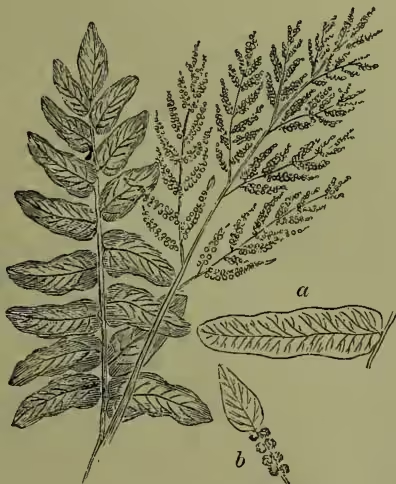
a, leaflet of barren frond; b, portion of fertile frond.
Royal Society. The origin of this society may be traced back to those stirring years of civil strife that brought in the Commonwealth. Clubs for political, theological, and sectarian purposes were then numerous and active; and in the year 1645 'divers worthy persons, inquisitive into natural philosophy, and other parts of human learning, did, by agreements, meet weekly in London on a certain day, to treat and discourse of such affairs.' Among these worthy persons were certain medical men, Dr Wilkins, afterwards Bishop of Chester; Foster, professor of astronomy in Gresham College; Wallis, the mathematician; and others, including Haak, a learned German from the Palatinate; and out of their meetings arose the now world-famous Royal Society. Wallis records that the subjects discoursed of were 'the circulation of the blood; the valves in the veins; the venæ lacteæ; the lymphatic vessels; the Copernican hypothesis; the nature of comets and new stars; the satellites of Jupiter; the oval shape of Saturn; the spots in the sun, and its turning on its own axis; the inequalities and selenography of the moon; the several phases of Venus and Mercury; the improvement of telescopes, and grinding of glasses for that purpose; the weight of air; the possibility or impossibility of vacuities, and nature's abhorrence thereof; the Torricellian experiment in quicksilver; the descent of heavy bodies, and the be fairly common in the districts of Scotland and Ireland of a very moist climate, but is disappearing degrees of acceleration therein; and divers other things of like nature.' In 1662 the persevering 'philosophers' (as students of the mathematical and natural sciences were then usually called) were, through the 'grace and favour' of Charles II., incorporated by charter, in which they were described as the Royal Society of London for the Promotion of Natural Knowledge. The king gave them also a mace, and subsequently granted two other charters conferring additional powers and privileges. They are inscribed in a handsome volume known as the Charter Book, which, containing, as it does, the sign-manual of the founder, of other royal personages, and of nearly every Fellow elected into the society, presents a collection of autographs unequalled in the world.
Through many difficulties the young society pursued their way. Their meetings were interrupted by the plague and the great fire; but in March 1664-65 they had published the first number of the Philosophical Transactions, and thus commenced a record of their labours and researches, and at the same time a history of science of the highest value, which now comprises upwards of one hundred and eighty quarto volumes. Besides this, the society publish an octavo serial entitled Proceedings, in which an account of the ordinary meetings is set forth. This serial was commenced in 1800, and now fills over forty-eight volumes. Another publication, in eleven quarto volumes, is the Catalogue of Scientific Papers, containing the titles of scientific papers published in all parts of the world from 1800 downwards. This great work, invaluable for purposes of reference, was compiled at the cost of the society, and gives in methodical form a record of the scientific progress of the century. These works are not restricted to the Fellows, but are sold to the general public. By increase of numbers—including scientific men on the Continent, who were elected as foreign members—the society widened their sphere of usefulness. They promoted the publication of Newton's Principia and optical works; they lent instruments to Greenwich Observatory in its early days, and were appointed visitors of that establishment by Queen Anne—a function which they still exercise; they aided travellers and scientific investigators; through force of circumstances, they became the advisers of the government on scientific subjects; Cook's celebrated voyage to observe the transit of Venus was undertaken at their instance; and from the voyage of the Endeavour down to the voyage of the Challenger it would be difficult to specify a scientific expedition which had not been equipped under the advice of the Royal Society. In 1710 the society removed to a house which they bought in Crane Court, Fleet Street. In 1780, by order of George III., quarters were assigned to them in the then new palatial building, Somerset House. There they abode until 1857, when, at the request of the government, they migrated westward to Burlington House, a wing of which they now occupy.
The society's session commences on the third Thursday in November, and ends on the third Thursday in June. During this period meetings are held weekly at 4.30 P.M. for the reading and discussion of papers, and these papers are for the most part afterwards published in the Proceedings or the Philosophical Transactions. The anniversary meeting is held on November 30. At that meeting the society elect a council to carry on their work through the ensuing year. This council, comprising president, treasurer, and secretaries, numbers twenty-one persons. The number of candidates for election into the society averages between fifty and sixty every year. From these the council elects fifteen, whose names are printed and sent to every Fellow, and in June the annual meeting takes place at which the fifteen are elected; but any Fellow is at liberty to alter the list of names. There are in all about 500 Fellows, including 50 foreign members. The society's income is derived from funded and landed property, and the annual contributions of the Fellows. Each Fellow contributed £4 yearly, or paid a life-composition of £60, with an admission fee of £10, till, a few years ago, a fund was raised to abolish admission fees and reduce the annual contribution to £3. Each Fellow is entitled to the Philosophical Transactions and Proceedings, and to the use of the library of about 45,000 volumes. The society formerly undertook the administration of the £1000 annually voted by parliament for scientific purposes, and also assisted in the administration of an additional grant. In 1882 a single grant of £4000 was substituted for the fund and grant of past years. The society also assists in the naming of the Meteorological Council, which receives a government grant. The president is a trustee of the British Museum. In fulfilment of trusts the society award annually, in recognition of scientific work and discoveries, the Copley medal and two Royal medals; the Rumford medal every two years for researches in light or heat; and the Davy medal for chemical investigations. Some of the most illustrious names in the annals of science appear on the roll of presidents of the Royal Society.
The ROYAL SOCIETY OF EDINBURGH, which took the place of the Philosophical Society of that city, was incorporated by royal charter in 1783. It owed its origin to Principal Robertson the historian, who successfully laboured to found in Edinburgh a society on the model of the Berlin Academy, for the investigation and discussion of subjects in every branch of science, erudition, and taste. In obtaining the royal charter the Principal was aided by the influence of Henry, Duke of Buccleuch, who zealously co-operated in the foundation of the society. The society was formally constituted at a meeting held in the College Library on the 23d June 1783, where the subsequent meetings were held till 1810, when the society purchased a house in George Street. In 1826 the society removed to its present apartments, leased from government, in the Royal Institution buildings in Princes Street. The original list of members included the names of most of the literati of Scotland—such as David Hume, Dugald Stewart, Henry Mackenzie, Adam Smith, Thomas Reid, Joseph Home, Sir James Hall, Joseph Black, James Hutton, and James Watt. The first president was Henry, Duke of Buccleuch; and amongst his successors have been Sir Walter Scott, the Duke of Argyll, Sir David Brewster, and Sir William Thomson.
The meetings of the society are held on the first and third Mondays of every month from December to July. The funds derived from fees are supplemented by an annual grant of £300 voted by parliament. The papers read before this learned body are published in its Transactions, of which thirty-five volumes have been published in quarto. Abstracts of the papers also appear in its Proceedings, of which seventeen volumes have appeared in octavo. The number of ordinary Fellows is about 490, of honorary British Fellows 20, and of honorary Foreign Fellows 36. The society has the disposal of some valuable prizes, which are bestowed on the authors of the best communications on scientific and other subjects. These are the Keith Prize, founded by Alexander Keith of Dunnottar; the M'Dougall Brisbane Prize, by Sir Thomas M. Brisbane; the Neill Prize, by Dr Patrick Neill; and the Gunning Victoria Jubilee Prize, by Dr R. H. Gunning. See the history of the society in Neill's index to the Transactions.
Royalty, originally the signiorage paid to the crown for a manor of which the king is lord, or a tax paid to the king for lands or to a superior as representing the crown; but most familiar nowadays in two derived senses of modified signification. Royalty is the term for the sum paid on minerals removed from a mine, not necessarily to the crown, but to the landlord, on the theory that the landlord owns the soil to the centre of the earth, and accordingly all the minerals found beneath his land (see MINING). This burden is frequently regarded as a grievance, and its abolition, with or without compensation, advocated by advanced politicians. Another sense of the word is the sum paid to the holder of a patent, by percentage for each article manufactured under the patent, or for the use of patent articles hired out by the patentee (see PATENT).
Royan, a small seaport of France (dept. Charrente-Inférieure), stands on the north side of the estuary of the Gironde, 60 miles NW. of Bordeaux. It is one of the most frequented seaside places on the Atlantic coast of France, attracting 20,000 visitors every year. Its people catch sardines (called royans locally). There are beautiful woods, a museum, a casino, &c. Pop. 5629.
Royat, a watering-place in the French department of Puy de Dôme, occupies a beautiful site 3 miles SW. of Clermont-Ferrand, and has numerous chalybeate, alkaline, and arsenical springs, (80°-95° F.), the waters of which have been used since Roman times. Pop. 1499.
Roy Bareilly. See RAI BARELI.
Royer-Collard, PIERRE PAUL, a French statesman, was born 21st June 1763, at Sompuis (dept. Marne). On the outbreak of the Revolution he was elected a member of the municipality of Paris, and from 1790 to 1792 acted as joint-secretary. Having incurred the enmity of the Jacobins, he lived in hiding at Sompuis during the Reign of Terror. Three years afterwards (1797) chosen to the Council of the Five Hundred, he took an active part in the work of that assembly, until the 18th Fructidor. In 1811 he was appointed professor of Philosophy in Paris, and exercised an immense influence on the philosophy of France. Rejecting the purely sensuous system of Condillac, he proceeded eclectically, giving special prominence to the principles of the Scottish Philosophy (q.v.) of Reid and Stewart. Strongly 'spiritualist' as opposed to materialism, he originated the 'Doctrinaire' school, of which Jouffroy and Cousin were the chief representatives. He was appointed president of the Commission of Public Instruction in 1815, but resigned that post in 1820; in 1815 also he returned to political life as deputy for the department of Marne. The French Academy opened its doors to him in 1827; and in 1828 he was named president of the Chamber of Representatives, and in that capacity presented the address of the 221 deputies (March 1830) withdrawing their support from the government, which the king refused to hear read. Next day the Chamber was prorogued. From 1842 Royer-Collard completely withdrew from public life; he died, 4th September 1845, at his country seat of Châteauvieux, near St Aignan (Loir-et-Cher). His salon was latterly the resort of such men as Cousin, Guizot, De Broglie, Casimir Prier, Villemain, De Rémusat, and others. He never was a writer, and he became a philosopher only by accident; his true interest in life was politics, his real eminence as a political orator after the ancient pattern, rather than that of the modern parliamentary debater. His idea of the monarchy was utopian; the famous charte was found impracticable as the sheet-anchor of liberty; even his best speeches, triumphs of dialectic as they often were, fell short of the effect that seemed secure, whether because ever in human things facts overturn the conclusions of reason, or because reason does not reach the profound depths in which are generated the opinions of men, to wit, their passions and their interests.
See the biographies by Philippe (1857) and Barante (new ed. 1878), and Spuller's work in the 'Grands Écrivains' series (1895); also Scherer's Études sur la Litt. Contemp., vol. i., and Faguet, Politiques et Monarchistes du XIXe Siècle (1891).
Royton, a town of Lancashire, 2 miles NNW. of Oldham, with large cotton-factories. Pop. (1851) 6974; (1891) 13,395.
Rsheff, or RJEV, a town of European Russia, on the Volga, 135 miles NW. of Moscow, is a river-port with a very extensive transit trade in agricultural produce, collected from the governments of Orel, Kaluga, and Smolensk, and sent to Riga and St Petersburg. Hemp is spun and boats are built. Pop. 35,810.
Ruabon, a town of Denbighshire, 4½ miles SSW. of Wrexham, with collieries and ironworks. Pop. of parish (1851) 11,507; (1891) 17,609.
Ruatan', or RATTAN, a long, narrow island in the Bay of Honduras in the Caribbean Sea, belonging since 1860 to the republic of Honduras. Area, 106 sq. m.; estimated pop. 2000, mostly Negroes.
Rubasse, a mineral prized for ornamental uses, is rock-crystal, limpid or slightly amethystine, filled internally with minute brown spangles of specular iron, which reflect a bright red, equal to that of the most brilliant ruby. There is an artificial rubasse, made by heating very pure rock-crystal red hot, and repeatedly plunging it into a coloured liquid.
Rubble, a common kind of masonry, in which the stones are irregular in size and shape. Walls faced with ashlar are generally packed with rubble at the back. Rubble is of various kinds, according to the amount of dressing given to the stones. Common rubble is built with stones left almost as they come from the quarry. Hammer-dressed rubble is so called when the stones are squared with the mason's hammer; coured rubble, when the stones are squared and equal in height, &c.
Rubefacients are external agents employed in medicine for the purpose of stimulating, and consequently reddening, the part to which they are applied. All agents which, after a certain period, act as Blisters (q.v.) may be made to act as rubefacients, if their time of action is shortened. The mildest rubefacients are hot poultices, cloths soaked in very hot water, moderately stimulating liniments—as, for example, soap-liniment, with various proportions of liniment of ammonia, or chloroform, &c. Spanish fly, in the form of Emplastrum Calefaciens, or warm plaster, in which the active ingredient is blunted by the free admixture of soap-plaster, resin-plaster, &c., is a good form of this class of agents. Capsicum or Cayenne pepper, in the form of a poultice, is an excellent rubefacient; it is much used in the West Indies, but is seldom employed in this country. Mustard, in the form of Cataplasma Sinapis, or mustard poultice, and oil of turpentine are perhaps the best of the ordinary rubefacients. The former is applied to the soles of the feet and the calves of the legs in the low stage of typhus fever, in apoplexy and coma, in narcotic poisoning, &c. It is also applied to the chest, with much advantage, in many cases of pulmonary and cardiac disease, and to the surface of the abdomen in various affections of the abdominal viscera. The best method of employing turpentine is to sprinkle it freely on three or four folds of clean flannel, wrung out of boiling water. The sprinkled surface of this pad is placed upon the skin, and a warm dry towel is laid over the flannel. Two or three such applications will produce a powerful rubefacient. facient effect. Turpentine thus applied is serviceable in all the cases mentioned in the remarks on Mustard, as well as in sore throat, chronic rheumatism, neuralgia, &c.
Rubens, PETER PAUL, the most celebrated painter of the Flemish school, was born on the 29th of June 1577 at Siegen, in Westphalia, where his father, John Rubens, an eminent lawyer, was living in disgrace, in consequence of his intrigue with Anne of Saxony, second wife of William the Silent. In 1578 his parents settled in Cologne; and upon the death of her husband in the year 1587, his mother returned to her native city of Antwerp, where the boy was educated in the Jesuits' college. He served for a short time as a page in the household of Margaret de Ligne, widow of the Count of Lanaing, and was intended for the profession of law; but he was animated by a strong desire to become a painter, and at the age of thirteen he began the study of art, first, for a brief period, under Tobias van Haeght, a skilful landscape-painter; then for four years under Adam van Noort, a painter of religious subjects, distinguished for his excellent colouring; until finally, in his nineteenth year, he passed into the studio of Othon van Veen, court-painter to the Archduke Albert, governor of the Netherlands.
In 1599 he was admitted a master of the Brotherhood of St Luke in Antwerp; and in the following year he started for Italy, making his way to Venice, where he studied the works of Titian and Veronese. He next entered the service of Vincenzo Gonzaga, the magnificent and luxurious Duke of Mantua, as gentleman of the chamber and court-painter; and in 1605 was despatched on a mission to Philip III. of Spain, thus beginning the career of a diplomatist, for which his keen intellect, his polished urbanity, and his linguistic attainments so admirably qualified him. While at Madrid he executed portraits of many of the Spanish nobility, as well as several historical subjects. On his return from Spain he travelled in Italy, copying celebrated works for the Duke of Mantua; and to this period is referable the sketch, now in the National Gallery, London, from one of the subjects of Mantegna's 'Triumph of Julius Cæsar.' In 1608, while in Genoa, he received news of his mother's illness, and returned home, but too late to see her alive. Settling in Antwerp, he was appointed in 1609 court-painter to the Archduke Albert and his wife Isabella, and soon afterwards married his first wife, Isabella Brant, whom his pencil has often portrayed, and who appears, seated hand in hand with himself, in the famous full-length group at Munich.
The painter was now rapidly approaching his full artistic maturity, and his 'Descent from the Cross' in the cathedral of Antwerp, begun in 1611 and completed in 1614, and usually regarded as his masterpiece, is a work in which both his earlier and later manner may be traced. It is a triptych, showing on the interior of its wings The Visitation and The Presentation in the Temple, and on their exterior subjects of St Christopher and a Hermit bearing a lantern.
In 1620 Rubens was invited to France by Marie de' Medici, the queen-mother, who was then engaged in decorating the palace of the Luxembourg in Paris; and he undertook for her twenty-one large subjects commemorating her marriage to Henry IV., works, completed with the aid of assistants in 1625, which are now in the Louvre, most of the sketches by the master's own hand being at Munich. In 1628 he was despatched by the Infanta Isabella upon a diplomatic mission to Philip IV. of Spain. He remained for nine months in Madrid, and there he made the acquaintance of Velasquez, and executed some forty works, includ- ing five portraits of the Spanish monarch. In 1629 he was appointed envoy to Charles I. of England, to treat for peace; and, while he conducted a delicate negotiation with perfect tact and success, his brush was not idle, for he painted the 'Peace and War,' now in the National Gallery, London, and the portrait of the king and his queen as St George and Cleoline, a work now at Windsor, and also made sketches for the Apotheosis of James I. for the Banqueting-hall at Whitehall, completing the pictures on his return to Antwerp. In acknowledgment of his services he was knighted by Charles I.; and he received a similar honour from Philip IV.
In 1630 Rubens married his second wife, Helena Fourment, a beautiful girl of sixteen; in 1635 he designed the decorations which celebrated the entry of the Cardinal Infant Ferdinand into Antwerp as governor of the Netherlands; and, having with much difficulty completed a picture of 'The Crucifixion of St Peter' for the church dedicated to that saint in Cologne, he died at Antwerp on the 30th of May 1640, and was interred with great pomp in the church of St Jacques, his body being deposited, two years afterwards, in a chapel specially built there for its reception.
Not only was Rubens great as a subject-painter, but he was equally distinguished as a portraitist, an animal-painter, and a landscapist. The main characteristics of his productions are their power, spirit, and vivacity, their sense of energy, of exuberant life. As Reynolds has truly said, 'Rubens was perhaps the greatest master in the mechanical part of the art; the best workman with his tools that ever used a pencil;' and he was great alike in handling and as a colourist. It is, however, mainly on technical grounds that he claims supremacy, for his works are wanting in the dignity, quietude, refinement, and in the profound imagination which distinguish the greatest Italian painters. He was a most prolific artist; his works number in all several thousands, of which Smith in his Catalogue has described over thirteen hundred; and about twelve hundred prints have been executed after his paintings and designs, frequently under his personal supervision by such of the best contemporary engravers as Pontius, Vosterman, Soutman, and the Bolswarts. Many of his finest works are still at Antwerp; but his art may probably be most adequately studied in the Pinakothek at Munich, which contains nearly a hundred examples of his brush, several of them ranking with his noblest efforts. Among the most distinguished of his many pupils were Van Dyck, Van Diepenbeck, Jordaus, and Snyders.
See Lettres Inédites de P. P. Rubens, publiée par Emile Gachet (Brussels, 1840); De Waagen's Life of Rubens, published in Raumer's Historisches Taschenbuch (Berlin, 1833; trans. by R. R. Noel, Lond. 1840); Original Unpublished Papers Illustrative of the Life of Sir P. P. Rubens, as an Artist and a Diplomatist, by W. Noel Sainsbury (Lond. 1859); Rubens et l'Ecole d'Anvers, par A. Michiels (Paris, 1877); the volume in the 'Great Artists' series by C. W. Kett (1880); the posthumous work of Charles Ruelens, of the Brussels Library; and the Life by Michel (trans. 2 vols. 1899).
Rube'ola. See MEASLES.
Rübezahl. See RIESENGEbirge.
Rubiaceæ, a natural order of dicotyledonous plants, in which, according to many botanists, the Cinchonaceæ are included as a sub-order; but which, as restricted by others (Stellatæ of Ray, Galiaceæ of Lindley), consists entirely of herbaceous plants, with whorled leaves, angular stems, and numerous very small flowers; the calyx superior, with four, five, or six lobes, or almost wanting; the corolla wheel-shaped, or tubular, regular, inserted into the calyx, and with the same number of divisions as the calyx; the stamens equal in number with the lobes of the corolla; two styles; the fruit a dry pericarp with two cells, and one seed in each cell. There are between 300 and 400 known species, chiefly abounding in the northern parts of the northern hemisphere, and on the mountains of tropical regions. The most important plant of the order is Madder (q.v.). To this order belong also Bedstraw (q.v.) and Woodruff (q.v.).
Rubicon, a stream of Central Italy, falling into the Adriatic a little north of Ariminum, has obtained a proverbial celebrity from the well-known story of its passage by Cæsar, in the middle of January, 49 B.C. It formed the southern boundary of his province, so that by crossing it he virtually declared war against the Republic. Cæsar himself makes no mention of its passage; Suetonius, Plutarch, and Lucan tell how he hesitated awhile on the bank and then crossed with the words, Jacta est alca. A papal bull of 1756 identified the Rubicon with the modern Luso, but a comparison of distances shows that it must rather have been the Fianicino or Rujone.
Rubidium (sym. Rb; atom. wt. 85) is one of the alkali metals. Its salts exist in very minute quantities in numerous mineral waters, and in these rubidium salts, along with cæsium salts, were detected by Bunsen and Kirchhoff by means of spectrum analysis. The mineral lepidolite is the best material from which to prepare rubidium compounds. The metal is, like cæsium, silver-white. It melts at 38.5° C., but is still soft at -10° C. Its sp. gr. is 1.52. Like cæsium, it takes fire spontaneously in the air, and it decomposes water at the ordinary temperature, in the latter respect resembling all the other alkali metals. The salts of rubidium resemble generally those of potassium. The name rubidium is derived from rubidus, 'dark red,' in allusion to the colour imparted to a flame by the salts of the metal.
Rubinstein, ANTON, pianist and musical composer, was born, the son of a Polish Jew and a German Jewess, near Jassy in Moldavia, on 28th November 1829, and was trained to music in Moscow by his mother and a master. Liszt heard him, 'an infant prodigy,' play in Paris in 1841, recognised his genius, and encouraged him to go on and play in other cities. After some further 'touring,' he gave himself to serious study in Berlin and Vienna, and in 1848 settled in St Petersburg as teacher of music. In 1854 he set off on another musical tour, with the reputation of being a second Liszt, and 'the coming' composer. On his return to St Petersburg he succeeded in getting a musical conservatoire founded (1862) there, and became its director. But his concert tours engrossed a good deal of his time, and in 1867 he resigned the directorship of the conservatoire. In 1872 he went to the United States and had an enthusiastic reception. He wound up his concert tours in 1886, his last having had for its object a series of seven pianoforte recitals illustrating the great masters of music historically. He was induced in the following year to resume the directorship of the conservatoire at St Petersburg. Rubinstein was both composer and player. Amongst his best musical productions are the operas, The Maccabees, The Demon, Feramors (the libretto from Moore's Lalla Rookh), and Kalaschnikoff; the two symphonies, Ocean and Dramatic; and the sacred operas, Paradise Lost, The Tower of Babel, and Sulamith. His numerous songs and pieces of chamber music are highly esteemed and more widely known. His style, while of course embracing fuller modern developments, presents several points of likeness to
Schubert's; there is the same predominance of the lyric, rhythmic, and formal elements over the dramatic; an exuberant melodiousness, frequently charming, but sometimes falling below the mark; an absence of meretricious effects, and a tendency to protracted length, not to say occasional prolixity; while in feeling he is more akin to Mendelssohn. He was a strongly pronounced opponent of the principles of Wagner. As a pianist he held the highest rank, being usually reckoned the greatest since Liszt. His mastery of technique was supreme; opinions differed about his fidelity to a composer's intentions, but the depth of feeling and significance he could impart to even the simplest piece evinced a rare musical susceptibility at once intense and widely sympathetic. He retired from the platform some years before his death, 20th November 1894. See his Autobiography, trans. from the Russian by Aline Delano (1891), a Study by M'Arthur (1889), and the Life by Zabel (Leip. 1892).
Ruble. See ROUBLE.
Rubrics (Lat. rubrica, from ruber, 'red'), in classic use, meant the titles or headings of chapters in law-books, and is derived from the red colour of the ink in which these titles were written, in order to distinguish them from the text. In mediæval and modern use the name is restricted to the directions in the service-books of the church as to the ordering of the prayers and the performance of the ceremonies that accompany them. The first printed missals have few rubrics, and the printing of both the words and ceremonies of the mass in full dates only from 1485. The same name, together with the usage itself, is retained in the Book of Common Prayer; and in all cases, even where the direction has ceased to be printed in red ink, the name rubric is still retained. Where red ink is not employed the rubric is distinguished from the text by italics or some other variety of print.
Rubruquis, WILLIAM DE, a mediæval traveller, was born, it is pretty certain, at Rubrouck (8 miles NE. of St Omer, in northern France), and not at Ruysbroeck, near Brussels, early in the 13th century. He entered the Franciscan order, and was sent by Louis IX. of France into central Asia for the purpose of opening up communications with Sartak, the son of the Mongol prince, Batû Khan, a supposed Christian. Friar William travelled (1253) by way of Constantinople across the Black Sea and the Crimea to the Volga. Sartak referred him to his father, Batû, and that prince sent him forward to the Mongol emperor, Mangû Khan, whom he found on 27th December, about 10 days' journey south of Karakorum in Mongolia. With that sovereign he remained until July 1254, then returned to the Volga, penetrated the defiles of the Caucasus, proceeded through Armenia, Persia, and Asia Minor, to Syria, and arrived at Tripoli in August 1255. King Louis had meanwhile returned to France, and Friar William wrote him the account of his journey which has come down to us. The best edition is that of D'Avezac in vol. iv. of Recueil de Voyages (1839) of the Paris Geographical Society. Of the later history of Rubruquis the only fact known is that he was living in 1293, when Marco Polo was returning from the East.
Rubus (Blackberry or Bramble, &c.), a genus of plants of the natural order Rosaceæ, sub-order Rubæ, distinguished by a 5-lobed calyx without bracts, and the fruit formed by an aggregation of small drupes adhering to each other upon a long torus. The fruit is eatable in all, or almost all, the species. The genus is a large one, comprising, according to Bentham and Hooker, about 100 species, widely distributed over nearly every part of the globe. Among the most important species are R. Chamæmorus, the Cloudberry (q.v.); R. Idæus, the Raspberry; R. cæsius, the Dewberry; R. articus, characterised by Linnæus as the prince of wild berries; R. fruticosus, the Common Bramble (q.v.); and R. saxatilis, the Stone Bramble. Of the Common Bramble a number of varieties having very large luscious fruit have been introduced into Britain from North America within the last few years with the view of cultivating them for their fruit. The opinion of gardeners as to their merits for profitable culture in Britain is varied, but they are much appreciated in Canada and in the United States of America. The varieties which are most approved are the Lawton, Wilson Junior, Early Harvest, and Mammoth. The ornamental species frequently planted in British gardens are R. odoratus, the Virginian Raspberry; R. laciniatus, with large flowers and elegant leaves; and R. biflorus, whose snow-white bark contrasts strikingly with the dark-green leaves.
Ruby, a gem much prized, is a pure transparent, red-coloured Corundum (q.v.), just as Sapphire (q.v.) is a blue variety of the same mineral. It is inferior in hardness to the diamond only among gems. Although usually red, yet violet, pink, and purple rubies are met with, but the most highly esteemed are those which have the colour of pigeon's blood. The finest true oriental rubies are more highly prized than diamonds of similar size and quality; those over a carat in weight are worth from £20 to £100 per carat, and no stone increases so much in value in proportion to increase in size. But perfect specimens, as regards colour, transparency, and freedom from flaws, are much less common than good diamonds. Gems of this character seldom exceed 8 or 10 carats; but Gustavus III. of Sweden presented one, now in the Russian regalia, to the Empress Catharine, which was of the size of a pigeon's egg. The throne of the Great Mogul, according to Tavernier, was adorned with 108 rubies of from 100 to 200 carats each. One possessed by the king of Ceylon was, according to Marco Polo, a span in length, as thick as a man's arm, and without a flaw; Kublai Khan offered for it the value of a city, but the king would not part with it. The Burmese government sent two rubies to London in 1875, one of which, reduced by re-cutting to 325/6 carats, was sold for £10,000; the other, of 385/6 carats, was sold for £20,000. The specific gravity of the ruby (3.900 to 4.283) exceeds that of all other gems. When rubbed it becomes electrical, and remains so for some time. The finest rubies—those having the colour of pigeon's blood—come from Upper Burma, near Mogok, north of Mandalay (see BURMA, Vol. II. p. 563). Dark-red rubies, sometimes with a brownish tint, are found in Siam, and purplish rubies in Ceylon. Rubies are also met with in the mountain-region of Yunnan in China, in Afghanistan, and in the basin of the Oxus. The true or oriental ruby, as above described, occurs in crystalline limestone in Burma, and in alluvial deposits which have been derived from the denudation of granitoid igneous and schistose rocks. Ruby-bearing gravels and sands occur sparingly in Europe, as in Auvergne, Bohemia, the Urals, &c. Small rubies have also been detected in such rocks as basalt, as in Victoria and New South Wales; and fine rubies have been reported to be found in New Guinea. Many of the so-called rubies of jewellers are not true or oriental rubies, but varieties of Spinel (q.v.), a mineral composed chiefly of alumina and magnesia, inferior in hardness and of less specific gravity than the oriental ruby, and crystallising in the cubical system. Oriental rubies belong to the hexagonal system, and, unlike the spinel, are always dichroic. Spinel rubies are found in the form of crystals or rounded pebbles in alluvial deposits and in the beds of rivers in Ceylon, Siam, Pegu, Badakshan, and other eastern countries, having been derived like the true ruby from crystalline igneous and schistose rocks. They occur also in crystalline limestone and in serpentine. Small rounded spinel-rubies occur in the sands of mountain-streams in Wicklow; and large crystals have been found in various parts of North America, but rarely, if ever, fit for the purposes of the jeweller. Spinels are also found in Australia. Spinel-ruby is the name given by jewellers to a stone of a deep carmine-red; a rose-red stone is distinguished as Balas-ruby; red with a decided tinge of orange is Vermeil or Vermeille; yellow or orange-red is Rubicelle; violet is Almandine ruby. There are also transparent spinels, which when large and fine are treated as jewels. All these, however, are merely variously-tinted varieties of one and the same mineral—spinel—which is allied to Corundum (q.v.), being composed mainly of alumina, with a smaller proportion of magnesia.
As early as 1837 small rubies were produced chemically by fusion of alumina; but it was not till 1878 that Frey and Verneuil produced rubies on a scale of commercial importance, though less brilliant than oriental rubies. In 1890 they succeeded in making larger and finer stones, which for the purposes of the watchmaker quite equalled natural rubies.
Rückert, FRIEDRICH, German poet, was born at Schweinfurt, 16th May 1788, and educated there and at Würzburg. For some years he led a wandering life, studying philology and poetry, and cultivating the muses. During this period of his life he helped Arndt and Theodor Körner to fan the flame of German patriotism by his Deutsche Gedichte (1814), especially by the Geharnischte Sonette included in this volume. From 1826 to 1841 he filled the chair of Oriental Languages at Erlangen; but the greater part of his summers were passed at the country seat of his wife's parents, Neuses near Coburg. After learning Persian, Arabic, and Turkish, incited thereto by Hammer-Purgstall at Vienna (1818), Rückert recast in German verse, with great skill, several of the famous books of the East, as Die Verwandlungen des Abu Seid of Hariri (1826), Nal und Damajanti from the Mahabharata (1828), Rostem und Suhrab from Firdausi's Shah-Nameh (1838), Amrulkais (1843), Hamasa (1846), a collection of Arabic folk-songs, and others. His most popular books are the collection of lyrics entitled Liebesfrühling (1844; 14th ed. 1888) and the reflective poems gathered together as Die Weisheit des Brahmanen (1836–39; 12th ed. 1886). In 1841 Frederick-William IV. invited him to Berlin, making him professor of Oriental Languages; but the poet preferred his idyllic life at Neuses, and went back there in 1848. There he died on 31st January 1866. Rückert wrote with fatal ease; he tried nearly all forms of poetical composition, and produced too much. Nevertheless he penned several charming little lyrics, which may be read in the selected Gedichte (1841; 22d ed. 1886). Two qualities distinguish his work in general—a marvellous command of language and rhyme, and the gift of giving poetic expression to philosophic thought. The former has sometimes led him into mannerisms of form and unpleasing tours de force; the latter often betrays him into throwing a poetic glamour over dull, pedantic, and unimportant ideas. His posthumously published work includes German adaptations of Theocritus, Aristophanes, Kálidása's Sakuntala (1867), Sádi's Bostán (1882), and a good deal of original poetry.
See biographical works by Beyer (3 vols. 1868–77), Boxberger (1878), Konrad Fischer (1889), and F. Reuter's Rückert in Erlangen und Joseph Kopp (1891).
Rudd. See RED-EYE.
Rudder. See STEERING.
Rudder-fish, a name loosely applied to at least three different kinds of fish, of which the Pilot-fish (q.v.) is one.
Ruddiman, THOMAS, Latin grammarian, was born near Banff in 1674, and in 1690 gained a bursary at King's College, Aberdeen, taking his M.A. four years later. In 1695 he became parish schoolmaster of Laurencekirk, and here in 1699 accidentally made the acquaintance of the celebrated physician and Latinist, Dr Archibald Pitcairne, who was so impressed with his learning and sagacity that he got him appointed assistant-keeper of the Advocates' Library, Edinburgh. His new office gave him ample opportunity for prosecuting his favourite studies, but the remuneration was so small (£8, 6s. 8d. per annum) that, in 1707, he started business as a book auctioneer. In that year he edited Florence Wilson's Latin Dialogue on the Tranquillity of the Mind, to which he prefixed a life of the author; in 1709 Arthur Johnston's Poetical Paraphrase of the Song of Solomon and Cantica—both also in Latin. In 1714 appeared his well-known Rudiments of the Latin Tongue; in 1715 his great edition of Buchanan's works. He now exchanged the calling of a book auctioneer for the more congenial one of printer; and in 1728 he was appointed printer to the university, in 1730 principal keeper of the Advocates' Library. In 1725–32 he published his great Grammaticæ Latine Institutiones, on which his philological reputation mainly rests; in 1739 he completed Anderson's magnificent Diplomata et Numismata Scotice, writing the learned Latin introduction and appendices. Controversy as to the respective merit of the Latin verse of Johnston and Buchanan, and as to the hereditary right of the kings of Scotland to the crown, consumed a great part of his time, but did not so preoccupy his thoughts as to prevent him from publishing in 1751 an edition of Livy, still known as the 'immaculate,' from its entire exemption from errors of the press. Ruddiman died in Edinburgh, January 19, 1757. He was in politics, like his friend Pitcairne, an ardent Jacobite, and in private life a most upright and estimable man. Besides the publications already noted, and a multitude of minor tracts, he edited Gawin Douglas' translation of the Aneid, and appended a very valuable glossary (folio, 1710). He also founded the Caledonian Mercury newspaper. See his Life by George Chalmers (1794).
Rüdesheim, a town of Prussia, on the right bank of the Rhine, opposite Bingen, at the foot of the Niederwald (q.v.), and 16 miles W. of Mainz. Round Rüdesheim is grown one of the most esteemed of the Rhine-wines, the Rüdesheimer. Pop. 4040.
Rudolf, or RUDOLPH, German king and founder of the present imperial dynasty of Austria, was born in Limburg castle in the Breisgau, on 1st May 1218. He became a warm partisan of Frederick II., distinguished himself in arms, and spent much of the early years of his manhood in quarrels with the bishops of Basel and Strasburg. His possessions were greatly increased by inheritance and by his marriage, until he was the most powerful prince in Swabia. In 1273 the electors chose him to be German king; as never having been crowned by the pope, he was not entitled to be called kaiser or emperor. His accession was opposed by none; the pope's consent was secured at the price of certain rights already parted with by Rudolf's predecessors. Ottocar of Bohemia, however, refused to tender his allegiance. He was put under the ban of the empire in 1276, but, sub- mitting on Rudolf's approach with an army, was invested with Bohemia. Having soon afterwards taken the field against his suzerain, he was defeated and slain in 1278 at Marchfeld beside the Danube. Rudolf spent the greater part of his life that remained in suppressing the castles of the robber knights and putting an end to their lawless practices. He died at Spire, 15th July 1291, and was buried in the cathedral there. His son Albert, to whom (and his brother Rudolf) Austria, Styria, and Carniola had been given in 1278, succeeded him as German king. Rudolf was a pattern knight, tall in person, upright, pious, valiant, and energetic. See Lives by Schönhuth (1844), Kopp (1845), and Hirn (1874); Lorenz, Deutsche Geschichte in 13. und 14. Jahrhundert (1863–67); and a work by Kaltenbrunner (Prague, 1890).
Rudolf II., eldest son of the Emperor Maximilian II., was born at Vienna on 18th July 1552, and educated at the Spanish court by the Jesuits. He was made king of Hungary in 1572, king of Bohemia, with the title King of the Romans, in 1575, and on the death of his father in 1576 succeeded to the imperial crown. Gloomy, taciturn, bigoted, indolent both in body and mind, he put himself in the hands of the Jesuits and low favourites, and left the empire to govern itself. His attention was given to his curiosities, his stable, his alchemical and magical studies; nevertheless his taste for astrology and the occult sciences, and his desire to discover the philosopher's stone, made him extend his patronage to Kepler and Tycho Brahe. The astronomical calculations begun by Tycho, and continued by Kepler, known as The Rudolphine Tables, derive their name from this emperor. Meanwhile the Protestants were bitterly persecuted by the Jesuits throughout the empire; the Turks invaded Hungary and defeated the archduke Maximilian (1596); Transylvania and Hungary rose in revolt; and at last Rudolf's brother Matthias wrested from him the crowns of Hungary and Bohemia, and the states of Austria and Moravia. Less than a year after losing the crown of Bohemia he died, unmarried, on 20th January 1612, and was succeeded by Matthias. See works by Gindely (1865) and Von Bezold (1885).
Rudolf, LAKE, an equatorial sea in British East Africa, near the edge of the Kaffa or South Ethiopian highlands, is long and narrow, stretching 160 miles NE. and SW. by 20 broad, with an area of 3000 sq. m., at a height of 1300 feet above the sea. It is crossed by 4° N. lat. and 35° E. long. It has no visible outlet, and its waters are very brackish. It was discovered by Count Teleki in 1888. See his Discovery of Lakes Rudolf and Stephanie (Eng. trans. 1894).
Rudolstadt, the chief town of the German principality of Schwarzburg-Rudolstadt, lies in a hill-girt valley, on the left bank of the Saale, 18 miles S. of Weimar. There are two royal castles, a library, picture-gallery, &c., and factories for porcelain, chemicals, and wool. Pop. 10,562.
Rudra is, in Vedic mythology, a collective name of the gods of the tempest, or Maruts. In later and Puranic mythology Rudra ('the terrible') is a name of Siva, and the Rudras are his offspring.
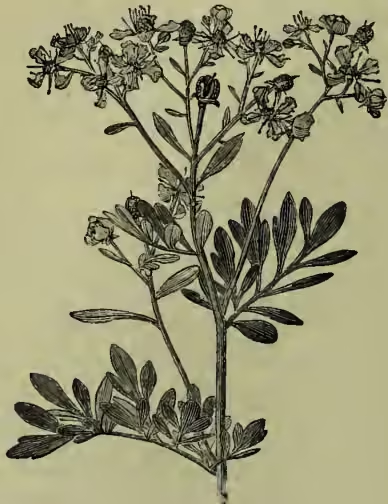
Rue (Ruta), a genus of plants of the natural order Rutaceæ. The species are half-shrubby plants, natives of the south of Europe, the north of Africa, the Canary Isles, and the temperate parts of Asia. Common Rue, or Garden Rue (R. graveolens), grows in sunny stony places in the countries near the Mediterranean. It has greenish-yellow flowers, the first of which that open have ten stamens, the others eight only (they are of unequal length, and each one is bent inwards in turn to touch the pistil, and when the pollen is shed it bends back again), and glaucous evergreen leaves with small oblong leaflets, the terminal leaflets obovate. It is not a native of Britain, but is frequently cultivated in gardens. It was formerly called Herb of Grace (see Hamlet, act iv. scene 5), because it was used for sprinkling the people with holy water. It was in great repute among the ancients, having been hung about the neck as an amulet against witchcraft in the time of Aristotle. It is the Péganon of Hippocrates. Rue is still employed in medicine as a powerful stimulant, but the leaves must be used fresh, as they lose their virtues by drying. The smell of rue, when fresh, is very strong, and to many very disagreeable; yet the Romans used it much for flavouring food, and it is still so used in some parts of Europe. The leaves chopped small are also eaten with bread and butter as a stomachic, but they must be used sparingly, as they are acrid enough to blister the skin if much handled, and in large doses act as a narcotic poison. All their properties depend on an acrid volatile oil, which is itself used for making Syrup of Rue, eight or ten drops of oil to a pint of syrup; and this, in doses of a teaspoonful or two, is found a useful medicine in flatulent colic of children. The expressed juice of rue, mixed with water, and employed as a wash, is believed to promote the growth of the hair.
Ruff (Machetes pugnax), a bird, the sole representative of the genus, belonging to the Sandpiper (q.v.) sub-family of the Snipe family (Scolopacidae). In the British Isles it is now little more than a visitor in its spring and autumn migrations, owing to the draining of its marshy breeding-places and the practice of capturing it in spring when game is out of season. It is more common on the east than on the west coast of England. The same is true of the east coast of Scotland, where it is found from Berwick to the Orkneys and Shetlands, but it has been recorded from the Outer Hebrides. As a straggler it is found on the Faroes and Iceland, in Canada, in some of the eastern United States, and it has been found once in Barbadoes and once on the Upper Orinoco. It breeds over the greater part of northern Europe; it is found as a migrant over the rest of Europe, the southern shores of the Mediterranean, and the east and west coasts of Africa as far as the Cape; in Asia it extends from Siberia to Japan, Burma, and India.
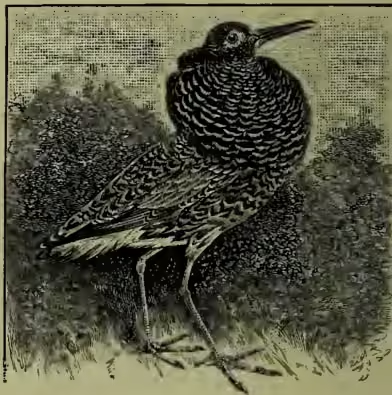
The male bird, the Ruff, is about a foot long. In spring it sheds the feathers of the face; curled tufts of feathers appear on the sides of the head; and an erectile ruff is developed which lasts for a couple of months. This ruff, as well as the feathers on the back, shows every variation of colour in different birds; but each bird annually regains its own peculiar colour. After moulting the neck and upper breast are of a buff colour; the under parts dull white; the feathers of the upper parts are dark brown with buff margins; and the primary wing-feathers are dusky brown. The female, the Reeve, is about one-fourth smaller in size, and shows very much the same colours as the moulted male. In habit these birds are polygamous; the males fight for possession of the females, and in battle the ruff serves for defence. The nest is made among the coarse grass of a dry tussock in a moist swampy place. The eggs, four in number, are grayish green marked with reddish brown. The food consists of insects and their larvæ, worms, seeds, rice, and other vegetable substances. When captured and being fattened for the table, the birds are fed on boiled wheat, bread and milk, and bruised hemp-seed.
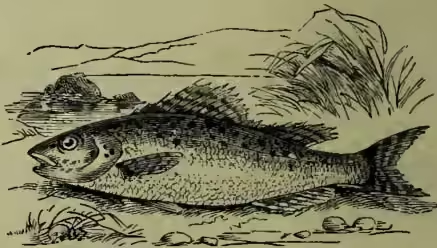
Ruffe, or POPE (Acerina cernua), a small freshwater fish of the Perch family (Percidae), abundant in the lakes, slow rivers, and ditches of many parts of the middle of Europe and of England. It is five or six inches in length, of an olive-green colour mottled with brown, and has only one dorsal fin. The flesh of the ruffe is highly esteemed for the table.
Rufiji, or LUFIFI, the chief river of German East Africa, which rising far in the interior enters the sea through a delta opposite the island of Mafia. Shoals and bars at the mouth prevent the access of large ships; but the river is navigable by smaller boats throughout great part of its course. The valley is extremely fertile.
Rugby, a town giving name to the south-east division of Warwickshire, of which it stands at the northern corner, is situated at the junction of several railways in the middle of country such as George Eliot describes in Felix Holt. By rail it is 83 miles NW. of London and 30 ESE. of Birmingham. At the foot of the hill on which it stands the Swift gave John Wyclif's ashes to the Avon; close by at Ashby and at Dunchurch the Gunpowder Plot was hatched; the battlefield of Naseby was visited by Carlyle from its schoolhouse in 1842 a few days before Arnold's death; it is within a drive of Stratford-on-Avon, Coventry, Kenilworth. It is at once the centre of a great hunting district and the seat of a public school. This probably accounts for the large number of residential houses there. John Moultrie (q.v.) was long rector of the parish. Pop. (1851) 6317; (1891) 11,262.
The school was founded in 1567 by Lawrence Sheriff, a grocer and a staunch supporter of Queen Elizabeth, by a gift of property in Manchester Square, London. After maintaining its position for some time as a good school for the Warwickshire gentry and a few others, specially under Dr James and Dr Wool, it became of national reputation under Dr Arnold, who in raising his school raised at the same time the dignity of his whole profession. Since his time the school has never lacked able teachers, remarkable for independence of mind. When Arnold died in 1842, Archbishop Tait succeeded him, having as coadjutors Lord Lingen, Dean Bradley, Principal Shairp, Thomas Evans, Theodore Walrond, Bishop Cotton. Dean Goulburn (1850-58) had as an assistant the future Archbishop Benson. The next heads were Dr Temple (1857-69), afterwards Archbishop of Canterbury; Dr Hayman (1869-74); Dr Jex-Blake (1874-87); Dr Percival (1887-95), afterwards Bishop of Hereford; and Dr H. A. James (since 1895). The Public Schools Commission reported of Rugby in Dr Temple's days that the general teaching of classics was absolutely unsurpassed; that Rugby School was the only public school in which physical science was a regular part of the curriculum; that only Harrow had done as much as Rugby in awakening interest in history. Having secured this tribute for his teaching and having collected enough money to rebuild the chapel, to erect a gymnasium, and to build new schools, Dr Temple was succeeded by Dr Hayman. To him succeeded Dr Jex-Blake, who inaugurated a still greater building era. When he resigned in 1887 he left behind him a school simply unrivalled in its appointments. He was succeeded by Dr Percival. Of illustrious Rugbeians may be named the poets Landor, Clough, and Matthew Arnold; Dean Stanley, who had the rare privilege of recording the work of his great head-master in biography; Judge Hughes (statue, 1899), who did the same in Tom Brown's School-days; Dean Vaughan, Lord Derby, Lord Cross, Mr Goschen, Sir R. Temple, Franck Bright and York Powell the historians, Justice Bowen, Sir W. Palliser, Professor Sidgwick, Robinson Ellis and Arthur Sidgwick, C. Stuart-Wortley, and Arthur Acland. From Rugby went the first head-master to Marlborough, Wellington, Clifton, Haileybury, Fettes College, and Newcastle High School. Mission work found its Rugby worker in Fox, in whose memory the school still keeps up a missionary at Masulipatam. The learned author of Gothic Architecture, Matthew H. Bloxam, was taught and lived at Rugby, where he died in 1888, leaving his valuable collection of antiquities and books to the school. The school possesses an observatory, given by Archdeacon Wilson, and the Natural History Reports, written by members of the school, have often been of exceptional value.
See, besides Stanley's Life of Arnold and Tom Brown's School-days, The Book of Rugby School, edited by Dean Goulburn (1856); M. H. Bloxam and Rev. W. H. Payne Smith, Rugby: Its School and Neighbourhood (1889); Rugby School Registers, 1567-1887 (1881-91); A. Rimmer, Rambles round Rugby (1892); W. H. D. Rouse, A History of Rugby School (1898); and Bradby, Rugby (1900).
Rugby, TENNESSEE. See HUGHES, THOMAS.
Ruge, ARNOLD, German writer, was born at Bergen on the island of Rügen, on 13th September 1802, studied philosophy at Jena and Halle, and took such a warm interest in the Burschenschaft (q.v.) agitations of 1821-24 as to bring down upon himself a sentence of six years' imprisonment in a fortress. After his release he taught at Halle, from 1832 as a privat-docent at the university. Along with Echtermeyer he founded in 1837 the critical journal Hallesche Jahrbücher (later Deutsche Jahrbücher), which as the organ of Young Germany and the Young Hegelian School filled an influential place in the world of letters. Its liberal political tendencies drew upon it the condemnation of the Prussian censor, and after an attempt to transplant it to Dresden, thwarted by the censorship, Ruge withdrew to Paris. After spending some years there and in Switzerland, he started a bookseller's business in Leipzig, until the stormy revolutionary movement of 1848 drew him into its vortex. He published the democratic journal Die Reform, took his seat in the Frankfurt parliament for Breslau, attended the Democratic Congress in Berlin, and took part in the disturbances at Leipzig in May 1849. In the following year he found it expedient to repair to England. In London he organised along with Mazzini and Ledru-Rollin the Central European Democratic Committee, but in 1850 withdrew to Brighton, where he lived by teaching and writing. For the services he rendered the Prussian government, by supporting it against Austria in 1866 and against France in 1870, he was rewarded with a yearly pension of £150. He died at Brighton on 31st December 1880. A thorough doctrinaire, Ruge advocated a universal democratic state, of which the several nations should be provinces, and put cosmopolitan dreams above national ideals. Unstable by nature, he readily changed his political opinions; and he was intemperate in language, and brimful of the shallow humours and prejudices of a little nature. Ruge wrote numerous books, plays, novels, &c., including the outlines of a Geschichte unserer Zeit (1881), Manifest an die Deutsche Nation (1866), his autobiography in Aus früherer Zeit (4 vols. 1863-67), and translations into German of Buckle's History of Civilisation, the Letters of Junius, Bulwer's Lord Palmerston, &c. See Ruge's Briefwechsel, &c., ed. by Nerrlich (2 vols. 1885-86).
Rugeley, a market-town of Staffordshire, on the Trent, 10 miles ESE. of Stafford. It has good public buildings (1879), a grammar-school, iron-works, and neighbouring collieries. Pop. (1851) 3054; (1881) 4249; (1891) 4181.
Rügen, an island of Prussia, lies in the Baltic, off the coast of Hither Pomerania. Greatest length, 33 miles; greatest breadth, 25 miles; area, 374 sq. m. Pop. (1895) 46,732. It is separated from the mainland by a strait about a mile in width. The island, which is deeply indented by the sea, terminates at the north-eastern extremity in the precipitous cliff called the Stubbenkammer (400 feet). Erratic boulders are common all over the island. Numerous barrows exist. Hertha Lake is believed to be the place where, according to Tacitus, the ancient Germanic goddess Hertla (Earth) was worshipped. The soil is productive, and yields good wheat; cattle are reared; and fishing is carried on. The scenery, everywhere pleasing, is frequently romantic, and, together with the facilities for sea-bathing, attracts numerous visitors. Chief town, Bergen (pop. 3761), in the middle of the island. Rügen was occupied originally by Germanic tribes, then by Slavs, was conquered by the Danes in 1168, threw off their supremacy in 1209, and formed an independent principality until 1478, when it was incorporated with Pomerania (q.v.).
Ruhmkorff, HEINRICH DANIEL, electrician, born at Hanover in 1803, in 1839 settled in Paris, and died there 21st December 1877. His Induction Coil, exhibited in 1855, is described and figured in Vol. VI. p. 129.
Ruhnken, DAVID, classical philologist, was born 2d January 1723 at Stolpe, in Pomerania, received his education at Königsberg, at Wittenberg University, and at Leyden under Hemsterhuis, who taught him Greek. Ruhnken's first works were to prepare a new edition of Plato, to collect the scholia on that author, and publish an edition of Timæus' Lexicon Vocabum Platonicarum (Leyden, 1754; a much improved edition, 1789). In 1755 he went to Paris, and spent a whole year there examining the MSS. of the Royal Library and of the Library of St Germain. Hemsterhuis then got him appointed assistant to himself (1757) at Leyden. In 1761 he succeeded Oudendorp in the chair of Eloquence and History. In 1774 he succeeded Gronovius as librarian to the university, which he enriched with a multitude of valuable books and MSS. He died 14th May 1798. One of the best scholars and critics of the 18th century, Ruhnken possessed fine taste and sagacity, vast learning, and a remarkably lucid and graceful Latin style. His principal literary works embraced Epistolæ Criticæ (1749-51), an edition of Rutilius Lupus (1768), of Velleius Paternus (1779), of Muretus (1789), &c. His pupil Wytttenbach wrote his Life (Leyden, 1799).
Ruhr, a right-hand affluent of the Rhine, rises in Westphalia, near the south-west frontier of Waldeck, flows generally west, and, after a course of 144 miles, joins the Rhine at Ruhrort.
Ruhrort, a town of Rhenish Prussia, situated at the influx of the Ruhr into the Rhine, 26 miles by rail N. of Düsseldorf, is one of the busiest river-ports on the Rhine, carrying on a large trade in corn, timber, iron, &c. In the vicinity there are large ironworks and coal-mines. Pop. 9866.
Ruisdael. See RUYSDAEL.
Rule, St. See REGULUS.
Rule Nisi. See DIVORCE.
Rule of Faith, not the sum of the Christian faith as laid down in Creeds (q.v.) and Confessions (q.v.); but, in polemical theology, the sources whence the doctrines of the faith are to be authoritatively derived—the Scriptures, the tradition of the Church, the teaching of the fathers, &c. See ROMAN CATHOLIC CHURCH, REFORMATION, CHILINGWORTH, NEWMAN, &c.
Rule of the Road. This phrase includes the regulations to be observed in the movements of conveyances either on land or at sea. On Land: In England drivers, riders, and cyclists keep the side of the road next their left hand when meeting, and that next their right when overtaking and passing other horses or conveyances. The person neglecting this rule is liable for any damage that may happen through such neglect. A man riding against a horse, or a conveyance driving against another that is standing still, is answerable for any damage that may ensue. On the Continent and in America drivers and riders keep to the right. At Sea: If two steamers are meeting end on or nearly end on, both alter their courses to starboard—i.e. both turn to their right hand. If two steamers are crossing each other, the one which has the other on the starboard (right hand) side keeps out of the way. A steamer must keep out of the way of a sailing ship. A steamer shall slacken speed or stop and reverse if necessary. If two sailing ships are approaching each other, whether meeting or crossing, one running free keeps out of the way of one close-hauled; one close-hauled on the port tack keeps out of the way of one close-hauled on the starboard tack; one with the wind free on the port side keeps out of the way of one with the wind free on the starboard side; where both have the wind free on the same side the one to windward keeps out of the way of the one to leeward; and a ship with the wind aft keeps out of the way of the other ship. Notwithstanding the above rules, a ship, whether a sailing ship or steamship, overtaking any other must keep out of the way of the overtaken ship. Where one ship is to keep out of the way, the other must keep her course. Regard, however, is to be paid to all dangers of navigation, and to any special circumstances which may render a departure from the rules necessary to avoid immediate danger. See Marsden on Collisions.
Rullion Green. See PENTLAND HILLS.
Rum, a mountainous island of Argyllshire, belonging to the group of the Inner Hebrides, 15 miles N. by W. of Ardnamurchan Point. It is 8½ miles long, 8 miles broad, and 42 sq. m. in area, only 300 acres being arable, and the rest deer-forest and moorland. The surface presents a mass of high sharp-peaked mountains, rising in Halival and Haiskeval to the height of 2368 and 2659 feet. In 1826 the crofters, numbering fully 400, were, all but one family, cleared off to America, and Rum was converted into a single sheep-farm; but in 1845 it was sold (as again in 1888) for a deer-forest. Pop. (1851) 162; (1881) 89; (1891) 53.
Rum, a kind of spirit made by fermenting and distilling the 'sweets' that accrue in making sugar from cane-juice. The scummings from the sugar-pans give the best rum that any particular plantation can produce; scummings and molasses the next quality; and molasses the lowest. Before fermentation water is added, till the 'sett' or wort is of the strength of about 12 per cent. of sugar; and every ten gallons yields one gallon of rum, or rather more. The flavour of rum depends mainly on soil and climate, and is not good where canes grow rankly. Pine-apples and gnavas are at times thrown into the still, but on the great scale no attempt is made to influence flavour artificially. The finest-flavoured rums are produced by the old-fashioned small stills. The modern stills, which produce a strong spirit at one operation, are unfavourable to flavour. The colour of rum is imparted after distillation by adding a certain proportion (varying with the varying taste of the market) of caramel, or sugar melted without water, and thus slightly charred. Rum is usually distilled at about 40 per cent. overproof; and it is calculated that from nine to ten acres of land will produce two hogsheads of sugar as well as about a puncheon of rum. Rum is greatly improved by age, and old rum is very often highly prized; at a sale in Carlisle in 1865 rum known to be 140 years old sold for three guineas per bottle. It forms a very important part of colonial produce: the quantity imported into Britain in 1848 was 6,858,981 gallons; in 1875, 8,815,681 gallons; in 1881, 4,816,887 gallons (value £485,685); in 1889, 4,087,109 gallons (value £340,026). In the production of rum Jamaica claims the first place and Demerara the second. It is produced also in some of the French possessions.
RUM SHRUB, a liqueur in which the alcoholic base is rum, and the other materials are sugar, lime or lemon juice, and the rind of these fruits added to give flavour. Almost every maker has his own receipt, and much credit is assumed by each for his own especial mixture.
Rumania. See ROUMANIA.
Rumford, COUNT. Benjamin Thompson, a man of many talents, was born of an old colonial stock at Woburn, in Massachusetts, on 26th March 1753. His youth was spent as an assistant in a goods store at Salem and at Boston, and as a school teacher. But having married a lady of standing, he was made major in a New Hampshire regiment, and, through his royalist opinions, incurred the hostility of the colonists to such an extent that he found it best to cross the ocean to England (1775). In London he gave valuable information to the government as to the state of the colony, and was rewarded with an appointment in the Colonial Office. From his boyhood he had had a passion for physical investigations; in England he experimented largely with gunpowder, and was elected a Fellow of the Royal Society (1779). In 1782 he was back in America, with a lieutenant-colonel's commission in the king's army. After peace was concluded he was knighted, and entered the service of the Elector of Bavaria. In this new sphere he showed great reforming energy: he thoroughly reformed the army, drained the marshes round Mannheim, established in Munich a cannon-foundry and a military academy, cleared the country of the swarms of beggars and planned a poor-law system, spread widely the cultivation of the potato, disseminated a knowledge of cheap and good dishes (especially the Rumford soup) and foods, devised an economical fireplace, kitchen, and oven (the Rumford roaster), improved the breeds of horses and cattle in Bavaria, and laid out the English Garden in Munich. For these services he was rewarded by election to membership of the Academies of Science in Munich, Mannheim, and Berlin, by being put at the head of the War Department of Bavaria, and by being made a count of the Holy Roman Empire—he chose the title of Rumford, the former name of the town of Concord in Massachusetts. During the course of a visit to England in 1796 he endowed the two Rumford medals of the Royal Society of London, and he also endowed two similar medals of the American Academy of Science and Art, all four for researches in light and heat. Three years later was founded on his initiative the Royal Institution (q.v.) for diffusing the knowledge of mechanical inventions. Going back to Munich in the same year, he found it threatened by the opposing French and Austrian armies. The Elector fled, leaving Count Rumford president of the Council of Regency, generalissimo of the forces, and head of the police. In 1799 he retired from the service of the Elector. His remaining years were principally occupied with physical investigations, especially in heat, which he clearly recognised to be some form of motion, besides showing that a definite quantity of heat could be produced by a definite amount of mechanical work. In 1804 he married the widow of Lavoisier, the celebrated chemist, and soon after settled at Antuil, near Paris, where he died on 21st August 1814. See the Memoir prefixed to his Scientific Writings (5 vols. London, 1876), and the biography by Bauernfeind (Munich, 1889).
Ruminants, a name applied to those even-toed or Artiodactyl Ungulates which 'chew the cud.' These are (a) the Tragulidæ, often called musk-deer; (b) the Cotylophora, including antelopes, sheep, goats, oxen, giraffes, deer; (c) the Camelidæ, or camels and llamas. Their characteristics and the process of rumination are described in the article ARTIODACTYLA, with which those on DIGESTION and on CATTLE should be compared.
Rump Parliament. See LONG PARLIAMENT, CROMWELL.
Runcorn, a thriving market and manufacturing town and river-port of Cheshire, on the left bank of the tidal Mersey, 12 miles ESE. of Liverpool and 28 WSW. of Manchester. The river is crossed here by a railway viaduct, which, erected in 1864-69 at a cost of over £300,000, is 1500 feet long and 95 feet above high-water mark. An ancient place, where a castle was founded by the Princess Ethelfreda in 916, and a priory in 1133, it yet dates all its prosperity from the construction of the Bridgewater Canal (1762-72), which at Runcorn descends to the Mersey by a succession of locks. More canal-boats plied to and from Runcorn than from anywhere else in the kingdom even before the opening of the Manchester Ship-canal (1887-94; see MANCHESTER, and CANAL, Vol. II. p. 700); and there are besides spacious docks with considerable shipping, Runcorn having been made a head-port in 1847. The industries include shipbuilding, iron-founding, rope-making, the manufacture of chemicals, quarrying, &c. Pop. (1851) 8049; (1871) 12,443; (1891) 20,050.
Runeberg, JOHAN LUDVIG, the greatest poet who has written in Swedish, and the national poet of Finland, was born in that country, at Jacobstad on the Gulf of Bothnia, on 5th February 1804. His father, a retired sea-captain, gave him a good education; though from the time he entered (1822) the university of Åbo he supported himself. In 1830, after three years of private 'coaching,' Runeberg was given a secretaryship in the university (removed to Helsingfors in 1827) and was named reader in Eloquence (Latin literature), and in the following year added to these offices that of teacher in the lyceum. In these years he published his first books—in 1830 a volume of Lyric Poems and in 1831 a narrative poem, The Grave in Perrho, for which the Swedish Academy gave him its minor gold medal. Other books followed in quick succession, as a beautiful epic idyll, The Elk-hunters (1832), one of his finest pieces of work; a second volume of Poems (1833), containing amongst other things a second epic idyll, Christmas Eve; and a third epic idyll, Hanna, which is almost equal to The Elk-hunters in beauty and finish of style. All three are written in hexameters, which Runeberg manages with admirable effect; like other poems of the same class, they deal with the rural life of the interior of Finland, Hanna with the joys and sorrows of the quiet parsonage, The Elk-hunters with the peasantry and country-folk, and Christmas Eve with the manor-house and its dependents. Runeberg describes the fresh, unconventional manners and the old-world, patriarchal style of living of these people with great wealth of picturesque detail, with excellent taste, with tender sympathy, with grace and simplicity and beauty of form. The atmosphere that envelops his poetry was the immediate creation of his own wholesome, healthy, manly temperament and genius; one sterling ingredient is a quaint natural humour, deep-seated and pure in quality. Runeberg's poetry is moreover the written embodiment of the deepest feelings and sentiments of the dual people of Finland, of the Finns no less than of the descendants of the Swedish immigrants, and with his name all Finlanders associate their passionate devotion to their country.
From 1832 Runeberg added to his already numerous duties those of editor of the bi-weekly Helsingfors Morning News. But, with all these irons in the fire, he had too much work and too little pay, and there was little prospect of a good permanent position in the university; so in 1837 he applied for, and obtained, the post of reader of Roman Literature in the college of Borgå, where he spent the rest of his life, and died 6th May 1877. During these last years he wrote an epic of Russian life, Nadeschda (1841); a third volume of Poems (1843); an epic of old Norse times, King Fjalar (1844); Ensign Stål's Stories (2 vols. 1848 and 1860); a slight but merry little comedy, Can't (1862); a fine tragedy in the old Greek spirit, The Kings in Salamis (1863); and some short Prose Writings (1854). King Fjalar is, artistically, his greatest achievement, if not the greatest achievement in Swedish literature; but its fame has been eclipsed by Ensign Stål's glowing stories of Finland's heroic struggle against the giant Russia in 1809. The opening poem of the series, 'Our land, our land,' has been fittingly chosen as the national song of Finland. The very heart of the people throbs in these stirring songs. In 1857, after four years' labour, Runeberg edited for the Lutheran Church of Finland a Psalm-book, in which were included above sixty pieces from his own pen. He also excelled as a translator of folk-songs from Servian, German, and other languages. There is only one single poem in all his longer works that lacks the finished simplicity, beauty, and classic restraint which are so characteristic of him; that is a cycle entitled Nights of Jealousy, written in early youth.
The best biography (but only reaching down to 1837) is J. E. Strömberg's (3 parts, Helsingfors, 1880-89). This must be supplemented by Nyblom's preface to Runeberg's Samlade Skrifter (6 vols. Stockholm, 1873-74) and monographs (in Swedish) by Dietrichson and Rancken (Stockholm, 1864), Cygnäus (Helsingfors, 1873), and Vasenius (Helsingfors, 1890), a Life (in German) by Peschier (Stuttgart, 1881), and the preface to Eigenbrodt's excellent German translation of Runeberg's epic poems (2 vols. Halle, 1891). English readers will find a useful account of Runeberg's life, with specimens of his poems translated, in E. W. Gosse's Northern Studies (1879); a fairly faithful translation of his lyric poems, with a biographical notice, in Magnusson and Palmer's Runeberg's Lyrical Songs (1878); and an indifferent translation of Nadeschda by Mrs Shipley (1891).
Runes. In the Scandinavian lands, Sweden, Denmark, and Norway, thousands of inscriptions have been found written in the ancient alphabet of the heathen Northmen. Similar records are scattered sparsely and sporadically over the regions which were overrun or settled by the Baltic tribes between the 2d century and the 10th. A few are found in Kent, which was conquered by the Jutes, others in Cumberland, Dumfriesshire, Orkney, and the Isle of Man, which were occupied by the Norwegians, and in Yorkshire, which was settled by the Angles. One or two have been found in the valley of the Danube, which was the earliest halting place of the Goths in their migration southwards; and there is reason to believe that a similar alphabet was used by the Visigoths and Burgundians in Spain and France, while it is noteworthy that there is no trace of this writing having been used in Germany, or by the Saxons and Franks.
The writing is called Runic, the individual letters are called rune-staves, or less correctly runes, and the runic alphabet is called the Futhorc, from the first six letters f, u, th, o, r, c. The Old Norse word run originally meant something 'secret' or magical. The oldest extant runic records may date from the 1st century A.D., the latest from the 15th or 16th, the greater number being older than the 11th century, when after the conversion of the Scandinavians the futhorc was superseded by the Latin alphabet. The form, number, and value of the runic letters changed considerably during the many centuries they were in use, the runes of different periods and countries exhibiting considerable differences. They may, however, be arranged in three main divisions: (1) the Gothic or old Scandinavian runes, which are chiefly found in inscriptions earlier than the 6th century; (2) the Anglian runes, used in Northumbria from the 7th to the 9th century; (3) the later Scandinavian runes, used in Sweden and Norway in the 7th and following centuries. These futhors are shown in
| Names. | Values. | Goth. | Angl. | Scan. |
|---|---|---|---|---|
| fech, feh, fe | f | ƿ | ƿ | ƿ |
| ur | u | ᚱ | ᚱ | ᚱ |
| thorn | th | ᚹ | ᚹ | ᚹ |
| asc, æsc, os | æ, a, o | ᚠ | ᚠ | ᚠ |
| rad, rat | r | ᚲ | ᚲ | ᚲ |
| cen | c, k | ᚷ | ᚷ | ᚷ |
| gifu | g | ᚹ | ᚹ | |
| wen | w | ᚹ | ᚹ | |
| hegl, hagal | h | ᚱ | ᚱ | * |
| nyd, nod | n | ᚹ | ᚹ | ᚹ |
| is | i | ᚱ | ᚱ | ᚱ |
| ger, yr, ar | ge, y, a | ᚱ | ᚱ | ᚱ |
| ih, eoh | yo, eo | ᚱ | ᚱ | |
| peorth, pere | p | ᚹ | ᚹ | ᚹ |
| ilix, calc | a, i, k, x | ᚹ | ᚹ | |
| sigil | s | ᚹ | ᚹ | ᚹ |
| tir | t | ᚹ | ᚹ | ᚹ |
| berc | b | ᚹ | ᚹ | ᚹ |
| ech, eh | ē | ᚱ | ᚱ | |
| man | m | ᚱ | ᚱ | ᚱ |
| lagu | l | ᚱ | ᚱ | ᚱ |
| ing | ng | ᚹ | ᚹ | |
| dag | d | ᚹ | ᚹ | |
| othil | o, æ | ᚱ | ᚱ |
the table. The oldest is the Gothic futhorc of twenty-four runes, divided into three families, each of eight runes. This is used in about 200 inscriptions, several of which can be approximately dated from the 3d century to the 5th, while others, from the more archaic forms of the runes, must belong to an earlier period. The oldest to which a date can be assigned is on a golden torque from a temple of the heathen Goths in Wallachia, which must be earlier than the conversion of the Goths in the 3d century. In the Anglian futhorc, which was derived from the Gothic, many new runes were obtained by differentiation, and the phonetic values underwent considerable changes. The Anglian runes are from 25 to 40 in number. The later Scandinavian futhorc, in which the greater number of runic inscriptions were written, consists of a definite alphabet of 16 runes.
The origin of the runic writing has been a matter of prolonged controversy. The runes were formerly supposed to have originated out of the Phœnician or the Latin letters, but it is now generally agreed that they must have been derived about the 6th century B.C., from an early form of the Greek alphabet which was employed by the Milesian traders and colonists of Olbia and other towns on the northern shores of the Black Sea. These traders, as we know from Herodotus, penetrated to the north by the trade-route of the Dnieper, as far probably as the territory occupied by the Goths on the head-waters of the Vistula. This conjecture is confirmed by the fact that Greek coins struck in the 5th century B.C. have been found in the region of the Baltic. The oldest runic inscriptions being retrograde, the Goths must have obtained the art of writing from the Greeks at a time when Greek was still written in the retrograde direction from right to left, which gives us a date earlier than the 5th century, but after the new letters omega and chi had been evolved, and while H retained the value both of h, which it has in the Latin alphabet, and of ē, which it has in the Greek, and also before koppa, which became Q in Latin, fell into disuse among the Greeks. From these and similar data it appears that the runic writing must have been obtained from the Greeks after the 7th and earlier than the 5th century B.C. That the runic alphabet was developed from the Greek is proved among other things by the facts that it contains a symbol for ō which was developed from omega, a letter peculiar to the Greeks, and that it contains a symbol for ng, which proves to be a ligature of two gammās, Greek being the only language in which gg has the phonetic value of ng. The value of the runes must have changed to some extent after the symbols were obtained from the Greeks, owing to the sound changes tabulated in Grimm's Law (q.v.) not having been completed at the time when the runic writing was obtained. Thus, according to Grimm's Law, a Greek th answers to a Gothic d, and a Greek ch to a Gothic g, and we find, as we should expect, that the d rune was derived from theta, and the g rune from chi. The forms of the runes were considerably modified by the fact that they were cut with a knife on wooden slabs; consequently horizontal strokes, which would follow the grain of the wood, are necessarily avoided, and all the strokes are either vertical or slanting.
There are several interesting runic inscriptions in England, among which may be mentioned that on the Ruthwell (q.v.) cross in Dumfriesshire, and that on the Bewcastle (q.v.) cross in Cumberland, a fac-simile of which is given here. It is a memorial of Alfred, son of Oswin, king of Northumbria, and dates from the 7th century. Several crosses in the Isle of Man are carved with the old Irish interlaced ornament, and are in the form of the old Irish cross. As they have also runic inscriptions, this style of Irish ornament has wrongly acquired the name of runic knot-work, and the Irish form of cross is often called the runic cross. These names originated at a time when archaeological knowledge was less advanced than it is now, and should be rejected.
Fac-similes of the chief runic inscriptions have been conveniently collected by Dr G. Stephens of Copenhagen in his Handbook of Runic Monuments (1884), which is an abridgment of his larger work on the Old Northern Runic Monuments (3 vols. 1866-68-84). The origin of the runes is discussed by the present author in his book on The Alphabet (1883), and at greater length in a monograph entitled Greeks and Goths: a Study on the Runes (1879). The works of Dr Wimmer, Dr Bugge, Mr Haigh, and Dr Kirchhoff may also be consulted.
Runjeet-Singh. See RANJIT.
Rum of Cutch. See CUTCH.
Runner. In Botany, is a long, slender branch proceeding from a lateral bud of a herbaceous plant with very short axis, or, in popular language, without stem. It extends along the ground, and produces buds as it proceeds, which often take root and form new plants. Strawberries afford a familiar example. Another is found in Potentilla anserina. Runners are common in the genus Ranunculus.
Runners. See BEAN.
Runnimede. a long stretch of green meadow, lying along the right bank of the Thames, 1 mile above Staines and 36 miles by river WSW. of London. Here, or on Charta Island, a little way off the shore, Magna Charta (q.v.) was signed by King John, June 15, 1215. It bears to have been signed 'per manum nostram in prato quod vocatur Runnimede.'
Running. See ATHLETIC SPORTS.
Runrig Lands are a species of ownership, still existing in different parts of Scotland and Ireland, under which the alternate ridges of a field belong to separate proprietors. The right of the several parties to the alternate ridges is absolute, and thus this kind of possession differs from common property. These runrig, runridge, or rundale lands, as they are variously called, are survivals of the simple form of open-field husbandry, under the tribal system once universally prevalent in the western districts of Britain, and well suited to the precarious and shifting agriculture of those times. The form of rural economy which gave rise to this mode of tenure has lately been carefully and successfully investigated by several students, prominent among whom is Mr Frederic Seebohm, who has published the results of his researches in his well-known work on the English Village Community. The obstruction to agricultural improvement resulting from the land being thus dispersed in small pieces intermixed with each other led, in the end of the 17th century, to the introduction of a mode of compulsory division or allotment of such lands. By statute 1695, chap. 23, it was provided that, 'wherever lands of different heritors be runrig, application may be made to the judge ordinary or justices of the peace 'to the effect that these lands may be divided according to their respective interests.' This remedy, however, does not apply to burgh acres or to patches of land less than four acres in extent.
Rupee. a silver coin current in India, of the value of 2s. English (see INDIA, Vol. VI. p. 114). Owing to the depreciation of silver, the present average value of the rupee is 1s. 2½d. A lac (or lakh) of rupees is 100,000 (at the old value of 2s. = £10,000), and a crore is 10,000,000. Coins are struck in silver of the value of 1, 2, ½, ¼, and ⅓ rupee. The first rupee was struck by Sher Shah, the Afghan emperor of Delhi (1540-45), and was adopted by Akbar and his successors; but in the decline of the Mohammedan empire every petty chief coined his own rupee, varying in weight and value, though usually bearing the name and titles of the reigning emperor. The rupee is the official money of account in the island of Mauritius.
Rupert, Prince, third son of the Elector Palatine Frederick V. and Elizabeth, daughter of James I. of England, was born at Prague on 18th December 1619, his parents having the month before been crowned king and queen of Bohemia. He studied at Leyden, and became well grounded in mathematics and religion ('indeed, made Jesuit-proof'), as well as in French, Spanish, and Italian, and above all the art of war. After a year and a half at the English court, where it was proposed to make a bishop of him or viceroy of Madagascar, he served in 1637-38, during the Thirty Years' War, against the Imperialists, until at Lemgo he was taken prisoner, and confined for nearly three years at Linz. In 1642 he returned to England, in time to be present at the raising of the king's standard at Nottingham; and for the next three years the 'Mad Cavalier' was the life and soul of the royalist cause, winning many a battle by his relentless charges, to lose it as often by a too headlong pursuit. He had fought at Worcester, Edgehill, Brentford, Chalgrove, Newbury, Bolton, Marston Moor, Newbury again, and Naseby, when in August 1645 his surrender of Bristol after a three weeks' siege so irritated Charles, who the year before had created him Duke of Cumberland and generalissimo, that he curtly dismissed him, and sent him his passport to quit the kingdom. A court-martial, however, completely cleared him, and he resumed his duties, only to surrender at Oxford to Fairfax in the following June. He now took service with France, but in 1648 accepted the command of that portion of the English fleet which had espoused the king's cause. As admiral or corsair, Prince Rupert acquitted himself with all his old daring and somewhat more caution; and for three years he kept his ships afloat, escaping at last the blockade in which for nearly a twelvemonth he was held at Kinsale on the Irish coast by Blake. But in 1651 the latter attacked his squadron, and burned or sunk most of his vessels. With the remnant the prince escaped to the West Indies, where, along with his brother Maurice, till the loss of the latter in a hurricane (1652), he led a buccaneering life, maintaining himself as before by the seizure of English and other merchantmen. In 1653 he was back in France, where and in Germany he chiefly resided till the Restoration. Thereafter he served with distinction under the Duke of York, and, in concert with the Duke of Albemarle, in naval operations against the Dutch; and he died at his house in Spring Gardens, 29th November 1682, in the enjoyment of various offices and dignities, being a privy-councillor, governor of Windsor, an F.R.S., &c. He left a natural daughter, Ruperta, born to him in 1673 by Margaret Hughes, actress. His last ten years had been spent in retirement in the pursuit of chemical, physical, and mechanical researches, for which he evinced considerable aptitude. Though he was not the inventor of mezzotint (see ENGRAVING, Vol. IV. p. 381), Prince Rupert no doubt improved the processes of the art, which he described to the Royal Society in 1662, after executing several interesting engravings on the new principle. Among his discoveries were an improved gunpowder, the composition known as 'Prince's metal,' and perhaps the 'Prince Rupert's Drops,' or curious glass bubbles described under Annealing (q.v.).
See Eliot Warburton's Memoirs of Prince Rupert and the Cavaliers (3 vols. 1849); Lord Ronald Gower's Rupert of the Rhine (1890); and Eva Scott, Rupert, Prince Palatine (1899).
Rupert's Land. See HUDSON BAY COMPANY.
Rupia is a somewhat severe form of skin disease. It is characterised by flattish, distinct bullæ or blebs, containing a serous, purulent, or sanious fluid, which become changed into thick scabs. Several varieties of this disease have been established by dermatologists. In its simplest form the blebs are not preceded by any inflammatory symptoms, are about an inch in diameter, and contain a fluid which is originally thin and transparent, but soon thickens, becomes purulent, and dries into brown, ragged scabs, which are elevated in the centre. The scabs are easily separated, and leave ulcerated surfaces, on which several successive scabs usually form before healing ensues. In a more severe form, known as Rupia prominens, the scab projects so much in the centre as to resemble a limpet-shell in form.
Rupia is a chronic disease, and is usually limited to the limbs, the loins, and the nates. It is not contagious, and generally attacks persons debilitated by old age, intemperance, bad living, or previous diseases, especially smallpox, scarlatina, and syphilis. The general treatment consists mainly in the administration of tonics (e.g. quinia), the mineral acids, ale, wine, animal food, &c. Some writers strongly recommend the tincture of serpentina; and there is no doubt that certain cases which will not yield to tonics rapidly improve when treated with iodide of potassium. The local treatment consists in puncturing the blebs as soon as they arise, in removing the scabs by poulticing, and in applying a slightly stimulating application—such as a solution of nitrate of silver—to the subjacent ulcers. The disease is frequently tedious and obstinate, but the patient almost always ultimately recovers.
Ruppin, NEU, a town of Prussia, on a small lake of the same name, which communicates with the Elbe, 48 miles by rail NW. of Berlin. It was built by Frederick William II. after a fire in 1787, and is a handsome town with (1895) 15,521 inhabitants, who manufacture cloth, picture-books, machinery, starch, brushes, &c.
Rupture. See HERNIA.
Rural Dean. See DEAN.
Rurik, the founder of the Russian monarchy. See NORTHMEN, and RUSSIA.
Rurki, a town in the North-west Provinces of India, 22 miles E. of Saharanpur, with the Thomason Engineering College, a station for British troops, mission school, and meteorological observatory. Pop. 15,953.
Rush, BENJAMIN, an American physician, was born in what is now the twenty-third ward of Philadelphia, December 24, 1745, graduated at Princeton in 1760, studied medicine in Philadelphia, Edinburgh, London, and Paris, and in 1769 was made professor of Chemistry in the Philadelphia Medical College. Elected a member of the Continental Congress, he signed the Declaration of Independence (1776). In April 1777 he was appointed Surgeon-general, and in July Physician-general, of the Continental army. His duties did not prevent him from writing a series of letters against the articles of confederation of 1776. In 1778 he resigned his post in the army, because he could not prevent frauds upon soldiers in the hospital stores, and returned to his professorship. He was a founder of the Philadelphia dispensary, the first in the United States, and of the College of Physicians, was active in the establishment of public schools, was a member of the state conventions which ratified the Federal constitution and formed the state constitution. He next became professor of the Theory and Practice of Medicine at Philadelphia, to which chair he added those of the Institutes and Practice of Medicine and Clinical Practice (1791), and of the Practice of Physic (1797); and during the epidemic of 1793 he was as successful as devoted in the treatment of yellow fever. Virulently attacked, owing to his methods of practice, by William Cobbett, who published a newspaper in Philadelphia, he prosecuted him for libel, and recovered $5000 damages. In 1799 Rush was appointed treasurer of the United States Mint, which post he held till his death, 19th April 1813. He was called 'the Sydenham of America,' and his medical works brought him honours from several European sovereigns. The chief of them were Medical Inquiries and Observations (5 vols. 1789-93), Essays (1798), and Diseases of the Mind (1821; 5th ed. 1835).—His son, RICHARD (1780-1859), a lawyer and statesman, was minister to England in 1817-25, where he negotiated the important Fisheries and North-eastern Boundary Treaties, and was Secretary of the Treasury from 1825 to 1829. In 1828 he was an unsuccessful candidate for the vice-presidency of the United States; and in 1836-38 he secured for his country the whole of the legacy which James Smithson had left to found the Smithsonian Institution.
Rush, a seaport of Ireland, 16 miles by rail NE. of Dublin. Pop. 1071.
Rush (Juncus), a genus of plants of the natural order Juncacee, having a glume-like (not coloured) perianth, smooth filaments, and a many-seeded, generally three-celled capsule. The species are numerous, mostly natives of wet or marshy places in the colder parts of the world; some are found in tropical regions. Some are absolutely destitute of leaves, but have barren scapes (flower-stems) resembling leaves; some have leafy stems, the leaves rounded or somewhat compressed, and usually jointed internally; some have plane or grooved leaves on the stems; some have very narrow leaves, all from the root. The name Rush perhaps properly belongs to those species which have no proper leaves; the round stems of which, bearing or not bearing small lateral heads of flowers, are popularly known as Rushes. The Soft Rush (J. effusus) is a native of Japan as well as of Britain, and is cultivated in Japan for making mats. The Common Rush (J. conglomeratus) and the Soft Rush are largely used for the bottoms of chairs and for mats, and in ruder times, when carpets were little known, they were much used for covering the floors of rooms; to this many allusions will be found in early English writers. The stems of the true rushes contain a large pith or soft central substance, which is sometimes used for wicks to small candles, called rushlights. There are twenty or twenty-two British species of rush, some of which are very rare, some found only on the highest mountains, but
Common Rush (Juncus conglomeratus), some are among the most common of plants. They are often very troublesome weeds to the farmer. Thorough drainage is the best means of getting rid of them. Lime, dry ashes, road scrapings, &c. are also useful. Tufts of rushes in pasture are a sure sign of insufficient drainage. Many marshy and boggy places abound in some of the species having leafy stems and the leaves jointed internally, popularly called Sprots or Sprits, as J. acutiflorus, J. lamprocarpus, and J. obtusiflorus. They afford very little nourishment to cattle; but are useful for making coarse ropes for ricks, &c., which are stronger than those made of hay.—Rushlights or candles with rush-wicks were anciently much in use, and Gilbert White tells us how, by carefully dipping the rush in grease with a little wax added, the poor man might enjoy five and a half hours of comfortable light for a farthing. Rushes, with a few sweet herbs, were used to strew the floors before carpets came into use, and, as they were seldom entirely renewed, the insanitary consequences may be imagined. The stage was also strewed with rushes in Shakespeare's time, as well as the churches with rushes or straw according to the season of the year—a custom still honoured at the Hull Trinity House—and anciently rushes were scattered in the way where processions were to pass. To order fresh rushes was a sincere mark of honour to a guest. The strewing of the churches grew into a religious festival conducted with much pomp and circumstance. This ceremonious rush-bearing lingered long in the northern counties, and has been occasionally revived in modern times, as at Grasmere in 1884, &c.
Rush-nut (Cyperus esculentus). See CYPERUS.
Rushworth, JOHN, whose Historical Collections of Private Passages of State, Weighty Matters of Law, Remarkable Proceedings in Five Parliaments, is an important contribution to our knowledge of the Civil War, and the events that led to it, belonged to an ancient family in Northumberland, and was born there about 1607. He studied at Oxford, and settled in London as a barrister. He appears to have spent a great deal of his time for many years in attending the Star Chamber, the Court of Honour, the Exchequer Chamber, Parliament, &c., and in taking down shorthand notes of the proceedings. When the Long Parliament met in 1640 he was appointed assistant to Henry Elysyngne, clerk of the House of Commons. He sat in parliament as member for Berwick; was in 1645 secretary to Sir Thomas Fairfax, and in 1677 to the Lord Keeper of the Great Seal. In 1684 he was flung into the King's Bench for debt, and here he died, 12th May 1690. Rushworth's Historical Collections cover the period 1618-48, and were published in four instalments—in 1659, 1680, 1692, and 1701. The whole was republished in 1721 in 7 vols. Rushworth had the instinct of perpetuity, for he sets forth as the motive for his labour 'the impossibility for any man in after ages to ground a true History, by relying on the printed pamphlets of our days, which passed the press while it was without control.' The work has been blamed by royalist authors as unfair, and Carlyle often rails on its worthy author as a Dryasdust.
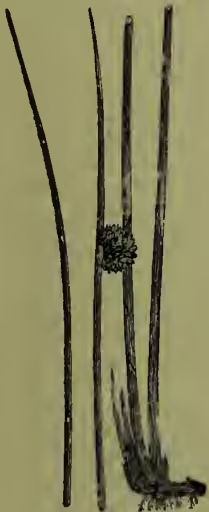
Ruskin, JOHN, the most eloquent and original of all writers upon art, and a strenuous preacher of righteousness, was born in London, 8th February 1819. He was an only child; his father (1785-1864), a wealthy wine-merchant, was an Edinburgh man settled in London. He was educated in his father's house, first in London and afterwards at Denmark-hill, till he went, as a gentleman commoner of Christ Church, to Oxford. There he gained the Newdigate prize for English poetry—by a poem on Salsolæ and Elephanta—in 1839, and took his degree in 1842. He studied painting under Copley Fielding and Harding; but his masters in the art were, he says, Rubens and Rembrandt. The story of the earlier years of his life has been told by Ruskin himself very fully in his Præterita, one of the most charming autobiographies in the language. In 1843 appeared the first volume of his Modern Painters, the primary design of which (in reply to a criticism of Turner in Blackwood's Magazine) was to prove the superiority of modern landscape-painters, and more especially of Turner, to the Old Masters; but in the later volumes (the fifth and last was published in 1860) the work expanded into a vast discursive treatise on the principles of art, interspersed with artistic and symbolic descriptions of nature, more elaborate and imaginative than any writer, prose or poetic, had ever before attempted. Modern Painters was essentially revolutionary in its spirit and aim, many of the most distinguished landscape-painters, both of old and new schools, being summarily dealt with and condemned; and the work naturally excited the aversion and hostility of the conservatives in art. But the unequalled splendour of its style gave it a place in literature; the originality of its views, the lofty conception of the painter's art displayed in it, and the evident justness of much of the criticism, secured recognition. Disciples soon appeared; and the views of art enunciated by Ruskin gradually made way, and have largely determined the course and character of later English art. The first volume was published in a much altered form in 1846. The last three volumes contained illustrations by the author. A revised and altered edition appeared in 1860-67; another in 1873; and an edition in six volumes, with some additional plates, an epilogue, and new index, in 1889. In 1849 appeared The Seven Lamps of Architecture; and in 1851-53 The Stones of Venice, both being efforts to introduce a new and loftier conception of the significance of domestic architecture. They were exquisitely illustrated by the author himself. About this time Pre-Raphaelitism (q.v.) began to develop itself as a distinctive phase of modern art, and Ruskin warmly espoused its cause in letters, pamphlets, and Notes on the Academy Exhibition (1855-60). He was the earliest literary advocate of this school, whose leading principle he defined as the resolve 'to paint things as they probably did look and happen, not as, by rules of art developed under Raphael, they might be supposed gracefully, deliciously, or sublimely to have happened.'
In 1854 he published four admirable and suggestive Lectures on Architecture and Painting; and in 1858 two Lectures on the Political Economy of Art. The Notes on the Construction of Sheepfolds (1851), dealing with the discipline of the church, illustrate his ingenuity in devising picturesque titles that suggest no notion of the subject treated. The King of the Golden River, a fairy story, was published in 1851; and in 1854 The Two Paths, lectures on art and its application to decoration and manufacture. The Elements of Drawing and the Elements of Perspective appeared in 1857 and 1859. The Crown of Wild Olive is a series of four essays on work, traffic, war, and the future of England; Sesame and Lilies, lectures on good literature. The Queen of the Air is a study of the Greek myths of cloud and storm; Ethics of the Dust, lectures on crystallisation; Ariadne Florentina, on wood and metal engraving; Aratra Pentelici, on the principles of sculpture. The Laws of Fesolè are the elements of painting and drawing; Frontes Agrestes are readings from 'Modern Painters'; Giotto and His Works, Love's Meinie (on Birds), and Deucalion (on Geology) are other publications. Munera Pulveris contains the elements of political economy according to Ruskin; while Unto this Last—in Ruskin's opinion, the best of his works—attacks the current doctrines of the 'dismal science.' Val d'Arno contains lectures on the art of the 13th century in Pisa and Florence; later courses dealt with the modern art of England and English history (Pleasures of England). Mornings in Florence are studies of Christian art for English travellers; and St Mark's Rest is on the history of Venice. The Eagle's Nest discusses the relation of natural science to art; Time and Tide are letters to a working-man of Sunderland. Arrows of the Chace is a selection of his letters; On the Old Road is the title of a republication of his miscellaneous pamphlets, articles, and essays contributed to various reviews and magazines, containing famous utterances on Samuel Prout, the History of Christian Art, the Lord's Prayer, the 'Cestus of Aglaia,' &c. An early volume of poems, issued for private circulation, became a much sought after bibliographical treasure; in 1891 it was reprinted (in 2 vols.) with many additional pieces and illustrations from the author's drawings. Fors Clavigera appeared as a sort of periodical at irregular inter- vals for several years, in the form of letters to the workmen and labourers of Great Britain, on a great variety of topics (vols. i.-viii. with full index, 1887). Proserpina, published in the same way, gives studies of wayside flowers. Hortus Inclusus (1887) is a series of letters 'to the ladies of the Thwaite.' Second-hand copies of the early works are still eagerly bought up at high prices: thus, the old edition of Modern Painters, worth £6, 10s. at its publication in 1860-67, has repeatedly been sold since 1880 for £30 or £35. All Mr Ruskin's books were for a time published privately at Orpington in Kent; but they are now published through an agent of his own in the usual way, except that the author insists on their being sold at net prices. From 1869 till 1879 Ruskin was Slade professor of Art at Oxford; in 1871 he gave £5000 for the endowment of a master of drawing there; in 1883 he was re-elected professor, but resigned in the following year. He is a D.C.L. of Oxford, and an honorary student of Christ Church. In 1871 the degree of LL.D. was bestowed upon him by the university of Cambridge. Subsequently he founded a museum at Walkley, near Sheffield (in 1890 transferred to Sheffield itself), where he bestowed part of his own priceless library and art treasures. In his later years he established himself at Brantwood, on Coniston Lake. There he died on the 20th of January 1900.
Ruskin was primarily a critic of art; but, as the titles of his works indicate, his teaching has extended over a wide area. Art for him was closely and inseparably bound up with truth, with morals, with religion; and in most departments of political philosophy, in social and political economy, Ruskin was constant, in season and out of season, in lifting up his testimony against what he conceived to be low views, perverted ideals, coarse and vulgar complacencies. Like Carlyle, whose pupil he professed to be, he held the world in these later days to have gone on a wrong tack; in his views of nature and life he was, he said, 'alone in the midst of a modern crowd, which rejects them all,' and has to 'maintain himself against the contradiction of every one of his best friends.' Within the sphere of art criticism he declares that an important part of his life-work has been to teach 'the supremacy of five great painters, despised till he spoke of them—Turner, Tintoret, Luini, Botticelli, and Carpaccio.' His life-long contention with political economy is based on the belief that the science has been used to inculcate the unchecked and competitive pursuit of merely material wealth. He affirms broadly that his Munera Pulveris contains the first accurate analysis of the laws of political economy which has been published in England. What is usually called political economy is in reality nothing more than the investigation of some accidental phenomena of modern commercial operations, and has no connection with political economy as treated by the great thinkers of the past—such as Plato, Xenophon, Cicero, Bacon. True political economy regulates the acts and habits of a society or state, with reference to its maintenance, as domestic economy does those of a household. It is neither an art nor a science, but a system of conduct and legislation, founded on the sciences, directing the arts, and impossible except under certain conditions of moral culture. By the maintenance of the state, which is the object of political economy, is to be understood the support of its population in healthy and happy life, and the increase of their numbers, so far as is consistent with their happiness. It is the 'multiplication of human life at the highest standard,' cherishing and developing the noblest type of manhood, alike in beauty, in intelligence, and in character. The wealth of which Ruskin takes cognisance is not mere exchangeable value, but intrinsic and effectual wealth, consisting of things contributing to the support of life in its fullest sense—as laud, houses, furniture, instruments, food, medicine, clothing, books, works of art. The subject of political economy, therefore, embraces a large part of the sphere of private and public morals, and of political philosophy. It deals with the relation of master to servant, employer to workman, of the state to its subjects, with the province of sanitary and commercial legislation, and with the duty of the state in promoting education, suppressing luxury, regulating the hours and wages of labour. He is as confident as the most revolutionary reformer that the conditions of modern society must be completely changed and reconstructed; his ideals coincide in many points with those of some Socialists, though many of his aims would be regarded as distinctly reactionary. A 'violent illiberal' rather than a conservative, Ruskin regards reverence for natural beauty, truth, and godliness as the highest elements in life, and would give properly constituted authority extensive powers; usury of any kind is as indefensible as avarice or dishonesty. Till of late he was seldom treated as a serious political economist; but it has recently been admitted that he has actually pointed out some real weaknesses of the old abstract political economy as a scientific theory. He devoted a great part of his originally large fortune to founding the St George's Guild, which was intended to be a kind of primitive agricultural community, where the old-world virtues should be strenuously inculcated on young and old, and where ancient and homely methods might be cherished in defiance of all modern mechanical and manufacturing processes. He has also striven to promote home industries in various places. Not more remarkable than the eloquence, power, and richness of his English style are the confidence and dogmatism of his assertions, the audacity of his paradoxes, the fearlessness of his denunciations; while his earnestness, conviction, and self-denying honesty of purpose are undisputed. His influence in creating a new interest in the beauty of nature and of art in England has been profound; and although the world rejects his theories of social economy as perverse, paradoxical, and impracticable, he has done much to vivify ideals of life, and ennoble our standards of conduct.
See E. T. Cook, Studies on Ruskin (1890); Shepherd's Bibliography (5th ed. 1882); J. P. Smart, Juurr., A Ruskin Bibliography (1890-91); W. G. Collingwood, The Life and Work of John Ruskin (2 vols. 1893); and various collections of Ruskin's papers, unpublished lectures (1894), and letters to a college friend (1894). A new edition of the works was appearing in 1894. The Ruskin Society was founded in 1881; the Ruskin Reading Guild, in 1887.
Russell, a great Whig house, whose origin has been traced back to Thor, through 'Olaf the sharp-eyed, king of Rerik,' Drogo, brother of Rollo, the first Duke of Normandy, and Hugh Bertrand, lord of Le Rozel, a follower of the Conqueror's. Anyhow, a John Russell was constable of Corfe Castle in Dorsetshire in 1221; and from him have sprung twenty-two generations of Russells, whose seats have been Kingston Russell, near Dorchester; Cheneys, in Bucks, near Amersham; and Woburn Abbey, in Bedfordshire. Among them, besides William Lord Russell and Earl Russell (both noticed separately below), the following may be mentioned: Sir John Russell, Speaker of the House of Commons in 1424 and 1432; John, created in 1539 Baron Russell of Cheneys, and in 1550 Earl of Bedford, who got the abbey lands of Tavistock and Woburn; Sir William Russell, who in 1594 became Lord Deputy of Ireland, and in 1603 was created Baron Russell of Thornhaugh; Francis, fourth Earl (died 1641), the drainer of the Bedford Level; William, fifth Earl, created in 1694 Marquis of Tavistock and Duke of Bedford; Admiral Edward Russell (1651-1727), who, semi-Jacobite though he was, beat the French at La Hogue in 1692, and for his victory was made Earl of Oxford; John, fourth Duke (1710-71), Lord-lieutenant of Ireland; his grandson, Lord William Russell (1767-1840), who was murdered by his valet Courvoisier; Francis, ninth Duke (1819-91); and his brother Odo (1829-84), who from 1871 was ambassador to the German court, and in 1881 was made Baron Ampthill.
See J. H. Wiffen's Historical Memoirs of the House of Russell (1833); and Froude's Short Studies, 4th ser. 1884.
WILLIAM RUSSELL, LORD RUSSELL, was born 29th September 1639, third son of the fifth Earl of Bedford by Lady Anne Carr, daughter of the poisoner Countess of Somerset; by the death of his brothers (one in infancy, the other in manhood) he, in 1678, succeeded to the courtesy title of Lord Russell. He was educated at Cambridge, and travelled on the Continent. At the Restoration he was elected M.P. for Tavistock, and was 'drawn by the court into some disorders' (debts and duelling), from which he was rescued by his marriage in 1669 with Lady Rachel Wriothesley (1636-1723), second daughter and co-heiress of the Earl of Southampton and widow of Lord Vaughan. He was a silent member till 1674, when he spoke against the doings of the Cabal, and thenceforth we find him an active adherent of the Country party. He dallied unwisely with France, but took no bribe; he shared honestly in the delusion of the Popish Plot; he presented the Duke of York as a recusant; and he carried the Exclusion Bill up to the House of Lords. The king and his brother resolved to be revenged on him and the other leaders of the Whig party; and he, Essex, and Sidney were arrested as participants in the Rye-house Plot. On 13th July 1683 he was arraigned of high-treason at the Old Bailey, and, infamous witnesses easily satisfying a packed jury, was found guilty. His father's proffer, through the Duchess of Portsmouth, of £100,000 for his life availed nothing, nor his own solemn disavowal of any idea against the king's life or any contrivance of altering the government; and on the 21st he was beheaded in Lincoln's Inn Fields. The pity of his judicial murder, the pathos of Burnet's story of his end, and the exquisite letters of his noble wife, who at his trial appeared in court as his secretary, have secured him a place in history that else he had never attained to, for he was a man of virtues, not genius, a Christian hero rather than a statesman.
See his life by Lord John Russell (1819; 4th ed. 1853); the Letters of Lady Russell (1773; 14th ed. 1853); and the Lives of her by Miss Berry (1819), Lord John Russell (1820), and Guizot (Eng. trans. 1855).
JOHN RUSSELL, EARL RUSSELL, K.G., was born on 18th August 1792, in Hertford Street, Mayfair, London, the third son of the sixth Duke of Bedford. A sickly child, he was educated at Sunbury, at Westminster (1803-4), and then at Woodnesborough vicarage, near Sandwich, until, in 1809, after a nine months' visit with Lord and Lady Holland to Spain and Portugal, he entered the university of Edinburgh. He lived there three years with Professor Playfair, studying under Dugald Stewart and Dr Thomas Brown, first exercising his powers of debate at the meetings of the Speculative Society, and paying two more visits to the Peninsula. In July 1813, while still a minor, he was returned for the family borough of Tavistock, but, though he spoke in 1815 against the renewal of war with France, foreign travel and literature for some years engrossed him rather than politics. He made his first motion in favour of parliamentary reform in 1819, and continued to bring the subject almost annually before the House. He was also the strenuous advocate of the repeal of the Test and Corporation Acts, of Catholic Emancipation, and of other measures of civil and religious liberty. At the general election of 1830, caused by the death of George IV., the rallying cry of reform won many fresh seats for the Liberals; the 'Great Duke' was driven from office, and Earl Grey proceeded to form a ministry. Lord John became Paymaster of the Forces, without a seat in the cabinet; but he was one of the four members of the government entrusted with the task of framing the first Reform Bill, and on him devolved the great and memorable honour of proposing it. The fortunes of the measure belong to the history of the day; enough that on 4th June 1832 it received the royal assent, and the country was saved from the throes of revolution that at one time seemed imminent. In November 1834 Lord John left office with the Melbourne government, which had succeeded Grey's; in March 1835 he brought forward a motion in favour of applying the surplus revenues of the Irish Church to educational purposes; and the success of his motion caused the downfall of Peel and the return of Melbourne to power.
As Home Secretary and leader of the Lower House Lord John now attained the zenith of his career, four measures with which his name is associated being the Municipal Reform Act (1835), and the Tithes Commutation, Registration, and Marriage Acts (1836). In 1839 he exchanged the seals of the Home for those of the Colonial Office; in 1841 he proposed a fixed duty of 8s. per quarter on foreign corn and a reduction of the duties on sugar and timber. Defeated by the opposition, the Melbourne government appealed to the country without success, so once more made way for Peel. In this general election Lord John, who meanwhile had sat for Hunts, Bandon Bridge, Devon, and Stroud, boldly challenged the verdict of London on free trade by standing for the City. He was returned by the narrow majority of 9, and continued to represent the City until his elevation to the Upper House.
In November 1845 he wrote a letter from Edinburgh to his London constituents, announcing his conversion to the total and immediate repeal of the Corn Laws. This letter led to Peel's resignation; and Lord John on 11th December was commissioned by the Queen to form an administration. He failed, however, owing to Lord Grey's antipathy to Palmerston, so Peel was forced back to office, and carried the repeal. On the very day on which the bill passed the Lords the Peel ministry was defeated in the Commons on a question of Irish coercion by a coalition of Whigs and Protectionists, whereupon a Whig ministry succeeded, with Lord John for prime-minister (1846). It succeeded to a difficult position. In Ireland there was the famine, followed by a foolish rebellion, whilst at home there was Chartism and the so-called 'Papal aggression,' which evoked from Lord John an indignant protest, first in the form of a letter to the Bishop of Durham, and next in the Ecclesiastical Titles Bill of 1851. In the winter of that year Lord Palmerston's approval of the French coup d'état without the Queen's or Lord John Russell's knowledge procured him his dismissal from the office of Foreign Secretary; within two months he 'gave Russell his tit-for-tat,' defeating him over a militia bill (February 1852). After a short-lived Derby government, Lord Aberdeen in December formed a coalition ministry of Whigs and Peelites, with Russell for Foreign Secretary and leader in the Commons.
His inopportune Reform Bill (1854), the Crimean mismanagement, his resignation (January 1855), and his bungling that same year at the Vienna Conference, all combined to render him thoroughly unpopular; and for four years he remained out of office. But in June 1859, in the second Palmerston administration, he became Foreign Secretary, which office he held six years, having meanwhile in 1861 been created Earl Russell. He did much for the cause of Italian unity; still, non-intervention was his leading principle—e.g. during the American civil war and the Sleswick-Holstein difficulty. On Palmerston's death in 1865 Earl Russell for the second time became prime-minister, but the defeat in the following June of his new Reform Bill left no alternative but resignation. He continued, however, busy with tongue and pen till his death, which took place at his residence, Pembroke Lodge, Richmond Park, on 28th May 1878. He is buried at Cheneys. Earl Russell was twice married, and by his second wife, a daughter of the Earl of Minto, was the father of John Viscount Amberley (1842–76), who was author of the posthumous Analysis of Religious Belief, and whose son succeeded as second earl.
The 'Lycurgus of the Lower House,' as Sydney Smith dubbed him, this 'little great man' was honest in all his convictions, in none more so than in his belief in himself. 'He knew he was right' gives the key to both his career and his character. Of his voluminous works, a score in number, and including a tale and two tragedies, need only be mentioned his Life of William Lord Russell (1819), Memoirs of the Affairs of Europe (1824), The Correspondence of John, fourth Duke of Bedford (3 vols. 1842–46), and the Memoirs of Fox and Moore.
See his Selections from Speeches and Despatches (1870), his Recollections and Suggestions (1875), and Spencer Walpole's Life of Lord John Russell (2 vols. 1889).
Russell, WILLIAM CLARK, a popular nautical novelist, was born in New York, 24th February 1844, son of the vocalist Henry Russell (1812–1900), the composer of 'Cheer, Boys, Cheer,' 'There's a Good Time Coming,' 'A Life on the Ocean Wave,' &c. He had his schooling at Winchester and in France, and went to sea at thirteen. After about eight years' service he left the sea to devote himself to the life of letters. He was employed writing for the Newcastle Daily Chronicle and the London Daily Telegraph, but from 1887 reserved his energies mainly for fiction, in which he had already scored a remarkable success with John Holdsworth, Chief Mate (1874), The Wreck of the Grosvenor (1877), An Ocean Free Lance (1880), The Lady Maud (1882), Jack's Courtship (1884), and A Strange Voyage (1885). Later novels were The Death-ship (1888), Marooned (1889), My Shipmate Louise (1890), An Ocean Tragedy (1890), and My Danish Sweetheart (1891). Other works are his collections of papers: Round the Galley Fire (1883), In the Middle Watch (1885), and On the Fok'sle Head (1884); a short Life of Nelson (1890), and another of Collingwood (1891).
Russell, SIR WILLIAM HOWARD (cre. 1895), the first of 'special correspondents,' was born at Lilyvale in County Dublin, 28th March 1821, had his education at Trinity College, Dublin, joined the staff of the Times in 1843, and was called to the bar in 1850. He went out to the Crimea at the beginning of the war, and there remained till the close, writing home those famous letters which opened the eyes of Englishmen to the shameful sufferings of the soldiers during the winter siege of 1854–55, and quickly brought about the fall of the Aberdeen ministry. He next witnessed the events of the Indian Mutiny, returning to England in 1858. He established the Army and Navy Gazette in 1860, and next year the opening of the civil war drew him to America, which he soon made too hot for him by a too truthful account of the Federal defeat at Bull Run. He at once returned to England; accompanied the Austrians during the war with Prussia (1866), and the Prussians during the war with France (1870-71); visited Egypt and the East (1874) and India (1877), as private secretary to the Prince of Wales; and went with Wolseley to South Africa in 1879. He contested Chelsea without success in the Conservative interest in 1869. Most of his letters were collected into volumes, which had great success in their day; three books that may be named are The Adventures of Doctor Brady (1868), a novel; Hesperothen, or Notes from the West (1882); and A Visit to Chile and the Nitrate Fields of Tarapaca (1890). Besides holding many medals and decorations, he is a Knight of the Iron Cross, and a Commander of the Legion of Honour.
Russia, EMPIRE OF, an immense territory extending over eastern Europe, the whole of northern Asia, and a part of central Asia. It is bounded on the N. by the Arctic Ocean; on the E. by the North Pacific Ocean and Chinese empire; on the W. by Sweden, the Baltic Sea, Prussia, Anstria, and Roumania; and on the S. by the Black Sea, Asiatic Turkey, Persia, Afghanistan, East Turkestan, and the Chinese empire. Its extreme limits are 38° 30' and 78° N. lat. and 17° 19' and 190° E. long. This territory, which covers an area more than twice as large as the entire area of Europe, and embraces one-sixth of the land-surface of the globe, has a population estimated at more than 115,000,000, the annual increase of which usually exceeds 1,500,000. The Russian empire consists of several well-defined parts—viz. European Russia, which embraces a little less than one-fourth of the whole, but includes nearly three-fourths of its population; Finland; Poland; Caucasias; Siberia; Turkestan; and the Transcaspian region. Two central Asian states, Khiva and Bokhara (112,000 sq. m., 3,200,000 inhabitants), are vassal states of Russia. The Russian dominions in America (Alaska) were sold to the United States in 1867 for $7,200,000.
The territory of the empire, however different its separate parts as regards latitude and climate, is more homogeneous than it appears at the first sight. It belongs to the great orographical division of Eurasia, which embodies both the plains of European Russia and the lowlands and plains that extend in the north of the two great plateaus of Asia—the high plateau of east Asia and the western plateau of Persia and Armenia (see ASIA, Vol. I. p. 486). However, the Russians are rapidly passing the limits of the lowlands. They crossed the narrow northern extremity of the plateau, and established themselves on the coasts of the Sea of Okhotsk. In 1855-59 they spread over the Pacific slope of the plateau, down the Amur and up the Usuri. The high steppes of Mongolia fell under their influence; in Turkestan their military outposts are now stationed in the Pamirs; Armenia has been partly absorbed; and in 1898 Manchuria (q.v.) became practically Russian, and was being connected with the great Siberian railway. The extent of Russian Asia (not including Manchuria) as compared with Chinese and British territory is shown on the map of Asia, Vol. I. p. 494.
A census of the empire was attempted in 1897, and gave a grand total of 128,931,827, of whom 94,215,415 were in European Russia, 9,455,943 in Poland, 9,248,695 in Caucasus, 5,727,090 in Siberia, 7,721,684 in Central Asia. The following are the figures calculated for 1890-95:
| Governments and Territories. | Area in sq. miles. | Population. | Density of pop. per sq. in. |
|---|---|---|---|
| EUROPEAN RUSSIA— | |||
| Archangelsk..... | 331,505 | 340,251 | 1 |
| Astrakhan..... | 91,327 | 932,539 | 10 |
| Bessarabia..... | 17,619 | 1,553,329 | 90 |
| Courland..... | 10,535 | 676,582 | 64 |
| Don, Region of..... | 61,836 | 1,896,113 | 30 |
| Ekaterinoslav..... | 26,148 | 1,874,162 | 71 |
| Estonia..... | 7,818 | 392,738 | 50 |
| Grodno..... | 14,931 | 1,354,425 | 90 |
| Kaluga..... | 11,942 | 1,199,882 | 100 |
| Kazan..... | 24,601 | 2,140,702 | 87 |
| Kieff..... | 19,691 | 2,917,997 | 148 |
| Kostroma..... | 32,702 | 1,354,162 | 41 |
| Kovno..... | 15,692 | 1,532,747 | 97 |
| Kursk..... | 17,937 | 2,666,573 | 148 |
| Kharkoff..... | 21,041 | 2,322,039 | 110 |
| Kherson..... | 27,523 | 2,026,853 | 73 |
| Livonia..... | 18,158 | 1,229,468 | 67 |
| Minsk..... | 35,293 | 1,680,615 | 47 |
| Moghilev..... | 18,551 | 1,294,116 | 69 |
| Moscow..... | 12,859 | 2,210,791 | 171 |
| Nijni-Novgorod..... | 19,797 | 1,513,318 | 76 |
| Novgorod..... | 47,236 | 1,213,058 | 25 |
| Olonetz..... | 57,439 | 341,568 | 5 |
| Orel..... | 18,042 | 2,021,239 | 112 |
| Orenburg..... | 73,816 | 1,289,358 | 17 |
| Penza..... | 14,997 | 1,522,537 | 101 |
| Perm..... | 128,211 | 2,713,987 | 21 |
| Podolia..... | 16,224 | 2,423,755 | 149 |
| Poltava..... | 19,265 | 2,794,739 | 145 |
| Pskov..... | 17,069 | 965,355 | 56 |
| Ryazan..... | 16,255 | 1,843,345 | 113 |
| St Petersburg..... | 20,760 | 1,680,273 | 80 |
| Samara..... | 58,321 | 2,614,405 | 43 |
| Saratoff..... | 32,624 | 2,311,220 | 70 |
| Simbirsk..... | 19,110 | 1,579,847 | 82 |
| Smolensk..... | 21,638 | 1,339,444 | 61 |
| Tamboff..... | 25,710 | 2,730,145 | 106 |
| Taurida..... | 24,539 | 1,096,670 | 44 |
| Tchernigoff..... | 20,233 | 2,109,983 | 104 |
| Tula..... | 11,954 | 1,445,600 | 120 |
| Tver..... | 25,225 | 1,781,861 | 70 |
| Ufa..... | 47,112 | 2,018,356 | 41 |
| Vilna..... | 16,421 | 1,304,788 | 79 |
| Vitebsk..... | 17,440 | 1,275,954 | 73 |
| Vladimir..... | 18,864 | 1,403,172 | 74 |
| Volhynia..... | 27,743 | 2,264,867 | 81 |
| Vologda..... | 155,498 | 1,239,754 | 7 |
| Voronej..... | 25,443 | 2,588,933 | 101 |
| Vyatka..... | 59,117 | 2,914,344 | 49 |
| Yaroslav..... | 13,751 | 1,126,891 | 81 |
| Sea of Azov..... | 14,478 | — | — |
| 1,902,092 | 85,464,140 | 45 | |
| POLAND— | |||
| Kalisz..... | 4,392 | 837,317 | 190 |
| Kielce..... | 3,897 | 692,328 | 177 |
| Lomza..... | 4,667 | 608,683 | 130 |
| Lublin..... | 6,499 | 979,700 | 150 |
| Piotrkow..... | 4,729 | 1,091,282 | 230 |
| Plock..... | 4,209 | 600,662 | 143 |
| Radom..... | 4,769 | 716,164 | 150 |
| Siedlce..... | 5,535 | 671,598 | 121 |
| Swulki..... | 4,846 | 656,932 | 135 |
| Warsaw..... | 5,623 | 1,465,131 | 260 |
| 49,157 | 8,319,797 | 169 | |
| FINLAND— | |||
| Abo-Björneborg..... | 9,335 | 380,501 | 40 |
| Kuopio..... | 16,499 | 277,635 | 16 |
| Nyland..... | 4,596 | 227,888 | 49 |
| St Michel..... | 8,819 | 175,110 | 19 |
| Tavastehus..... | 8,334 | 245,690 | 29 |
| Uleåborg..... | 68,971 | 234,015 | 3 |
| Viborg..... | 16,627 | 330,823 | 19 |
| Vasa..... | 16,084 | 393,750 | 24 |
| 144,255 | 2,270,912 | 15 | |
| CAUCASUS— | |||
| Northern Caucasias— | |||
| Kuban..... | 36,439 | 1,286,622 | 35 |
| Stavropol..... | 23,397 | 667,511 | 28 |
| Terek..... | 26,822 | 719,468 | 26 |
| Transcaucasia— | |||
| Baku..... | 15,177 | 744,930 | 49 |
| Daghestan..... | 11,492 | 597,356 | 51 |
| Elizabethpol..... | 17,041 | 753,395 | 44 |
| Erivan..... | 10,745 | 677,491 | 63 |
| Kars..... | 7,200 | 237,114 | 32 |
| Kutais..... | 14,084 | 955,000 | 67 |
| Tiflis..... | 17,223 | 819,264 | 18 |
| 182,457 | 7,458,151 | 40 | |
| Governments and Territories. | Area in sq. miles. | Population. | Density of pop. per sq. m. |
|---|---|---|---|
| KIRGHIZ STEPPE— | |||
| Akmolinsk..... | 229,609 | 500,180 | 2 |
| Semipalatinsk..... | 184,631 | 576,578 | 3 |
| Turgai..... | 176,219 | 364,600 | 2 |
| Uralsk..... | 139,168 | 559,552 | 3 |
| Lake Aral..... | 26,166 | — | — |
| 755,793 | 2,000,970 | 3 | |
| TURKESTAN— | |||
| Samarqand..... | 26,627 | 680,135 | 25 |
| Fergana..... | 35,654 | 775,600 | 22 |
| Semirechensk..... | 152,280 | 671,878 | 4 |
| Syr-Daria..... | 194,853 | 1,214,300 | 6 |
| 409,414 | 3,341,913 | 8 | |
| TRANSCASPIAN TER.— | |||
| Caspian Sea..... | 214,237 | 301,476 | — |
| 169,381 | — | — | |
| 383,618 | 301,476 | 1 | |
| SIBERIA— | |||
| Western Siberia— | |||
| Tobolsk..... | 539,659 | 1,375,455 | 2 |
| Tomsk..... | 331,159 | 1,299,729 | 7 |
| Eastern Siberia— | |||
| Irkutsk..... | 287,061 | 421,187 | 1 |
| Transbaikalia.... | 236,868 | 565,477 | 2 |
| Yakutsk..... | 1,533,397 | 255,671 | 0.1 |
| Yeniscisk..... | 987,183 | 458,572 | 0.4 |
| Amur Region— | |||
| Amur..... | 172,850 | 87,705 | 0.5 |
| Maritime province | (?) 715,980 | 120,000 | 0.2 |
| Sakhalin..... | 29,336 | 14,645 | 0.5 |
| 4,833,496 | 4,598,441 | 0.9 | |
| Total— | |||
| Asiatic Dominions.. | 6,564,773 | 17,700,951 | 3 |
| Russia in Europe.. | 2,095,504 | 96,047,849 | 46 |
| Grand Total— | |||
| Russian Empire.... | 8,660,282 | 113,748,800 | 13 |
Seaboard, Islands.—Until the end of the 17th century Russia's seaboard was limited to the Arctic Ocean, and she had to wage a long series of wars before she secured a firm footing on the Baltic and the Black Sea. The latter, however, still remains an inland sea, the entrance to which is in the hands of a foreign power. The Arctic Ocean, which offers excellent fishing grounds in its western part, makes a deep indentation on the north coast of Russia—viz. the White Sea (q.v.); but its gulfs, Kandalaksha, Onega, and Dwina, are ice-bound for nine months every year. The only port of any moment, Archangel, has now lost its former importance. Farther east, Tchesskaya and Petchora bays are surrounded by frozen deserts. The Kara Sea, between the crescent-shaped island of Novaya Zemlya (Nova Zembla) and the coast of Siberia, is navigable for a few weeks only every year (see SIBERIA). The islands of Kolgueff, Vaygatch, Novaya Zemlya, and the islands of Siberia—New Siberia, Medveyzhii, and others—are uninhabited. As to the Behring Sea and the Sea of Okhotsk, which contain good fishing and hunting grounds, their coasts are most inhospitable. The same is true of that part of the Japanese Sea which belongs to Russia. Its only great gulf, Peter the Great's, has in Vladivostok one of the finest roadsteads in the world; but this gulf is separated from the interior by wide tracts of uninhabited marshes and forests. The Baltic Sea, with the Gulfs of Bothnia, Finland, and Riga, is the chief sea of Russia; but it nowhere touches purely Russian territory, its coasts being peopled by Finns, Letts, Estonians, and Germans. Nevertheless, four out of the five chief ports of Russia—St Petersburg, Reval, Libau, and Riga—are situated on the Baltic Sea. Three of them are frozen for from four to five months every year; and Libau is the only one which has its roadsteads open nearly all the year round. The chief islands of the Baltic are the Åland archipelago, belonging to Finland; Dagö, Oesel, Moln, and Worms at the entrance of the Gulf of Riga; Hochland and Kotlin (with the fortress of Cronstadt) in the Gulf of Finland.
The Black Sea acquires more and more importance every year. The fertile steppes of its littoral are being rapidly settled, and the centre of gravity of Russia's population is gradually shifting south. The Black Sea suffers, however, from a lack of good ports. Its great gulf, the Sea of Azov (ports Taganrog and Rostoff), is very shallow; the fine ports of the Crimea are too remote from the mainland; and the seaboard of Northern Caucasus is separated from the interior by a high chain of mountains. Odessa is the chief port of this sea; and it has no rival in Russia except St Petersburg. Nikolaieff is the principal naval arsenal; and Sebastopol remains a naval station. Batoum, the chief port of Transcaucasia, is of great importance for the export of petroleum.—The Caspian Sea, which receives the chief river of European Russia—the Volga—is an excellent medium of communication between the central Asian dominions of the empire and the Caucasus, as also for trade with Persia (to which the south coast belongs); but it has no outlet to the ocean, nor is there any probability of connecting it advantageously by canal with the Black Sea, because its level is 70 feet below the level of the ocean. The fisheries in the Caspian supply Russia with considerable quantities of fish.
Colonies.—Russia has no colonies properly so called. Its possessions in Asia are mere reserve-grounds for surplus population. Russian immigrants are already the prevailing element in the population of Siberia and Northern Caucasus, numbering about 4,500,000 against less than 700,000 natives in Siberia, and about 2,000,000 in Caucasus.
Orography.—The geographical features of Finland, Poland, Caucasus, Siberia, and Turkestan being dealt with under those respective headings, the following remarks relate only to European Russia. The leading feature in its physical structure is a broad, flat swelling about 700 miles wide, with an average height of 800 feet, which crosses it from south-west to north-east and connects the elevated plains of middle Europe with the Urals. A belt of lowlands stretching from East Prussia to the White Sea fringes this central plateau on the north-west, separating it from the hilly tracts of Finland; while the plains of Bessarabia, Kherson, the Sea of Azov, and the lower Volga limit it on the south-east. The highest parts of the central plateau, hardly attaining 1000 to 1100 feet above the sea, lie along its north-western border—viz. the Kielee mountains of Poland, the plateaus of Grodno and Minsk, the Valdai Hills, and the hilly tracts of the Sukhona and Vytchegda (upper Dwina). In middle Russia the same altitude is attained by the flat eminences of the plateau about Kursk, in the hills on the right bank of the Volga, and in the spurs of the Carpathians. In all these places the country assumes a hilly aspect on account of the deep ravines which intersect it. The central plateau is, however, diversified by three depressions. One of these stretches south-east to north-west up the broad valley of the Dnieper and thence to the Vistula; another follows the Don and joins the valley of the Oka; and the third extends from the north shore of the Caspian along the left bank of the Volga to the bend it makes at Samara. During the Postglacial period an elongated gulf of the Caspian Sea extended in that direction up the valleys of the Volga and the Kama as far as 55° N. lat. A fourth depression, about Nijni-Novgorod,